 Joni Mitchell Profile
Spiritual inspirations for rock songs don’t just come from buildings such as churches, temples, ashrams, and mosques.
As these 15 examples show, they can include books (religious or otherwise), water baptisms, folklore, and religious fervour at concerts.
Goanna – Solid Rock (1982)
Growing up in the Victorian countryside, Shane Howard had a strong affinity with the land and the rights of his ancestors. That changed during a ten-day camping visit to Central Australia.
He set up a tent, cooked his food, and played his guitar. He then had what he described as an epiphany or a life-changing moment. Looking at the beautiful landscape, a deep sadness washed over him.
In what seemed a sheer coincidence, a woman from the Anangu people posted a notice on the campground advising they were holding an “inma” (song and dance ceremony) at the base of Uluru that night.
Howard walked 4km to the big red rock, arriving at sunset, as dancers put on ceremonial makeup. The stories he heard evoked spirituality and connection to Uluru and the land – and made him question if white people could claim that same relationship.
He would remember about the dancers: “They come into the firelight as darkness is falling and the light on the ocher makes them look like spirit figures, dancing. It was a powerful moment.
“These are stories that are some of the oldest archetypes of human stories that we have in language, in song, that may have been sung like that for 10, 20, 30 thousand years or longer.
“And in that very moment, over the silhouetted form of Uluru in the background, the full moon came up.”
The first lines of Goanna’s classic Solid Rock began as deference to Dreamtime and Country. “You can feel the endlessness with the coming of the light of day.”
But after that he went to Alice Springs, where he saw the poverty, racism, and alcoholism, and a wave of rage and guilt swept over him about the consequences of colonialism.
He gave him “fire in the belly”. The song moved to lines such as “white man, white law, white gun”. From the very first show that Goanna performed the song, they got standing ovations.
Cosby, Stills & Nash – Cathedral (1977)
On his 32nd birthday in 1974, Graham Nash celebrated with a 24-hour LSD trip. It began at 6am with him wandering into Winchester Cathedral and ended at Stonehenge. He gazed in wonder at the day’s light streaming through stained glass to reflect murals.
Outside in the graveyard, he saw the grave of a soldier who had died in 1799 and shared a birthday with him.
At that point, the song took a cynical political stance, from “too many people have died in the name of Christ” and “all religions have to have its day”. Cathedral is from their 1977 album CSN.
Joni Mitchell – Woodstock (1970)
She was supposed to play the legendary Woodstock festival in 1969. But Joni Mitchell had to watch it via TV news feeds from her hotel room in New York.
With the traffic jams and mud chaos, manager David Geffen had booked her on TV’s career-changing The Dick Cavett Show, and didn’t want to risk her stuck at the festival.
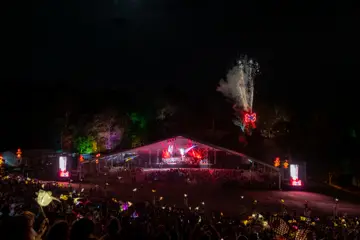
The news on TV focussed on the mud. But when her boyfriend Graham Nash returned from playing the festival, he was thrilled at what a religious experience it had been, of 400,000 helping each other, and no sign of aggression.
Growing up as a Christian, Mitchell was intrigued about biblical stories about Adam & Eve and the Garden of Eden. In the song, Mitchell’s character met a “child of God” walking to the festival to “camp out on the land/I’m gonna try and get my soul free”. The chorus went “We are stardust/we are golden/And we’ve got to get ourselves back to the garden.”
She released it on her 1970 album Ladies Of The Canyon but it was the big global hit for Crosby, Stills, Nash & Young.
Ella Hooper – Small Town Temple (2023)
Taking time off from Killing Heidi, Ella Hooper’s solo album Small Town Temple evoked the simple joy of growing up in the Victorian country town of Violet Town.
The title track was about The Parish, two old decommissioned weatherboard churches, described in the song as having peeling paint and cracks in the floorboard and the stained glass.
Her English and drama teacher mother Helen bought them and turned it into an inclusive community hub, local lodging, and music venue.
Led Zeppelin – Houses Of The Holy (1975)
Building their reputation on hard touring in the early ‘70s, Houses Of The Holy – a funk jam with jazz chords – was an ode to Led Zeppelin’s diehard fans.
Unlike The Ocean, which was about the wave effect by fans as they were swung mesmerised by the music, Houses Of The Holy was what a religious experience their concerts were to the band and fans.
It was, as common sense would have dictated, to have been included on the 1973 album Houses Of The Holy.
But at the last minute, leader Jimmy Page deemed its tempo too similar to Dancing Days, and it was pushed back to 1975’s Physical Graffiti. Zeppelin never played the song live.
John Lennon – India India (2010)
In the early ‘60s, the Indian mystic Maharishi Mahesh Yogi built an ashram (spiritual retreat) with 84 huts, on the banks of the Ganges, near Riskesh in the foothills of the Himalayas.
It had 84 huts, stone meditation domes and lecture halls. Followers from around the world came to get away from distractions of daily life to focus on 200-hour yoga sessions, meditation and spiritual growth.
The Maharishi had met The Beatles in England during a lecture tour. The four then arrived from February to April 1968 to study Transcendental Meditation with their wives and friends as Donovan, Mike Love of The Beach Boys, and actress Mia Farrow and her sister Prudence.
Much to the Maharishi’s displeasure, the celeb tourists had sneaked in drugs and booze.
Their India stay was certainly a prolific one. They penned 48 songs, some of which ended on The Beatles’ White Album and solo albums.
They included John Lennon’s Dear Prudence because Prudence Farrow kept meditating in her bungalow, I’m So Tired (he was exhausted from not having enough sleep from meditating too much), and Sexy Sadie (about ill-founded accusations made against the guru for sexual dalliance with the Farrows); Paul McCartney’s Blackbird and Why Don't We Do It On The Road after observing two monkeys fornicating on the road; and George Harrison’s All Things Must Pass which was a favourite guru saying.
India India was also written in that period, although with less religious fervour than you’d expect in an ashram. At the time he’d started an affair with Yoko Ono and received daily postcards from her even though he was in India with his wife Cynthia.
The song went “India India/Listen to my plea/Sit at your feet so patiently/I’m waiting by the river” and “I left my heart in England with the girl I left behind”. The Rish Kesh Song was another number that remained unreleased.
India India was originally to be part of a Broadway musical The Ballad Of John & Yoko that was never made.
He did a home demo in 1980 in New York. It was one of three unreleased songs issued on The John Lennon Signature Box in 2010. Five years before it was used in the Don Scardino Lennon musical which ran briefly in San Francisco and New York.
Al Green – Take Me To The River (1974)
US R&B singer Al Green grew up in a strict religious family where only gospel was allowed. Take Me To The River alludes to baptisms in rivers by born-again Christians to cleanse their souls and wash away their sins.
It was inspired by watching such a cleansing performed by his mentor Rev. James Turner in the Saint Francis River in Arkansas. But Green, apparently a womaniser, sneaked some secular lines in there about troubled relationships for his 1974 album Al Green Explores Your Mind.
“I was trying to get more stability in my life at the time,” Green said in Rolling Stone. “I wrote, ‘Take me to the river/Wash me down/Cleanse my soul.’”
On October 18, 1974, his girlfriend Mary Woodson poured boiling grits on him while he was in the bathtub in their Memphis home, giving him second degree burns on his back, stomach, and arms. Woodson then took her own life using Green’s handgun.
It changed Green’s life, and he became a pastor in 1976. He never performed Take Me To The River in concert again.
But in 1978, Talking Heads did a slinky cool version on their More Songs About Buildings And Food album. David Byrne was drawn to it because it “combines teenage lust with baptism. Not equates, you understand, but throws them in the same stew, at least. A potent blend.”
The Heads’ version, driven by Tina Weymouth’s funky bassline and produced by Brian Eno, was their first Top 40 entry in the US.
Alison Krauss – Down To The River To Pray (2000)
American bluegrass singer songwriter Alison Krauss from Decatur, Illinois, recorded Down To The River To Pray for the Grammy-winning O Brother, Where Art Thou soundtrack in 2000, and brought it to mass attention.
The traditional folk hymn is traced back to 1867, and said to have been written by a fleeing African American slave.
It was also said to be inspired by slaves jumping into rivers to escape detection by tracking dogs, or a code used by those travelling north to freedom on the Underground Railway.
Russell Morris – Wings Of An Eagle (1973)
Russell Morris was long interested in ancient folklore, history, religions, and philosophies – particularly in those of First Australians and First Americans – and noted the recurring role of eagles in flight, bridging life on earth and the spiritual heavens.
He travelled to the Northern Territory and met a First Australian elder called Mary. She told him the eagle carried the spirit of the dead.
In 1973, an EMI Music executive rang him at home in Melbourne and told him they needed another hit. He grabbed his guitar and went out to the porch. The first two verses came quickly.
The Midday Movie was about to begin, so he went back into the house and checked the TV guide to what was scheduled. It was The Wings Of Eagles (1957) directed by John Ford and starring John Wayne.
Gurrumul – Wiyathul (2008)
Sung in Yolnu, Wiyathul broke Gurrumul to a wider audience. About spirituality, deep connection to country and reverence for ancestors, in the song the singer songwriter recounted how it was inspired by sacred sites such as Guwalilna, Warradika, Yumayna, Mutlwutjna, and the spring Burarrapu.
Also an inspiration from the sacred dance of the Wiyathul bird.
In 2021, four years after his passing, an orchestral version of the track came with a music video in which dancers recreated the dance of the bird.
Elvis Presley – Crying In The Chapel (1965)
Crying In The Chapel was penned in the 1950s by Artie Glenn. The chapel in question was the Loving Avenue Baptist Church in Fort Worth, Texas.
In hospital for severe spinal surgery, Glenn made a pact with God that he’d become a better person if he got him through the operation.
The surgery worked. Upon release from hospital, he hightailed it to the nearest church to pray. The priest noticed he was crying “tears of joy.”
The song was rejected by various publishers. But his son Darrell Glenn did a version in 1953 which reached No. 6 in America.
It had a number of covers, but the biggest was by Elvis Presley who cut it for a gospel album. It went to No. 1 in Australia and the UK and No. 3 in America.
Buffy Sainte-Marie – God Is Alive, Magic Is Afoot (1969)
As a controversially self-professed Canadian First Nation member of Cree Nation raised in America, and adopter of the Persian-hailed Baha’i faith, Buffy Sainte-Marie’s spirituality interweaved through most of her songs. Even her anti-Vietnam war anthem Universal Soldier.
The lyrics of God Is Alive, Magic Is Afoot were an ad-libbed one-take interpretation of a poem in Leonard Cohen’s 1966 novel Beautiful Losers.
She explained to Songfacts, “I knew what the poem was about, and I knew how the music would feel in my head.
“But, like flamenco, I didn’t know where I was going from line to line. If it sounds stream of consciousness, that’s because it is.”
Cat Stevens – Miles From Nowhere (1970)
In the mid-’60s during his pop star days, Cat Stevens partied himself to hospital suffering from exhaustion and tuberculosis. While recuperating, a friend gave him a book on Buddhism. Its message of a lack of ego saw Stevens cover up his room mirror to force himself to look inward.
Upon release, he dug into books on spiritual texts on Tao, Hinduism, Zen, numerology, and astrology.
A visit to the city of Kathmandu, Nepal – regarded as a spiritual hub by many looking for enlightenment – intensified his interest in Buddhism.
Miles From Nowhere, from his breakthrough classic album Tea For The Tillerman (1970) was an expression of that. Without using specific Buddhist references, the song is about climbing up the mountain to achieve nirvana status. And becoming a spirit. “Lord my body has been a good friend/But I won’t need it when I reach the end.”
A later album Catch Bull At Four (1972) referenced the Buddhist text Ten Bulls Of Zen, the fourth stage of enlightenment also known as Catching The Bull.
His change of faith to Islam and name change to Yusuf Islam came a few years later. He was swimming in the Pacific Ocean and felt he was drowning.
He recalled: “So I looked up towards the heavenly sky and prayed, ‘Oh God! If you save me I’ll work for you.’
“Not a single second had passed before a wave from behind me came and gently pushed me forward. Within a minute I had found my strength and was back on land and still alive.
“It was after that my brother had visited Jerusalem and seen the Mosque and the beautiful Muslim way of prayer. He came back and bought me a present of the Qur’an for me to read. My answer had arrived.”
David Bowie – Silly Boy Blue (1965)
In 1966, David Bowie came across Heinrich Harrer’s 1952 book Seven Years In Tibet and was telling Melody Maker that year that he wanted to visit monasteries in the Himalayas.
He was fascinated with how monks showed their resilience by burying themselves in mountains for weeks and only eating once every three days.
“I stumbled into the Buddhist Society in London when I was about 17. Sitting in front of me at the desk was a Tibetan lama, and he looked up and he said, ‘Are you looking for me?’
“He had a bad grasp of English and in fact was saying ‘Who are you looking for?’ But I needed him to say ‘You’re looking for me.'”
Bowie contemplated becoming a monk, shaving his hair, wearing robes, and even thinking about changing the colour of his skin.
Silly Boy Blue, recorded with The Lower Third, had originally been written about a teenage runaway mod. The lyrics were rewritten about a Tibetan monk climbing up to the land of monasteries and passing by Tibet’s capital Lhasa and the Dalai Lama’s winter palace the Potala.
The final bit had no words, to depict he being speechless at what he was seeing when he arrived.
Focus – La Cathedrale De Strasbourg (1974)
Dutch band Focus were one of the most accomplished prog rock bands from the 1970s.
Hamburger Concerto was a six-part fusion of classical and rock, in which child prodigy keyboard wizard Thijs Van Leer imagined how to translate the splendour and acoustics of the French cathedral using a variety of keyboards.
Strasbourg Cathedral or the Cathedral of Our Lady of Strasbourg (French: Cathédrale Notre-Dame de Strasbourg) represents the great architecture of the Middle Ages. At 142 metres (466 feet), it was the world's tallest building for 227 years, from 1647 to 1874.