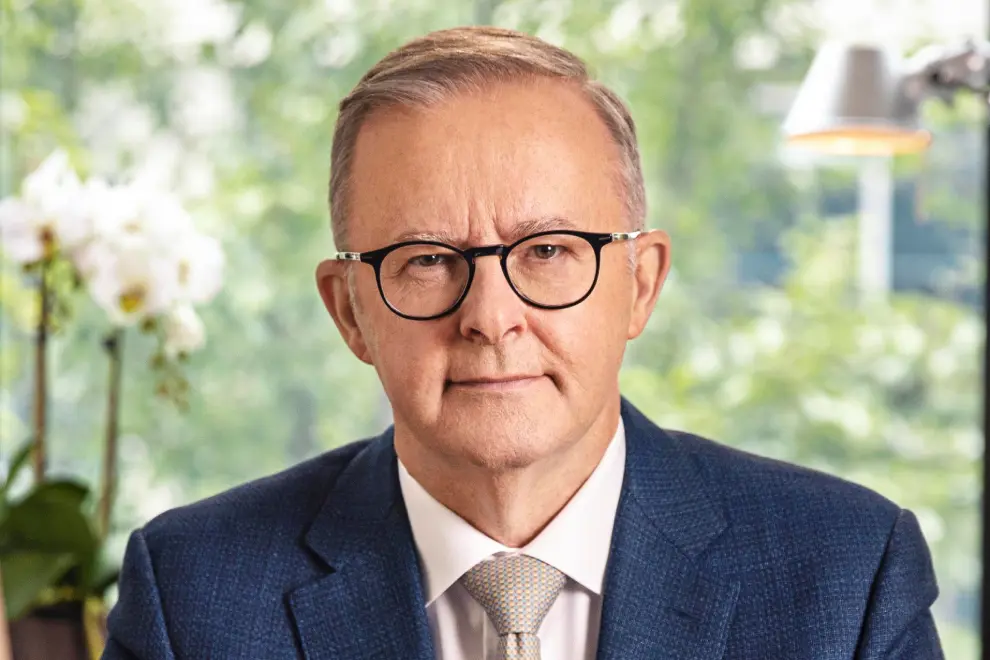
The likes of ARIA, AMPAL, and APRA AMCOS have all praised comments made by Prime Minister Anthony Albanese in regards to the rights of creatives as Australia embraces the future of artificial intelligence.
Speaking at the University of Sydney on Wednesday, July 15th, Mr. Albanese made a lengthy speech outlining the country’s approach to AI, and the need to remain proactive in the face of technological growth instead of taking on a reactionary approach.
Among the announcements made, a forthcoming set of Australian Standards for AI will outline stringent rules for the likes of data centres, ensuring they minimise water usage and either underwrite or supply their own power.
Most notably, Mr. Albanese also pointed out that while this announcement was “about building Australians’ confidence and trust in AI and our nation’s capacity to manage it,” he clarified that the extent to which the Government shares information and resources has its limits.
“Let me make this crystal clear: not everything produced in Australia is up for grabs,” he explained. “Not at all.
“Australian writers, musicians, artists and journalists must retain ownership and control of their work. Our laws will spell that out, plain as day.”
He continued:
An artist’s creative endeavour is their work and their property. No company should use Australian books, music, art or news to build or train AI without the artist’s control.
That includes the artist’s control of the price and value of their work. Anything less, is theft. No country has got this right yet.
Nowhere do artists or rights holders have sufficient control of their work, when it comes to AI training. That is why the best way to secure the strongest copyright protections for Australian artists is for Australia to be active and involved.
To build the best possible solution for ourselves. And to preserve the creativity that is fundamental to who we are to our national identity and the journalism that is essential to our democratic society.
This outlining of the approach to artistic copyright in the face of growing AI fears comes just weeks after numerous musicians descended upon Parliament House in Canberra to protest any potential future text-and-data-mining exceptions in the Copyright Act
Though the Federal Government ruled out such an exception last October, new reports that the federal government has considered new plans to allow AI companies to train on Australian copyright material without permission inspired this pilgrimage to Canberra.
“ The work that we've written, and that I've written and recorded, is essentially owned by me,” said Hunters And Collectors' Mark Seymour. “On that basis, the law states that it can't be used without us granting our permission first.”
The comments made by Mr. Albanese have so far been largely well-received, including by the music industry, who have applauded his proactive approach to the topic, and for ensuring that the rights of Australian creatives will remain untouched.
“The Prime Minister could not have been clearer: Australian writers and musicians keep ownership and control of their work,” responded ARIA CEO Annabelle Herd. “Artists control what that work is worth, not the Government and not a technology company.
“Control of price, value and terms of use are what underpin a commercial licensing market. The artist decides what their work is worth and who may use it. That is how licensing works everywhere else in the world and it is how it should work here. In the Prime Minister’s words: anything less is theft.
“This is clear message to AI companies: now is the time to get on with licensing,” she added. “Right now deals are being signed across music, journalism and publishing around the world. Australia’s creative industries are ready do business.”
“The Prime Minister has made it clear,” added APRA AMCOS Chief Executive Dean Ormston in a separate statement. “The future of AI development in Australia must respect creator rights, that permission and payment must be sought, and crucially, the creative economy must benefit from AI innovation and development in Australia.”
Additionally, APRA AMCOS also welcomed the announcement of a new Office Of AI, which will coordinate the design of these new Australian Standards, viewing it a renewed opportunity to ensure a licensing framework built on consent and payment.
“We commend the Prime Minister for bringing coordinated national leadership to AI policy, and we commend the Attorney-General for holding a clear, principled line that there will be no copyright exception for AI training,” Ormston added.
“We also commend the Minister for Industry and Assistant Minister for Digital Economy for their continued leadership on sustainable and world-leading AI development in Australia.”
He continued:
The Prime Minister and the Attorney-General have given this country consistent certainty that Australian copyright will be respected. This has been reinforced again today. The opportunity now is to use the Office of AI to turn that certainty into serious industry-to-industry licensing negotiations between platforms and rights holders, not further rounds of tech sector avoidance.
The Office of AI must seriously interrogate the numbers AI platforms are putting on the table. It must also ensure that the value of Australian creative works and intellectual property, which is the fuel AI is built on, is seen as an integral, appreciating national asset in its own right, not a line item to be settled quickly and cheaply.
AMPAL CEO Damian Rinaldi also echoed a positive sentiment, noting that Mr. Albanese’s “declaration that ‘anything less is theft’ sends a powerful and unambiguous message: permission must come first.”
“AMPAL looks forward to working with the Australian Government to ensure this commitment is reflected in a strong copyright framework built on consent, transparency and voluntary licensing,” he continued.
“Any future licensing framework must preserve the rights of music publishers and songwriters to choose how, when and by whom their works are licensed,” Rinaldi concluded. “Copyright is not up for negotiation, but music publishers are ready to negotiate fair licences.”
Maggie Collins, the Executive Director of the Association of Artist Managers, also shared a positive response to Mr. Abanese’s comments in an email sent to members and peers of the organisation.
“The AAM is relieved to have this stance reinforced by the government following many weeks of uncertainty,” Collins wrote.
She continued:
We also welcome the Prime Minister’s announcement of a new Office of AI, that will sit within his department, and incorporate – rather than absorb – the expertise of other portfolios, including Industry and Innovation; Science, Technology and the Digital Economy; Climate Change and Energy; Communications; Employment; Defence; Education; Treasury; and the Attorney-General’s Department, who has been facilitating consultation on copyright and artist protections where AI training is involved.
While the work on protecting copyright will continue, it is important to reflect on the words of UNSW copyright law professor, Kathy Bowrey, when she said in an interview to the ABC, that ‘Copyright has never been a cultural policy’.
While the Office of the Arts was not explicitly mentioned by the Prime Minister in his speech today, the AAM will continue to advocate for the social and cultural implications of AI on our society, especially when it comes to Indigenous Cultural Intellectual Policy, but also as it relates to our distinct musical identities and ability to develop audiences who care about how their music is made.
This could never be more relevant than at a time where AI labelling has just been introduced globally; a track allegedly made by AI has topped the AUS charts; and more education is needed – and at a faster pace – for both managers and artists alike.
The full text of Mr. Albanese’s address can be found on the Prime Minister’s official website.