There's every chance that at least once in recent history you've found yourself wondering if you're out of touch or if the world has simply changed so much that some aspects seem unrecognisable.
Perhaps you've tuned into triple j and realised that you don't recognise any of the artists being played, maybe you've looked at the charts and claimed you remember when sombr was an adjective and not a musician, or perhaps you've wondered when the word 'rave' got so co-opted that it lost all meaning.
In the case of the last one, you're not alone, because rarely does a day go by in which the term 'rave' is used in a manner that likely leaves clubbers wondering about just what is going on.
What's A Rave?
Let's go back for a second and ask a question which is likely deemed unnecessary by many reading this: what the heck is a rave?
In a 1992 discussion of rave culture, it was noted that the term was initially used in Britain back in the '50s to describe some of the era's "wild bohemian parties". While this would be underlined thanks to tracks like Buddy Holly's Rave On, or the freewheeling attitudes of the '60s, it wasn't until the '80s that the term came to mean what most people associate it with.
When it re-emerged in the '80s, it was used in association with the "illegal warehouse party scene" of the era, with assumptions being that the term actually came from Jamaican culture.
By the end of the decade, the term was being used to describe acid house parties (in reference to the music style), and by the '90s the term was being used to refer to almost any sort of gathering for fans of electronic music.
In 1994, the UK Parliament famously passed the Criminal Justice and Public Order Act, part of which was intended to crack down on these illegal gatherings – specifically targeting events of "20 or more" featuring music comprising "sounds wholly or predominantly characterised by the emission of a succession of repetitive beats".
This law was in turn inspired by the Castlemorton Common Festival – a week-long rave in May 1992 which attracted between 20,000 and 40,000 punters, resulting in something of a moral panic amongst the general public who were fearful of what electronic music events such as this could result in.
Needless to say, this change to the law was not a popular one. Most famously, The Prodigy and Pop Will Eat Itself teamed up on a track fittingly dubbed Their Law, with Clint Mansell delivering the line, "Fuck 'em, and their law."
When Did Things Start Changing?
By the start of the 21st century, the usage of the term 'rave' had begun to get muddied somewhat.
No longer did it just refer to events which showcased electronic dance music, but the homogeny of musical genres soon saw many individuals beginning to conflate adjacent styles and larger events with the term.
For a similar, localised example, think back to how the phrase 'doof' went from being a pejorative descriptor of electronic music, to being associated with music gatherings – especially bush doofs, and then often being used by uninformed observers to refer to any music with a strong beat.
On a wider scale, this is in part due to the influence of rave parties beginning to become more mainstream, with nightclubs and music festivals starting to use the terminology for their own events.
While there's nothing inherently wrong with this, there's a difference between clubs like Melbourne's Revolver advertising a rave, and a pub on Adelaide's Hindley Street calling an evening full of electronic music a 'rave night'.
But what's important to remember about this, is that the very spirit of raves refers to their underground, often illegal nature. The act of cultural protest that was the very attending of a rave had become cheapened by the mainstreaming of the term.
No longer was attending a rave seen as a daring, counter-cultural undertaking, but the teeth of the act had been removed as the years went by.
Of course, we see this shift in attitudes happen all of the time. After all, think of the moral panics that artists like Elvis Presley inspired in the '50s, and compare this with how beloved he had become by all and sundry – even those who had once protested him – by the time of his passing in 1977.
It's hard to hone in on the exact point at which electronic music became 'mainstream'. In 2003, Dutch producer Tiësto became the first DJ to play a solo show in a stadium when he took to the stage before 25,000 at the Netherlands' GelreDome.
He'd already managed to make a name for himself by performing as a solo act previously, but so well received was his stadium debut that he repeated the feat twice the following year.
Just weeks before Tiësto made his stadium debut, the US had effectively followed in the footsteps of the UK, passing the Illicit Drug Anti-Proliferation Act. It had previously been introduced the year prior, when it was known as the Reducing Americans' Vulnerability to Ecstasy Act – for those not reading between the lines, that's the RAVE Act.
Effectively, the plan was to further crack down on those who were involved in locations which could be used to distribute or use controlled substances. Given that the use of drugs such as ecstasy was prevalent within rave culture, the hopes were that this would crack down on drug usage.
The issue, however, is that things actually became more dangerous. If the events were held with an intent of letting punters take drugs, the organisers were on the hook. If they weren't aware, they were fine.
As such, organisers had to ensure they weren't promoting drug use at their events. This meant they couldn't offer any sort of testing facilities, wouldn't offer the likes of bottled water, and in some cases – in the event a raver found themselves in trouble – wouldn't call for medical attention lest they face the long arm of the law.
With the likes of Tiësto proving the rising popularity of electronic music and US cracking down on things, the genre seemed to need a bit of a rebranding. That's where we get the phrase 'electronic dance music' (EDM) coming into play.
As US-based promoters became fearful of pushing genres which could be associated with rave culture, so too did EDM become the catch-all term to relate to music previously described as house, techno, trance, et al.
As the term became homogenised, so too did pop music find itself conflated with EDM, and these days, there's a good chance that any pop tune that has some synths and a beat might itself be labelled as EDM.
However, attendees of the Castlemorton Common Festival would likely point out major differences between the likes of, say, festival performers Spiral Tribe and last year's Grammy winner for Best Dance/Electronic Recording – Tame Impala.
The State Of Raves Today
Decades since the word rave was used to describe underground dance events, and the term has become so homogenised that it really doesn't have relation to what it once did.
There's almost a sense of cultural gentrification at play, whereby outside observers have inserted themselves into the culture, altered it to suit their own needs and wants, and ultimately forced out those who were the pioneers in the early days.
No longer are raves the rebellious affairs that they once were. Now, events described as raves are tantamount to concerts, with the carefree nature of raves of the past being replaced by preoccupations with outfits, aesthetics, and ensuring moments are now tailored for social media.
Utilising Google Trends data, we can actually see how interest in raves has grown, with data available from soon after Tiësto helped kick things off in the mainstream.
In a graph of search interest over a specific time period, Google Trends shows the data on a relative scale from 0 to 100: zero suggests insufficient data, 50 indicates half the popularity, and 100 signifies the peak interest during a time period.
Looking at global searches for terms like 'what is a rave' from 2004 onwards, we can see a few spikes in early 2005 and 2006, but it was around 2007 that a constant interest in the term began to grow.
It reached an early peak of 38 in June 2011, and it remained relatively steady over the next decade, even as the global pandemic presumably sent raves underground. However, it began to rise again around May 2022, and it began to shoot up again in late 2025, hitting a peak of 100 in February 2026.
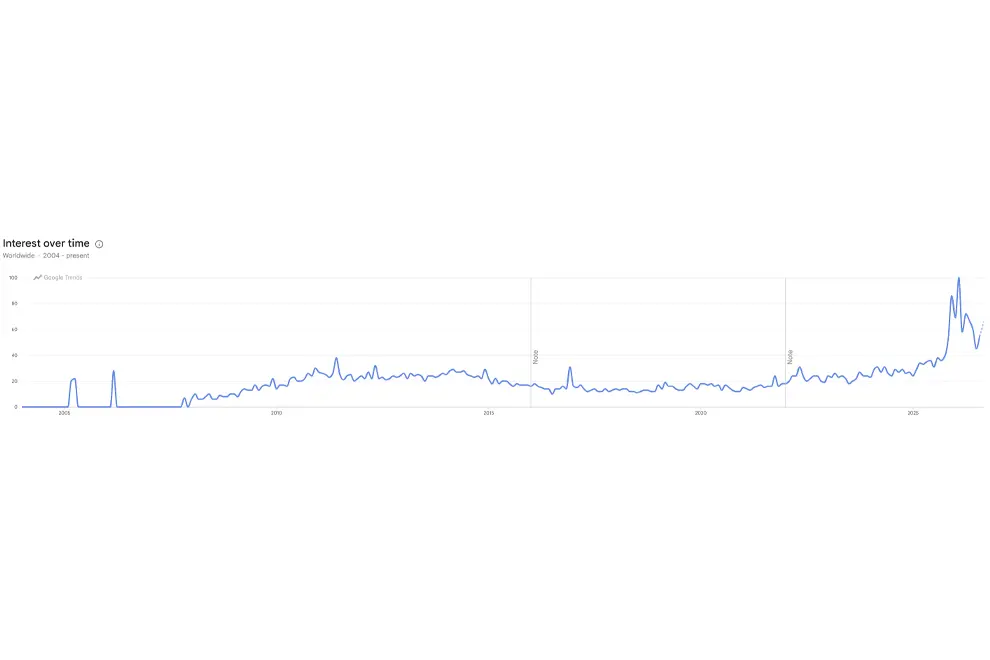
Google Trends searches for "what is a rave” between 2004 and 2026.
Given that curiosity in the educational side of raves has grown up, we likely see a progressive dip in the term actually being used in general.
Hitting peaks of 100 in April and December of 2004, it was a relatively consistent and gradual dip over the next two decades, hitting its low of 27 in March 2021. It's rallied since, however, and more recently it reached 69 in April 2026 – the highest interest in the term since July of 2013.
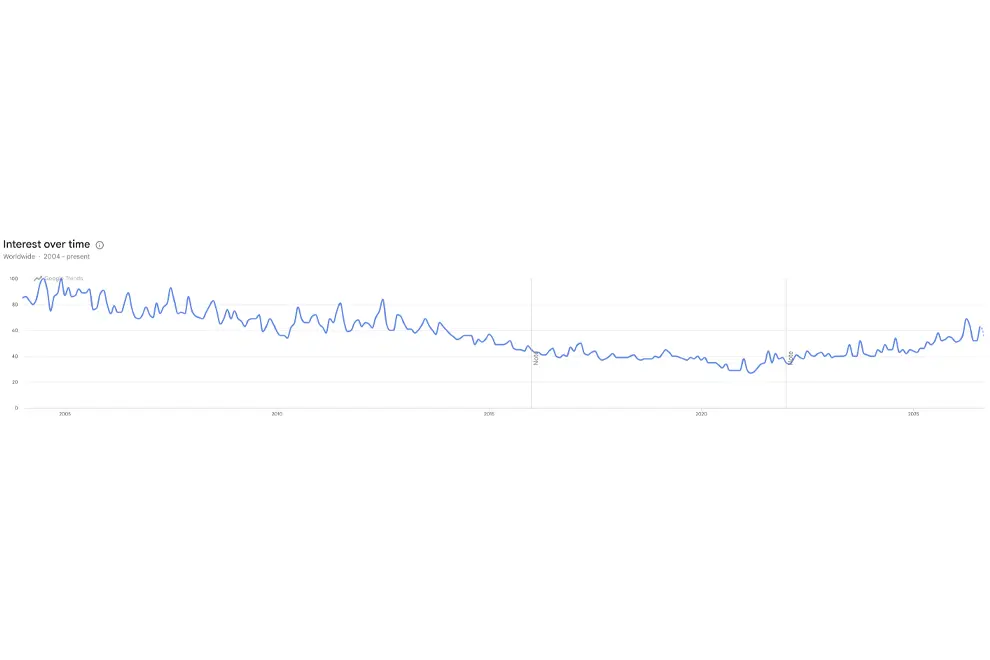
Google Trends searches for "rave” between 2004 and 2026.
This interest in raves – both for educational and attendance reasons – has also coincided with raves becoming less of a communal, underground, rebellious undertaking and more of a humorous affair with a populist lean.
Back in 2022, it was announced that Kat Dopper (of Heaps Gay and Summer Camp Festival, and recently of Sydney's Divine Playhouse) had reopened the iconic Harbour City Cinema, plotting 35 days of raves and parties.
Not all the artists were electronic, however, and the vibe was more of a celebratory one as opposed to simply being a techno-fuelled bastion of rebellion.
In 2024, The Wiggles got into the action, offering up their Rave Of Innocence album under The Wiggles Sound System moniker. In case you thought it sounds a bit naff, it topped the ARIA Dance Albums chart, well and truly putting Sia and RÜFÜS DU SOL in their place.
Fast-forward again to this year, and ABC Music unveiled their Play School: There's A Rave In There record, featuring remixes by KLP.
In Australia, the biggest normalisation of the rave likely came from the infamous Bunnings rave.
Originally beginning as a viral EDM remix of the Bunnings Warehouse by producer Kaila, it became a meme and punters called for Aussie names to get in on the action to host a rave at Bunnings.
Eventually, it took place in Melbourne in August 2024, with Kaila on deck, along with NayNay, Lottie, and headliners What So Not and Peking Duk.
The impact was fairly apparent both at home and abroad, even leading to the likes of Canadian rapper bbno$ to reference the notion of "doing pingas at Bunnings" on his track two.
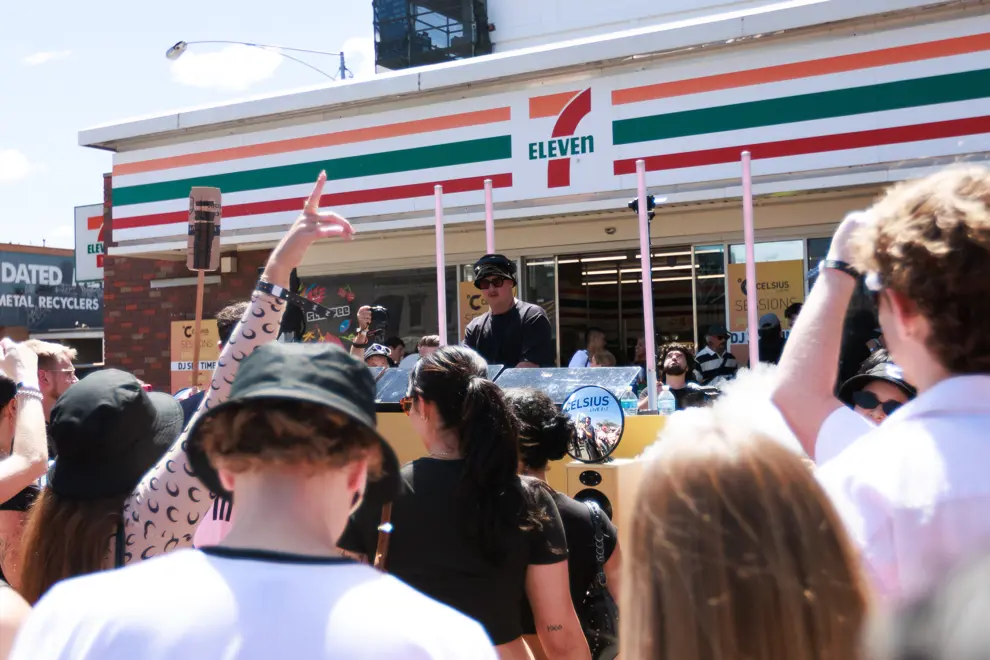
But that wasn't enough, it seems. Soon enough, there was a petition to host a rave at KFC, and earlier this year, CYRIL even hosted a rave at a Melbourne 7-Eleven.
However, things have since become even more ridiculous when you consider the origins of raves.
In 2025, Bondi Junction's Doglateria held a rave for dogs. Dubbed the Woof Doof (which is actually sort of cute) and sponsored by Spotify, the idea was to offer music played at a range suitable for dogs – 55-60 decibels – as DJ Adam Thomas spun “scientifically proven” songs dogs can enjoy
One may think that's reaching the point of peak silly for raves, but while the initial vibe of raves may have been to effectively lose oneself in a musical sense, so too has that notion been revisited via the likes of yoga raves.
However, the logic of this one actually makes a little bit of sense. If raves were designed to, again, lose oneself via this method of musical expression, it seems appropriate that yoga and meditation come together in this sense. After all, if you're trying to reach a point of self-enlightenment, what better way through yoga and meditative, beat-driven music?
Though footage of yoga raves make it look more like a concert bolstered by the tenets of yoga, the intent is there.
Funnily enough, Google Trends actually shows that since 2004, searches for the term have been constant over the years. Most notably, they reached a peak of 100 back in October 2012 – far before the current trends rose.
However, they fell off for some time, and most recently, they spiked to 79 in April of this year.
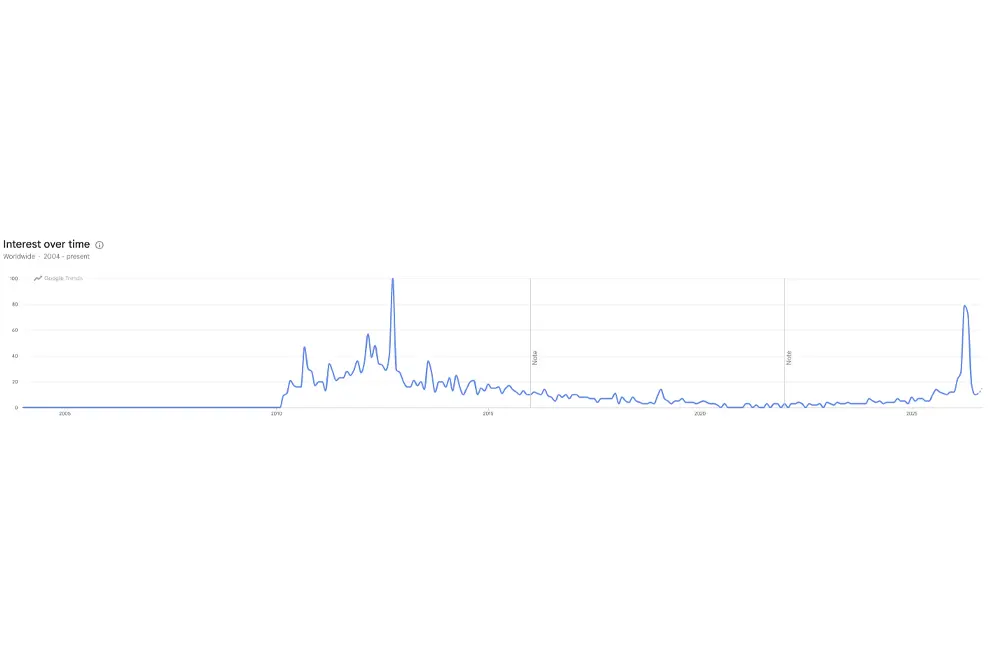
Google Trends searches for "yoga rave” between 2004 and 2026.
But the thing about raves like these is that they're accessible, they're all about fun, and most importantly, they're safe.
That's likely why searches for 'kids rave' have also risen recently. Again, a relatively constant batch of interest held sway in the early 2010s – hitting a peak of 42 in June 2011 – it fell off again for some time, but reached a peak of 100 back in April 2026.
It's worth noting, it's hard to say whether these searches are specifically looking for family-friendly raves suitable for kids, or whether there are events targeted towards kids, but the notion of keeping it safe and accessible is clear.
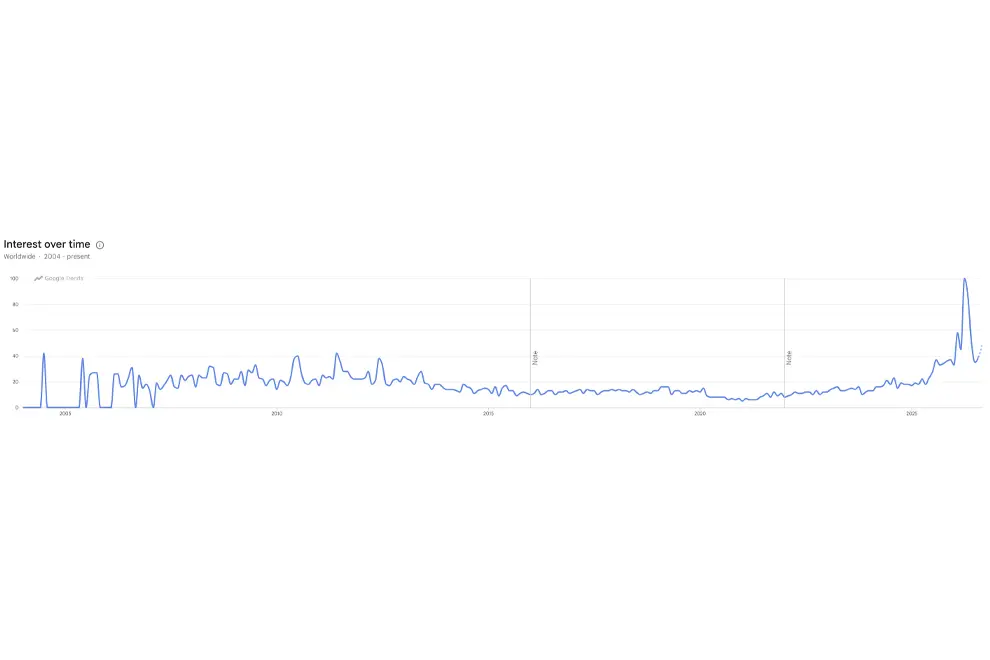
Google Trends searches for "kids rave” between 2004 and 2026.
As time has gone on, raves have made headlines for – more often than not – the wrong reasons. We've unfortunately seen numerous deaths, we've seen bad behaviour glorified, we've seen unsafe drug usage spike, and we've seen electronic music viewed in a negative light as a result of these.
Perhaps then, it's a good thing that the term rave has been co-opted? Perhaps it's great that we can use 'rave' to refer to the positive side as we forget the negatives, and the traditional raves once again return to the underground?
Of course, we're aware that terminology changes. After all, it was once used to refer to wild bohemian parties before being adopted for electronic music parties. Phrases change, as do the times.
However, does the definition of what a rave is necessarily mean anything? If a lover of the genre was going to head to an event featuring pounding electronic music and wanted to convey that to an outsider, calling it a rave rather than an 'electronic music dance event' certainly gets the meaning across.
But if someone was to mention plans to head to a rave and they ended up at a Bunnings featuring a live DJ set, there could be something of a breakdown in communication. The vibe is different, the culture is not the same, and the differences between the two are likely far greater than the similarities.
However, it's the presence of gatekeeping that can result in the life or death of one's passion, so does it really matter?
That said, if you're sick of the notion of raves being misappropriated like this, don't worry, you're not alone.
Last year, Keli Holiday – who is one half of Bunnings Rave headliners Peking Duk – reflected on how much he hates the concept of "coffee shop raves". "Personally, I find them pathetic,” he told triple j.
“I find them disgusting. I think they’re void of any culture. I think it’s actually representative of the commodification of culture; it just feels like ChatGPT in a real-life setting to me.
“I don’t want to see people in athleisure wear at 6am, dancing like this with a latte while there’s some dude that’s ChatGPTed some tech house records that he hasn’t listened to, DJing in the corner going [starts dancing]. I don’t want it.
“Like, if you want to go to a rave, go to a rave, support the culture. Like, those people aren’t about it, and that’s okay. But if you do want to be about it, be about it. Coffee shop raves, get ‘em out!”