There was a time where televised performances were seen as something of a normal part of an artist's career.
Back before the likes of YouTube and social media platforms took over, it was one of the most effective and prominent ways for a musician to get their music seen by the masses. It might have been one thing for their music to be heard on the radio, but getting their image and performance style witnessed by the general public was a big deal.
While the likes of The Ed Sullivan Show were instrumental in kickstarting careers of artists like Elvis Presley and The Beatles in the US in the early days of television, others such as Top Of The Pops, Saturday Night Live, and even Australian productions like Countdown and Recovery helped bring unknown or rising names into households.
Of course, such is the unpredictability of any live performance – especially a televised one – that something can go wrong, or an artist can go off-script in a way which has the potential to be either disastrous or iconic.
With that in mind, we've decided to compile a batch of some of the best moments where artists decided to go rogue on live TV.
The Who on The Smothers Brothers Comedy Hour (September 15, 1967)
By 1967, The Who had spent three years setting themselves apart as one of the most influential and exciting British rock bands of the era, and their live performances had become a vital part of their musical experience. In September of that year, the group found themselves booked on The Smothers Brothers Comedy Hour, a then-nascent program helmed by the titular Smothers Brothers.
Booked to play My Generation, the group were set to complement their song with the addition of light pyrotechnics and instrument destruction – as was standard for their shows. Drummer Keith Moon (himself a noted practical joker and pyrotechnic fan) had loaded a batch of explosives into his drum head for the gig, though they hadn't gone off during rehearsal.
Intent on making a bigger bang, he loaded up an additional round before the recording that night, unaware a stagehand had also loaded another round of explosives as well.
As the recording came to an end, Moon detonated his stockpile, unaware it was three times as powerful as he had planned. The result was chaos. The explosion was deafening, Moon was cut with a piece of shrapnel from his symbols, guitarist Pete Townshend's hair caught on fire, and he also suffered from hearing loss which persists to this day.
The Doors on The Ed Sullivan Show (September 17, 1967)
In September 1967, The Doors had been around for two years and already managed to curate a strong reputation as solid performers and songwriters. While frontman Jim Morrison's live performances were already subversive, the more infamous onstage behaviour and arrests were only a few months away.
But first, they had managed to find themselves booked on The Ed Sullivan Show for a performance of Light My Fire, though network executives had explicitly told the group that the word "higher" needed to be removed from the lyrics so as to not promote drug use.
Conflicting accounts exist as to whether it was intentional or not, but Morrison neglected to make the change, and the program's producer advised the band they would never appear on the show again. Morrison appeared unfazed, simply responding, "Hey man. We just did the Sullivan Show."
The Jimi Hendrix Experience on Happening With Lulu (January 4, 1969)
As 1969 ticked over, the eyes of the world were on The Jimi Hendrix Experience, and with the group having just scored massive success globally with the release of their cover of Bob Dylan's All Along The Watchtower, the group were booked to perform on the second episode of Happening With Lulu.
The plan was for them to play a rendition of Voodoo Child (Slight Return), then their version of Hey Joe, before closing their set with a duet with host Lulu. The set started off fine, but after being introduced to play Hey Joe, the trio – who presumably wanted to play something fresher instead of a track which was years old by that point – deviated from the plan.
Instead, they jammed on Hey Joe before Hendrix addressed the audience. "We’d like to stop playing this rubbish and dedicate a song to Cream," he said, referring to the recently-dissolved supergroup. "Rregardless of what kind of group they may be in. We dedicate this to Eric Clapton, Ginger Baker, and Jack Bruce."
Moving into a rendition of Sunshine Of Your Love, the extended performance reportedly caused havoc behind the scenes, and as the group went well over time, the production manager informed Hendrix the set was over. "We're being pulled off the air," Hendrix alerted the audience, before the song came to a gradual end, and the group were banned from the entirety of the BBC.
Sadly, the ban was short-lived, as Hendrix would pass away just 19 months later at the age of 27.
Sex Pistols on Today (December 1, 1976)
Not every incident of artists going rogue came in the form of a performance, as was the case of the Sex Pistols when they replaced Queen on UK program Today in late 1976.
The band – who were at that point gaining traction off the back of their freshly-released Anarchy In The U.K. single – were backed by a small entourage dubbed the Bromley Contingent. Host Bill Grundy was adversarial from the beginning, clearly discounting their punk aesthetic and attitude as a youthful phase, while offering up supercilious remarks to their responses.
While the band were also somewhat combative, when Johnny Rotten (aka John Lydon) swore under his breath, Grundy pressed him to say it clearly for the people at home, before turning his attention to Siouxsie Sioux – positioned behind the band – and made a comment toward the young woman which was interpreted as a sly pass.
"You dirty sod, you dirty old man," responded guitarist Steve Jones, before Grundy encouraged him to "say something outrageous". Jones complied, calling Grundy a "dirty bastard" and a "dirty fucker", before the host brought the segment to a close.
The backlash was swift, Grundy was suspended for two weeks, and the program itself was axed two months later. In his defence, Grundy claimed he had simply set out "to prove that these louts were a foul-mouthed set of yobs. And that is what I did prove."
@musicdumpgrrl #ElvisCostello performing Radio Radio on #SaturdayNightLive in 1977. Costello was supposed to perform his song “Less Than Zero” but 15 seconds into the song, stopped the band to change the song. Costello was banned from SNL for years after this.
♬ original sound - musicdumpgrrl
Elvis Costello on Saturday Night Live (December 17, 1977)
There's a few Saturday Night Live mentions in this list, but in December 1977, a fresh-faced Elvis Costello was booked to perform on the show, replacing a previously-booked Sex Pistols (who never appeared due to visa issues). Costello was set to perform Watching The Detectives and Less Than Zero, and after the first song went swimmingly, it appeared the second song would, too.
However, a few moments into Less Than Zero, he stopped the track, stating, "I'm sorry, ladies and gentlemen, there's no reason to do this song here." Instead, he switched to Radio Radio, an as-yet unreleased track which was critical of commercialism in British radio, and one since considered his best.
Reportedly, producer Lorne Michaels was furious and refused to invite Costello back for 12 more years. Following appearances in 1989 and 1991, during the show's 25th anniversary special in 1999, the Beastie Boys began a performance of Sabotage before Costello appeared, kicking off a rendition of Radio Radio once again.
Iggy Pop on Countdown (July 8, 1979)
Arguably one of the most iconic TV appearances ever made by the Godfather of Punk occurred right here in Australia, when Iggy Pop stepped off a plane, and right into the ABC studios, readying for a chat with Molly Meldrum for Countdown.
Watching Meldrum corral Iggy is like watching a flustered parent wrangle a petulant child, with the rocker bouncing up and down, becoming distracted, and even beginning the chat with a boisterous "Hiya, dogface!" Despite the awkwardness of the interview, Iggy is soon jets off to the stage where he offers up a very clearly mimed version of his song I'm Bored.
Reflecting on the incident years later, Iggy claimed he was actually far more aware of his situation than one would expect, having been not only suffering extreme jet lag, but "pissed off" that "the record company bribed my manager at the time or tricked me" into having to mime a performance.
"I can still remember the stage set up," he recalled. "It was set up as a kind of catwalk with the audience on two sides, and I remember talking to [Molly] and there was an interior dialogue, there was a voice telling me ‘Do not let yourself take this guy seriously'. "I don't know why I thought that," he added. "I didn't feel like being reasonable that day. Let's put it that way."
Fear on Saturday Night Live (October 31, 1981)
By 1981, founding Saturday Night Live cast member John Belushi was no longer with the show, but he still had a lot of pull. After having discovered the group Fear, Belushi attempted to get the group on the soundtrack to his film Neighbors, but after that fell through, he got them a guest spot on SNL instead.
The first time a hardcore punk band would appear on the show, the group brought in a bunch of their diehard fans – including the likes of Minor Threat and Fugazi's Ian MacKaye, the Meatmen’s Tesco Vee, John Brannon of Negative Approach, and future Cro-Mags members Harley Flanagan and John Joseph – and subsequently caused a riot.
Performing tracks like I Don't Care About You, Beef Bologna, and New York's Alright If You Like Saxophones (they were cut off as they began to play Let's Have A War), the story goes that the performance resulted in tens of thousands of damages and saw Fear banned from the show, though Sketch Music Producer Hal Wilner denied this version of events. (SNL producers actually claim no one has ever really been banned.)
"There wasn’t a riot, they didn’t destroy equipment, that was a good story but otherwise they were totally nice people and acted totally professionally," he later explained.
Fun fact: watch until the end, and young Saturday Night Live cast member Eddie Murphy can be seen picking up a guitar and attempting to join the band.
The Replacements on Saturday Night Live (January 18, 1986)
Well before they were Rock and Roll Hall of Fame nominees, The Replacements were a scrappy, alternative rock outfit who would one day be considered influential icons of the genre.
By the start of 1986, they were in full flight, having just released their first major label album by way of Tim, and they found themselves invited onto a Harry Dean Stanton-hosted episode of Saturday Night Live. While it should have been the band's big break, it ended up being a shambolic mess, thanks in part to a frustrating dress rehearsal, and the group asking stagehands to ensure the dressing room was well stocked with beer.
Launching their two-song set with Bastards Of Young, the group turned up the volume on their amps without telling engineers, and as the solo approached, Paul Westerberg shouted "Come on, fucker!" to guitarist Bob Stinson. Stinson would attempt a somersault at the end of the song, showing a tear in his pants and exposing himself to the audience.
After the song, producer Lorne Michaels furiously told the group they'd never perform on TV again. But they still had one song left, and after a false start, they launched into Kiss Me On The Bus. Stinson, who was "in the bathroom getting high", was unaware his bandmates had all switched clothes before the set, confusing all and sundry.
Despite being apparently banned from the show, Westerberg would later appear as a guest on the show in December 1993.
Iron Maiden on P.I.T. (August 1986)
Having already rebelled against the notion of lip-syncing by telling Top Of The Pops in 1980 they would only perform if they could do it live, it feels a little bit odd that Iron Maiden would change their tune just six years later.
Well, it seems that having a bit fun is the only thing that would convince them, because when producers of Germany’s P.I.T. invited the group to perform their newly-minted single Wasted Years in August of 1986, the group were more than happy to lip-sync… in fact, all of them were.
Indeed, the performance is wild from the start, with members swiftly swapping instruments, taking their turn on the microphone, and making it abundantly clear that no one is actually performing live.
By the end of the performance, it feels like this televised version of musical chairs was simply an opportunity for everyone to have a chance playing the bandmates’ instruments, and to finally have a chance to ‘sing’ lead vocals on a Maiden cut.
TISM on Hey Hey It's Saturday (April 22, 1989)
In hindsight, booking TISM on a show like Hey Hey It's Saturday was probably a bad idea, but given that Molly Meldrum had previously given their debut album, Great Truckin' Songs Of The Renaissance, a positive review on the show, it somewhat made sense.
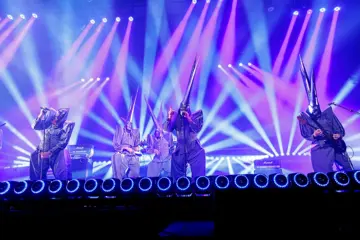
However, the masked mirthmakers were primed for a televised appearance given that their live show needs to be seen to be believed. Fittingly performing their single Saturday Night Palsy, the seven-piece outfit launched their rendition of the track in normal fashion, with the members dressed in black and adorned with headpieces featuring names of The Beatles' members.
But from there, it went a little bit rogue, with the group being joined by another version of TISM… and another, and another, ultimately resulting in 28 'members' of the band performing the track at one time.
It was pure, controlled chaos that showcased just how loose TISM could be when they were let off the hook. Of course, it wasn't the last time they did this. In the early '90s, they brought two versions of the group to a live show in Melbourne, and this year – again in Melbourne – three separate versions of TISM all performed simultaneously for a special gig at PICA. Talk about getting bang for your buck.
Nirvana on Top Of The Pops (November 27, 1991)
British musical program Top Of The Pops was infamous for ensuring that guests would need to mime any of their performances save for the vocals, and as a result, numerous artists would rebel, choosing instead to fight back and play with the concept. That's exactly what happened when Nirvana were welcomed aboard in November 1991 to play their landmark single Smells Like Teen Spirit.
Deciding to eschew any sort of theatre, guitarist and vocalist Kurt Cobain figured he would mimic The Smiths' frontman Morrissey, lowering his vocals, pretending to play his instrument, and even altering the lyrics. The result is a gloomy, goth-like rendition of the song, but one that stands tall as one of the best performances in the show's history.
Fans didn't care either, and as the song came to an end, they'd jumped onstage with the band as expected. Thankfully, we can only assume Nirvana learned their lesson after this one, and we certainly won't be hearing from them again in this list…
Bob Dylan on Late Night With David Letterman (January 18, 1992)
Ask any critic of Bob Dylan's and they'll likely claim that enunciation isn't his strong suit, with mumbling being his preferred method of communication. A bold claim to make for one of music's most influential and impactful figures, but in January 1992, David Letterman got a first-hand taste of why Dylan draws such criticism.
The story goes that Dylan had been roped into appearing on the tenth anniversary special of Letterman's Late Night program, and was set to perform alongside an all-star band, featuring Letterman's musical director Paul Shaffer, Emmylou Harris, Carole King, Steve Vai, Chrissie Hynde, Mavis Staples, and more.
However, Dylan was apparently not informed he'd be performing with others, having believed he'd be going it alone on the night.
During the rehearsal, Dylan didn't perform at all, and on the night, he played Like A Rolling Stone but barely moved his mouth, providing a performance which was baffling, awkward, and a little cringeworthy. "You almost needed someone signing because it was so bizarre," Letterman later said of the lacklustre performance.
The KLF on the BRIT Awards (February 12, 1992)
If you were to look up the phrase “going rogue” in the dictionary, there might as well be a picture of The KLF included.
Comprising Bill Drummond and Jimmy Cauty, the pair were only active for five years in their initial incarnation, but managed to entirely subvert expectations of how the music industry should be run, unexpectedly topped the charts under their alias The Timelords, became the biggest-selling singles act in the world for 1991, and – in 1994 – burned £1 million of their earnings.
In 1992, they were up for four honours at the BRIT Awards, including British Album, Video, and Single of the Year, while they shared British Group with Simply Red. They were also booked to perform on the evening, so when they prepped a rendition of their nominated single 3 a.m. Eternal, they decided to team up with the very un-nominated grindcore outfit Extreme Noise Terror.
The two had recorded a version of the song the year prior, and had planned to perform it on Top Of The Pops, but after being knocked back, pivoted to the BRIT Awards. The high-energy set was a mystifying one, filled with shouted vocals, and Drummond wearing a kilt and propped up with crutches. “This is television freedom,” he can be heard yelling at the start of the song.
As the set came to an end, Drummond popped a cigar in his mouth, armed himself with a machine gun, and fired blanks into the audience as the curtain fell and it was announced that, “Ladies and gentlemen, The KLF have now left the music business.”
Bizarrely, the crowd – including an eager Billy Bragg – can be seen applauding as if it’s just another day in the industry. It also gets weirder given that the story goes the band had initially planned to drench the crowd with sheep’s blood. Instead, they dropped the dead sheep off at the afterparty as something of a commentary on the industry. Nauseating.
Nirvana at the MTV Video Music Awards (September 9, 1992)
Okay, maybe we're not done with Seattle's grunge icons just yet. Alongside winning a handful of awards on the night, Nirvana were selected as performers at the MTV Video Music Awards in September of 1992. Despite all of their nominations being for Smells Like Teen Spirit, the group were booked to perform their latest single Lithium at the event.
But Nirvana didn't want to play ball. Instead, they wanted to perform their then-unreleased song Rape Me. With the song still a full year away from being released (and weeks away from being recorded), it was indeed an odd choice, and one that didn't sit well with producers, who were worried it "would make it seem like MTV was normalizing rape," and chose not to listen to Cobain's claims it was actually a pro-feminist song.
On the night in question, Nirvana got up to play, launching into their performance with the opening lines of Rape Me, almost causing the live broadcast to switch over to a commercial. It was all a fake-out, however, and the band continued their appearance by switching over to Lithium and winning over the crowd with a legendary performance.
Sinéad O'Connor on Saturday Night Live (October 3, 1992)
Arguably one of the most iconic acts of televised musical rebellion belongs to the late Sinéad O'Connor, whose Saturday Night Live appearance in October 1992 made headlines around the world.
Having made her debut on the series just two years earlier (after first cancelling an appearance which was to be hosted by Andrew Dice Clay), O'Connor joined the line-up of the Tim Robbins-hosted episode to play two songs, Success Has Made A Failure Of Our Home, and an a capella rendition of Bob Marley's War.
During the latter, O'Connor – who was hyper-critical of the catholic Church and the way it dealt with numerous topics, including cases of child sexual abuse – held up an image of Pope John Paul II and tore it, urging viewers to "fight the real enemy".
In rehearsals, she had held up an image of a starving African child, so producers were also shocked by the musician going off script. The backlash was swift and immense, with 4,484 complaints made to the network (compared with 725 supportive calls) and the divisive performance being discussed globally as either immensely disrespectful or incredibly brave.
O'Connor's stance has since been vindicated after abuses by the Church were made public, and in 2025, Saturday Night Live rebroadcast the event as part of their 50th anniversary celebrations, with producer Lorne Michaels stating he "admired the bravery of what she'd done, and also the absolute sincerity of it".
Cypress Hill performing I Ain't Goin Out Like That on SNL, introduced by Shannon Doherty. Muggs lighting up the joint on live TV ended up with Cypress being "banned" from SNL
by u/bside313 in 90sHipHop
Cypress Hill on Saturday Night Live (October 2, 1993)
Those with delicate sensibilities might be somewhat shocked and appalled to learn that Californian hip hop group Cypress Hill (known for tracks like Hits From The Bong) hold a rather laissez-faire attitude when it comes to drugs. Well, fans aren’t shocked, and promoters aren’t shocked, but apparently Saturday Night Live producers were.
To be fair, one couldn’t have assumed that – when the group appeared on the Shannen Doherty-hosted show in October 1993 – they would make such a bold showing of drug use. However, after performing Insane In The Brain, the group closed out their two-song set with a rendition of I Ain't Goin' Out Like That.
Seemingly living up to the title, DJ Muggs decided to make the most of their televised appearance and lit up a joint as the song began. The rest of the song went along as planned (save for a little bit of instrument destruction near the end), but Muggs’ appetite for a university cigarette didn’t resonate well with broadcasters, and the group haven’t been invited back since.
Faith No More on The Word (March 3, 1995)
When Faith No More were booked to perform on UK series The Word in March 1995, they were still a few days away from releasing their fifth album, King For A Day... Fool For A Lifetime. While the record would be a massive hit, the group were still riding high off the back of 1992's Angel Dust and the surprise success of their cover of The Commodores' Easy.
So, when the group were scheduled to play The Word, they kicked things off by playing a stellar version of the album cut What A Day, and ostensibly told hosts they were planning to perform Easy for the crowd.
What happened, however, was a bit of a tease and something fans are still unsure was a joke or not. As the host throws to the band, they start the track, play a few bars, and then pause on a discordant note. Swiftly, they come back in, this time with a different cover version, performing the Bee Gees' I Started A Joke instead.
Though a great performance, like their forthcoming album as a whole, I Started A Joke hadn't yet been released. In fact, when King For A Day… arrived, the song was only included on Brazilian editions of the record, and was instead widley packaged as a B-side to their Digging The Grave single. Fans had to wait another three years for a more mainstream release of the track, when it was included on their Who Cares A Lot? greatest hits compilation.
Some claim the change-up was due to the band sick of being pigeonholed as a Commodores cover act, others have posited it was a joke to showcase another softer side of the hard rock outfit, while others have just suggested the band were wanting to have a good time on stage… and so they did.
Oasis on MTV Unplugged (August 23, 1996)
In the mid-'90s, there were no two things bigger in alternative rock than Oasis and MTV's Unplugged series. While Nirvana's triumphant appearance in the series gained worldwide recognition in the wake of Cobain's death, Oasis' rise to the top with their (What's The Story) Morning Glory? album in 1995 had made them household names.
So when the two were planned to meet at London's Royal Festival Hall in August 1996, history looked set to be made. Now, to be fair, this one is included in the list more for what happened off-screen rather than on, but it's a wonder we got what we did.
The story goes that Liam Gallagher had become something of a concern in the lead-up to the performance, with his tabloid antics and contentious relationship with brother Noel resulting in fears the performance would not go ahead.
Sure enough, behind-the-scenes drama, disastrous rehearsals, and last-minute line-up shifts resulted in Noel refusing to take part in the performance at the last minute, singing songs he'd never sung publicly without Liam up front.
Informing audiences of Liam's sore throat ("You're stuck with the ugly four," Noel quipped of those on stage), it quickly became clear it was something of a cover story, with Liam sitting in the balcony above, drinking champagne, heckling his brother, and resulting in a performance that should have been a train wreck.
Metallica at the MTV Europe Music Awards (November 14, 1996)
The mid-'90s were something of a controversial period for fans of thrash metal icons Metallica. Having gone 'commercial' with the release of their self-titled Black Album in 1991, the release of 1996's Load saw them cut their long locks and take on more of a media-friendly metal image. While some fans saw them as having sold out, others viewed them as distancing themselves from their aggressive, dangerous origins.
MTV figured that, since they were nominated for Best Rock at the MTV Europe Music Awards that year, they'd be a perfect fit to perform, booking the group to perform their then-upcoming single King Nothing. However, they didn't tell the band that expletives and pyrotechnics weren't allowed during their performance.
Incensed, the band decided to go rogue, eschewing their previously-planned song in favour of two covers: the Misfits' Last Caress and Anti-Nowhere League's So What?. This sounds fine on paper until you release the former contains lyrics all about infanticide and sexual assault, and the latter contains lyrics relating to bestiality, and language which certainly isn't suitable for mixed company.
Purportedly, network executives were furious with the last-minute change of plans and the group were apparently banned from MTV for years.
The Jon Spencer Blues Explosion on Recovery (September 6, 1997)
Arguably one of the greatest live moments in Australian television history occurred in September 1997 when US rockers the Jon Spencer Blues Explosion found themselves in the country off the back of the previous year's Now I Got Worry album.
Following a standout performance of Wail, it was during a rendition of 2 Kindsa Love that the group let loose. Spencer quickly abandons his guitar and screams into the mic, moving over to a theremin before heading into the crowd and almost daring the camera operator to follow him as he runs about while his bandmates keep the groove going.
More theremin is followed by a false ending, another chaotic trip into the crowd, the destruction of their stage decoration, and the smashing of the microphone. A quick bow gives way to a swift exit as host Dylan Lewis is left to simply gape in wonder as he plays them off. "Rock and roll is alive," he excitedly reminds the crowd.
Green Day on Recovery (March 28, 1998)
In March 1998, US punks Green Day were in Australia to promote their fifth album, Nimrod. Most folks would remember the album for the track Good Riddance (Time Of Your Life), and while it featured singles like Hitchin' A Ride, Redundant, and Nice Guys Finish Last, in Australia, the record might be well remembered for the track The Grouch.
While in the country, the trio were marched into the Recovery studio where they chatted to Dylan Lewis and – despite not being booked to do so – asked fans if they wanted to hear a song. Heading to the stage, they lifted instruments from house band Starsign and whipped into a rendition of the foul-mouthed The Grouch.
Despite Lewis' half-hearted attempts to stick to the script and prevent them from performing (he even requested Platypus as they asked fans what they should play), Recovery history was made that day, and the show even got into a bit of hot water for allowing a swear-laden song to go to air in the morning timeslot.
This performance also raised the track's profile, and the studio version ended up reaching No. 52 in triple j's Hottest 100 countdown of 1998.
The Vines on the Late Show With David Letterman (August 19, 2002)
If any music lovers from international shores were pointing their peepers towards Australia in 2002, it was likely due to The Vines. The Sydney outfit had managed to make waves for their ferocious, grunge-inspired compositions, and it’s long been noted how some press viewed them as a reincarnation of Nirvana, largely thanks to the raw power and frenetic energy of guitarist and vocalist Craig Nicholls.
Debut album Highly Evolved was released in July of 2002, and went on to chart in the top ten globally, including an impressive No. 11 spot in the US. This American invasion was planned to be helped along by an appearance on the Late Show With David Letterman, where the band were booked to perform their then-recent single, Get Free.
For diehards, the performance was exactly what you may have expected from the band. Nicholls’ vocals were howled and messy, and he writhed around the stage, knocking over drums, somersaulting over Letterman’s couch, and generally causing a scene.
Though some members of the band feared the chaotic spot cost them US success, and some naysayers have likely written the set off as a case of the band being unprepared and unready for television, it stands tall as a moment when a small Aussie band captured the attention of international audiences.
Muse on Quelli Che Il Calcio (September 20, 2009)
When Muse released their fifth album, The Resistance, in September 2009, the group were at the top of their game, having gone from strength to strength with each previous record and ready to take over the world even further.
This global domination led them to Italy, where the record topped the charts, and the group were asked to appear on Quelli Che Il Calcio to perform their single Uprising. However, they’d been asked to mime the track, and we all know how that goes.
The performance looks set for a shaky start when the host introduces them as ‘The Muse’, before a reconfigured version of the group appeared before viewers. Vocalist and guitarist Matt Bellamy sat behind the drums, bassist Christopher Wolstenholme was over on guitar and keyboards, and drummer Dominic Howard had been given a bass and told to 'sing'.
Fans can easily see they’re having a great time, and the best part is that the host doesn’t even seem to realise. When interviewed afterwards, Howard expresses his love of Italy, explaining that the band had actually recorded the record near Lake Como. "Our drummer here, Matt, lives in Como,” he slyly noted. “It's a place that inspires your creativity."
Rage Against The Machine On BBC Radio 5 Live (December 17, 2010)
This one is likely cheating because it was on radio, but it was filmed, so we'll let it slide. In December 2009, a campaign was launched to sabotage The X Factor's domination of the annual Christmas number one slot on the UK Singles Chart, and instead get Rage Against The Machine's Killing In The Name to the top spot.
Ultimately, the campaign was successful, and prevented Joe McElderry from claiming the No. 1 position. However, just prior to the announcement of their victory, Rage Against The Machine appeared on BBC Radio 5 Live where they performed a version of the song, and were asked to adhere to the broadcaster's rules regarding censorship.
Fittingly, the song went by perfectly well until the end, where the band did censor the line "Fuck you, I won't do what you tell me" a few times, only to live up to the very nature of the lyric by performing it uncensored for the rest of the song.