How does the story end?
When friends heard I was working on Ian “Molly” Meldrum’s life story, that’s the question they would always ask.
And I would always reply: “I kill him in the end.”
It was a joke, of course. And, really, I thought that the book was going to kill me.
We signed the publishing deal in 1998. The book was meant to come out for Christmas 1999; it came out for Christmas 2014.
Molly was not great at meeting deadlines. Just ask Russell Morris.
If you want proof of Molly’s genius, do yourself a favour and listen to his production of Russell’s The Real Thing.
Molly’s friend Brian Cadd, who appeared on the song, called it “the alien monster in the basement”.
“It was the first time I’d seen production turn into obsession,” Brian recalled. “The song just grew and grew. The Real Thing became the living thing.”
And then there was The Ferrets’ debut album – Molly’s only full album production. He was credited as “Willie Everfinish”.
Put simply, Molly was too busy living his life to write about it.
And what a life!
Molly was like the Forrest Gump of rock, present for so many magical moments in music history.
John Lennon gave him the world exclusive that the Beatles were breaking up. But Molly was so awed, he wasn’t listening.
“My biggest scoop,” he later reflected, “and I missed it.”
Molly was in the studio when America’s biggest stars recorded We Are The World.
He was there when Elton John got married. He was on the road with Michael Jackson when the King of Pop wed in Sydney.
He accompanied Johnny Farnham on his first international trip, bringing actress Linda Lovelace as his date to a concert in London.
“Molly finds the most unbelievable people,” Farnham’s former manager Darryl Sambell remembered.
Molly was there when Joe Cocker was kicked out of Australia, hosted the documentary on the first Sunbury Festival, was the first person in the world to play Paul McCartney’s Mull of Kintyre video on television, helmed the Australian leg of Live Aid, organised the Rocking With The Royals concert for Prince Charles and Princess Diana, and had punch-ups with Johnny Rotten and Boz Scaggs.
Molly also demanded that ABBA release Mamma Mia as a single, gave Blondie and John Mellencamp their first hits, introduced Australian audiences to Madonna, and signed a 16-year-old Peter Andre on live TV – he went on to have three number one singles and a number one album in the UK.
And then there was that interview with Prince Charles. Thirty-seven years later, the soon-to-be King of England said, “It only seems like yesterday. I wish it were tomorrow; I’d cancel it.”
Our book journey started in 1998. “Come over about two o’clock on Sunday,” Molly suggested. “We’ll watch some of the footy and then do some work on the book.”
I turned up and … no one was home.
I later discovered that Molly was still out clubbing. At 7 pm that evening, he rang his partner to remind him I was coming over. Molly, however, thought it was 7 am – he had somehow lost 12 hours.
Writing a book is never easy. But as Prince Charles noted, “Nobody prepared me for Molly Meldrum.”
We called that first book The Never, Um, Ever Ending Story.
Remarkably, we delivered a second book – just two years later. That book was titled Ah Well, Nobody’s Perfect.
And that was a neat summation of Molly.
Many years ago, Molly bumped into Geoffrey Rush at a Royal Command screening of Titanic. The actor told Molly how much he admired him.
Molly responded by congratulating Geoffrey on winning an Oscar for The Piano. But as he rambled on about how much he loved the movie, Molly was struck by the dreadful realisation that the movie was actually called Shine, not The Piano.
As he profusely apologised, Geoffrey gently placed his hand on Molly’s shoulder.
“Look, that’s what I’m trying to say, Molly – that’s why we love you so much.”
Molly would often remark, “I’m just a simple country boy.”
As a child, he dreamed of becoming a conductor. He would stand on a soft-drink box, with a wooden spoon in his hand, and pretend he was conducting an orchestra.
He cherished memories of his mother and grandmother taking him to the city to see the Melbourne Symphony Orchestra.
“I would sit there, hypnotised, thinking, ‘How can they make all these sounds work, and tell a story in such a beautiful way?’”
Molly treasured his childhood in Quambatook in the Mallee. (Once, when interviewing the Red Hot Chili Peppers, he mentioned that they looked “as fit as Mallee bulls”. They were perplexed. “What?” singer Anthony Kiedis queried. “We’re as fit as Molly’s balls?”)
But, in reality, Molly was built for the bright lights of a big city.
His life changed forever following a fateful meeting on the Barkly Street bus in 1962.
He asked if he could move in with his fellow passenger “for a couple of weeks”.
Nine years later, Molly was still living with Ronnie Burns and his family at their Elwood home.
Ronnie was Molly’s entrée to the music world.
Ronnie’s band, The Flies, supported The Rolling Stones. Molly interviewed Ronnie for his first piece of music journalism, for Go-Set. And Ronnie introduced his friend to the legendary Melbourne radio DJ Stan “The Man” Rofe.
It was Stan who gave young Ian his famous nickname.
After a fight, the DJ decided to give Ian a woman’s name, thinking it would annoy him. He intended to call him Mildred in the next edition of Go-Set, but his 3UZ colleague Ian Buckland typed “Molly” instead.
It stuck. And Australian music would never be the same.
Kylie Minogue says simply: “There is another word for music in Australia – Molly.”
Molly did 564 episodes of Countdown, counting down to 179 number ones.
The show played more than 6000 songs, and Molly did more than 1000 interviews – travelling about 768,000 kilometres to gather them all.
And after Countdown finished, Molly enjoyed 12 years on Hey Hey It’s Saturday, where John Blackman – via Dickie Knee – dubbed him “The Guru”.
“It was a name I never wanted,” Molly said, “as I’ve never considered myself to be a guru of music.”
Molly was a great TV presenter because he was not a great TV presenter.
He was real.
TV presenters are now so slick they could be AI-generated. But not Molly.
And artists loved him.
Inside an awkward TV performer was a great music man.
Molly had incredible ears. He could pick a hit and, more importantly, he could make it happen.
So many stars owe their careers to Molly.
Elton John said Molly was “the best thing that ever happened to Australian music”.
Madonna calls Molly “the first man in Australia to fall in love with me”.
Björn from ABBA says, “We have so much to thank Molly, Countdown and Australia for.”
ABBA had more hits in Australia (15 Top 10 singles, including six chart-toppers) than at home in Sweden (13 Top 10 singles; four number ones).
John Mellencamp credits Molly with saving his career. His US label was planning to drop him – until they discovered that his single I Need A Lover was a big hit in Australia, courtesy of Countdown.
Mellencamp later thanked Molly by painting his portrait, which he called “The Ghost Cowboy”.
How do you explain Molly’s remarkable career? Perhaps Spinal Tap summed it up best: “It’s such a fine line between stupid and clever.”
He stumbled and bumbled and mumbled. But he was an unforgettable part of our lives.
Molly was thrown out of the Beatles concert at Festival Hall in 1964 because he was too hysterical. Five years later, he had met the Beatles and was working at Apple Records.
He fainted before the final siren at the 1966 Grand Final – he would often ruefully joke that he never got to see St Kilda’s one and only premiership. But he became the club’s most famous fan.
In 2014, Molly became the first – and only – non-recording artist to be inducted into the ARIA Hall of Fame.
He was inducted into the TV Week Logie Hall of Fame in 2012.
He won $500,000 for charity on Who Wants To Be A Millionaire.
And Molly was King of Moomba – twice.
He particularly valued that honour because he loved Melbourne. Elton John wanted Molly to move overseas and work for him, but Molly didn’t want to leave his hometown.
But, of course, he travelled the world, having many memorable encounters with pop stars, including this celebrated exchange with English ’80s pop star Kim Wilde:
Molly: When you look back at sort of the three hits that you’ve had, do you and your brother purposefully go out to find, you know, like, I mean, in other words, do you knock back tracks that you may write, or what? Is it a calculated thing? I mean, I’m … it’s a strange question, you know. I mean, like … Let me start again.
Kim Wilde: I don’t understand the question at all.
Molly: I got a bit mixed up myself.
Countdown boss, Michael Shrimpton, had a lovely description of Molly:
“A collection of nouns searching for a verb.”
And then there were his legendary parties for the Australian cricket team, the St Kilda Football Club and the Melbourne Storm.
One summer night in 1986, the guests at Molly’s house included Mark Knopfler, Cyndi Lauper, Tom Petty, Stevie Nicks and Brian Mannix.
Then in walked Bob Dylan with Lauren Bacall on his arm.
No one threw a party quite like Molly.
His best mate, the late music mogul Michael Gudinski, told me:
“Molly is a friend of the stars, but you don’t have to be a star to be Molly’s friend.”
A taxi driver or someone at the supermarket Molly met the day before a party? Molly would invite them.
“I have probably spent more time in public with Molly than anyone else has,” Gudinski said. “And you know what? I have never seen anyone come up and abuse him.
“People love Molly, and he loves people.”
When he was a young boy, Molly’s grandmother told him:
“Remember, no one is above you, no one is below you. Treat everyone the same.”
For the past couple of years, Molly has lived a quiet life at home in Richmond.
“I’m ready to go now,” he told me recently.
“Just tell all the stories.”
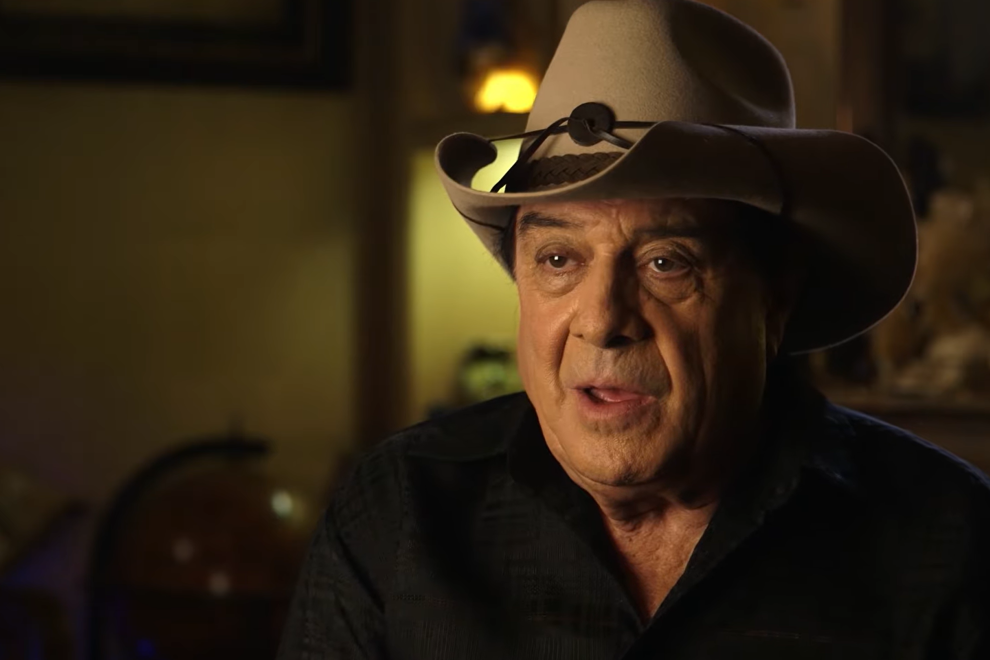
Where do you start? Everyone who met the man in the hat walked away with a Molly story.
My favourite depends on which day it is.
Today, this tale, from Roxus drummer Darren Danielson, is making me smile:
“Our lighting guy at one of our gigs at Billboard in Melbourne came up to me afterwards and told me that Molly had tapped him on the shoulder and told him to turn the bass up.
“Remember, he’s the lighting guy!
“Not too sure what to do, he put one of the sliders up, and this orange light came on. He looked over to Molly, who gave him the big thumbs up.”
Then there was an encounter with an American woman who Molly had sat next to at Olympic Park when Michael Jackson’s Bad tour hit Melbourne in 1987.
A few years later, the woman spotted Molly when he was walking through Central Park in New York.
“You’re Molly, aren’t you?”
“That’s right,” he replied.
“I met you in Melbourne at the Michael Jackson concert.”
“Oh yes, of course,” Molly said, realising that the woman must have worked for Sony, Michael Jackson’s record company.
After a pleasant chat about how great the concert was and what a lovely day it was in New York, Molly asked:
“So, are you still at Sony?”
The woman looked a little confused. “I don’t work at Sony,” she explained. “I’m Meryl Streep.”
In 1987, she had been in Australia, starring as Lindy Chamberlain in the movie Evil Angels.
One of the greatest actors of all time knew Molly. But in that New York moment, Molly didn’t know her.
And that’s why we loved him.
I was lucky enough to be at the table read for the top-rated Molly mini-series.
As the actors gathered to go through the script, producer John Molloy thanked the writers and the cast and crew.
“And, most of all,” John added, “I want to thank Molly for having lived such a wonderful life.”
So, how does the story end?
Molly talked about death in the final chapter of our first book.
“Of course, my accident forced me to think about my own mortality [he fell off a ladder at home in 2011, suffering a brain injury].
“Death doesn’t scare me.
“And I want my funeral to be the silliest, happiest thing on earth. I’ve even told my friend Krystal, Hey Hey’s props guru, to work with the undertakers and rig it so the lid of my coffin flies off. I’ll pop up and say:
“Just one more thing – can I have another drink, please?”
And his funeral song?
The Beatles’ The Long and Winding Road.
Molly packed so much into his life. When he was 20, he told Ronnie Burns, “I don’t want to live past 30.”
And he confided to the great Australian music critic Ed Nimmervoll, “I always thought I would die young.”
“He was just rushing into life as fast as he possibly could, to cram as much of it in, because he had this belief that he wouldn’t be around for long,” Ed told me.
Fortunately, we got Molly for 83 wonderful years.
“Would I have traded my life to be a pop star?” Molly asked in the final chapter of The Never, Um, Ever Ending Story.
“A footballer for St Kilda? A cricketer for Australia?
“No. I wouldn’t trade my life for anything. It’s been the most extraordinary, fortunate life.”
As Elton once wrote on the wall at Molly’s house:
“Dear Molly,
So many years,
So many tears,
But so many great times.”
A couple of years ago, Molly and I reflected on his remarkable life.
“There is no ‘normal’,” he said. “And I’ve never really ‘fitted in’.
“A man named Molly working at the conservative old ABC in the ’70s? It was ludicrous, really.
“But we can all find our place in the world. I’ve always loved Oscar Wilde, and he had a great saying: ‘Be yourself, everyone else is already taken.’”
And that’s exactly what Ian “Molly” Meldrum did.
The last time I saw Molly, I told him that I loved him.
“I love you, too,” he replied.
I tickled his feet and said, “You behave yourself.”
He smiled. “There’s little chance of that.”
We both laughed.
And with that, he was gone. But never forgotten.
Ian Alexander “Molly” Meldrum is survived by his partner Yan, son Morgan, grandson Jason, and brothers Brian and Robert.