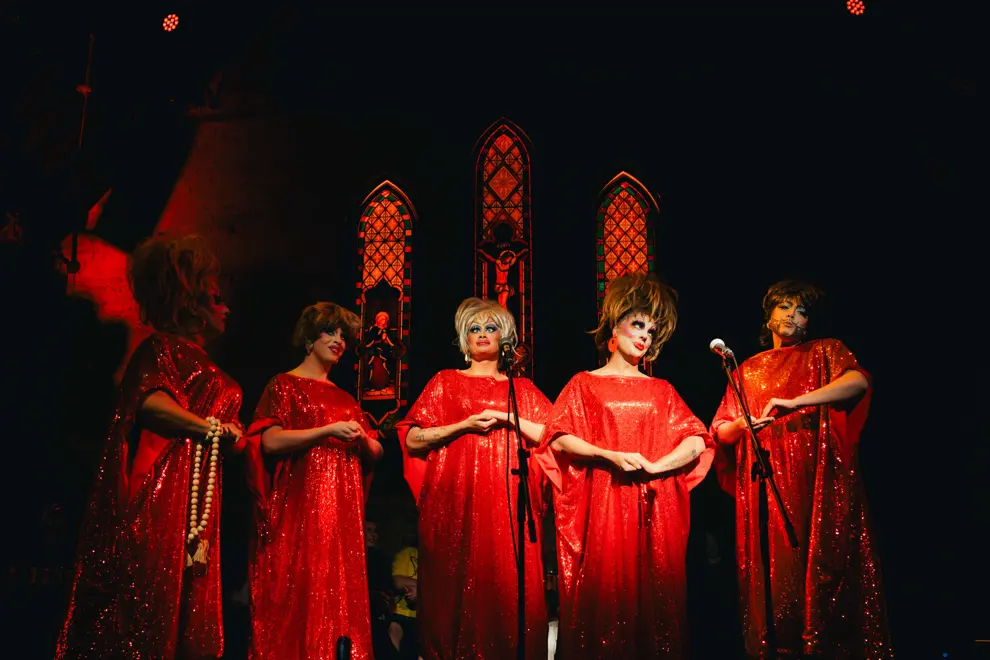
Divine Playhouse, a new performance, live music and arts pop-up venue and bar hosting LGBTQIA+ events, is in danger of being evicted following vocal protests from religious groups.
Based in the heart of Sydney’s CBD, the former church – deconsecrated in the 1930s – has previously operated as a theatre, homeless shelter, and a children’s school. Since last week, the heritage-listed church has opened as Divine Playhouse under a one-year lease.
The Guardian reports that upon its opening night last Wednesday (8 July), a group of 70 people gathered outside the venue to protest against its events.
The following day, landlords sent a “notice of breach” to the venue’s events organisers, Heaps Gay Events, accusing them of insulting and mocking “religious beliefs of millions of Christian Australians.”
Additionally, the venue had been subjected to online complaints, with Australian influencer Spanian criticising it on social media. Q News also notes that Christian groups revealed plans for additional protests scheduled for 17, 20, 21, and 23 July.
The Guardian noted that Divine Playhouse’s landlord ordered venue operators to “cease engaging in offensive trade” by last Saturday (11 July), or risk having their lease terminated. Events scheduled for last weekend were cancelled, and the Divine Playhouse and Heaps Gay social media accounts were removed following the intensity of complaints.
Before its opening last week, it was reported that the venue began operating with support from the NSW Government through a $100,000 grant from Create NSW.
Initially, it was set to run under the name Unholy Playhouse, but following concerns from members of the Christian community, it was renamed Divine Playhouse. Members of the Catholic men’s group, Fit for the Kingdom, and the Christian brotherhood, Prodigal Sons, claimed that the venue’s mere existence “mocks religious faith.”
Upon its opening last week, Divine Playhouse Promoter and Heaps Gay Founder, Kat Dopper, described the venue as a “community centre” for Sydney, expressing hope that people would walk away with “a sense of discovery.”
Addressing the venue’s name change, Dopper added, “It’s really important to me that when we create spaces like this, they feel safe, welcoming and inclusive for everybody.
“While the project has received an overwhelmingly positive response, there has been a small number of people in the community who felt hurt by the use of the name UNHOLY. I still stand by my decision to use that word as a reclamation for communities who may not have always felt included in traditional holy spaces, but I never wanted the name to become the story.
“I wanted the people, the art and the community to be the story and to create an inclusive joyful space. So today, we’re proud to introduce DIVINE PLAYHOUSE.”
Following news that the venue operators were in danger of eviction, drag artist Fran Giapanni started a Change.org petition to keep the Divine Playhouse open.
“If a lawful tenant can be driven out because a vocal minority objects to the LGBTQIA+ community and its creative expression, it sets a dangerous precedent,” the petition reads, “It sends the message that organised pressure campaigns can determine which communities are allowed to occupy public and cultural spaces.”
It continued, “While this has been framed as a matter of religious offence, no one has a right to veto a lawful arts venue simply because they find its creative expression objectionable. 420 Kent Street has not been a church for decades. It was deconsecrated long ago and operated as a theatre for approximately seventy years before becoming home to this new venue.”
In a statement seen by The Music and sent to key venue stakeholders, Kat Dopper addressed the recent events, revealing that Divine Playhouse has been forced to close while they explore legal options for the venue's future.
“To our artists, promoters, partners, ticket holders and supporters, we wanted to share a brief update following the events of the past week,” the statement reads.
She added that the venue was created with a “simple purpose” in mind: “To provide a space where artists, performers, audiences and communities can come together through culture, creativity and connection. That purpose has not changed.”
Dopper wrote that, just one week after opening, the venue has been “forced to close the venue and cancel all events while we explore our legal options regarding the future” of the space after facing “pre-emptive action taken by our landlord.”
Additionally, she claimed that Meta “shut down” social media accounts connected to Divine Playhouse, “as well as personal accounts and all LGBTQIA+ community accounts (including Heaps Gay).” The loss of those accounts, “and being silenced,” Dopper says, “makes this situation even more difficult.”
“We strongly believe we have acted in good faith throughout this whole process and remain committed to meeting our obligations as Tenants and working towards a constructive resolution,” the statement continued.
“The arts have always been a place where people ask difficult questions, challenge ideas and use humour, satire and performance to reflect on the world around us. Not every work will resonate with every person, but the freedom to make and experience art is part of what makes an open, creative and democratic society.”
Dopper said causing offence was “not in our intention,” adding that she heard the concerns shared by the Christian community and “in good faith promptly made changes prior to opening.”
“As a small creative business, Divine Playhouse is facing significant operational, legal and financial challenges as it navigates this situation,” the statement continued.
“Over the year, it looked to support over 1,500 artists, producers, performers, technicians, promoters, small creative businesses, staff, and was to provide substantial investment of over $650,000 into the independent arts sector.
“Our goal is to minimise the negative impacts for these communities and give Divine Playhouse the best possible chance of reopening and continuing to serve Sydney's creative sector.”
“To our programmed artists and everyone involved, we are deeply sorry this is happening to you too. Divine Playhouse was built by artists, for artists, and we remain committed to doing everything we can to reopen our doors and continue supporting Sydney's creative community for you and our audiences.”
Dopper concluded the statement by expressing gratitude to the local creative community and the lawyers assisting the venue, adding that she’s “deeply sorry” for the artists booked to perform at the venue who have been affected by the situation.
Ticket holders will be contacted with information regarding refunds and rescheduled events.
In a statement, Jess Miller, Deputy Lord Mayor for the City of Sydney, told The Music that she was “proud” to speak at the opening of Divine Playhouse last Wednesday, and was impressed to see it come to life.
She continued, “I am concerned by reports that the lease that enabled temporary adaptive re-use of 420 Kent Street (which was a church almost 100 years ago, and has been a theatre for 80) into a pop-up performance space was terminated by the landlord.
“It’s not my place to decide what is ‘art’ or make moral judgements as to what is or isn’t offensive and to whom. But I am very sympathetic to those whose livelihoods are directly and seriously affected by this abrupt decision.”
Miller added that she’s “acutely aware” of the difficulties in earning a living wage as a creative in Sydney. “Beyond its economic worth, it should also be measured in ways that are less tangible,” the statement continued. “Like for example, do people feel safe to express their views? Can we disagree respectfully? Is artistic expression welcomed - even though you may not like it?
“Our creative community is the significant and important component of our creative economy, and I believe worth protecting and supporting.”