 Odd Future Profile
Back in March, British musician RAYE released her second studio album, This Music May Contain Hope. Given the success of the record's chart-topping lead single WHERE IS MY HUSBAND!, it should come as no surprise that the record swiftly topped charts around the world.
In fact, such was the record's success that in July, the Official UK Charts named it the fourth best-selling vinyl release of 2026 to date. It was beaten out by albums from the likes of Harry Styles, Olivia Dean, and Olivia Rodrigo, but there's one thing that Raye's LP had that the others didn't – a credits track.
Indeed, the record's 17th track – fittingly dubbed Fin. – features a somewhat self-referential narration about the closing of the record before Raye chimes in to read out a list of credits.
In case you've not heard the record, it's not exactly a swift recitation. In fact, the final four-and-a-half-minutes of the song are dedicated to thanking those that made it possible, while the final 35 seconds are an additional message of thanks directed to the listener.
For those keeping score at home, the Academy Awards have had a 45-second limit on their acceptance speeches since 1942 (though it didn't stop Adrien Brody breezing past that last year).
It's not even the first time Raye has done this either, with her 2023 debut album My 21st Century Blues also closing with a track titled Fin., which runs at a far leaner 33 seconds.
This might seem like something of an oddity, and to be blunt, it is. But why is it an oddity? After all, movies have been packaged with credits for years and no one has blinked an eye.
Of course, the immediate differences are obvious. Movies are a visual medium and crediting the myriad individuals who have spent their time working on the film at the end of the feature certainly doesn't hurt anyone.
So why hasn't it been typically done with music?
Unlike film, music is an aural medium, one in which every second fights for the listener's attention. Also unlike their visual counterpart, albums and singles have traditionally been accompanied by details regarding those who worked on the finished product.
While singles would traditionally list the songwriters alongside the performing artist, albums would usually expand on this a lot more, going deep into the mix as it lists the studio, the producer, the engineers, and additional performers, just to name a few.
This wasn't gospel by any means, of course. Not every album would be packaged with credits, and not every individual would be credited correctly, either.
In recent years, there's been a big push for musicians and associated individuals to be credited. For example, the hip hop community has been a massive proponent in listing a song's producer in its title, and when it comes to film clips on YouTube, the description will often list every member of the crew. Heck, sometimes that information is even listed onscreen.
When it comes to music, it's not exactly a new phenomenon.
In Australia, Melbourne band TISM wrapped up their 1988 debut Great Truckin’ Songs Of The Renaissance by featuring a song dubbed The Ted Commandments, in which they credited the studios in which the album was made, and thanked a number of individuals close to them, along with a number of people named Ted.
Their 1992 mini-LP The Beasts Of Suburban also closes a rather bizarre recitation of people involved in the creation of the record. Notably, it also included a brief diatribe from producer Tony Cohen as he criticises the group as "middle-class, pathetic little wankers".
When Death Cab For Cutie released their 2008 album Narrow Stairs, the iTunes edition of the album features (not closes, mind you) with a track fittingly titled Album Credits (As Read By Mike West). The Spotify version of the album does close with this cut, but it's not exactly one to throw into the shuffle.
In 2011, British musician Katy B closed out her On A Mission record with the track Hard To Get, which ends with a similar list of people who had helped to make the record possible; and in 2012, Odd Future closed out their OF Tape, Vol. 2 with the track Oldie.
Arguably one of their best songs, it launches with a brief thanks to "everybody that worked on the album", before a ten-minute cut drops featuring every member of the collective.
One could argue that the rise of these credits tracks aligns with the digital era of music, and thus one in which liner notes are less common and the accessibility of a written list of contributors is available.
Indeed, while the rise of services such as iTunes removed readily-available album credits, it coincided with the rise of sites such as Discogs, which effectively serves as a user-populated encyclopedia of musical releases, and has seen countless credits attached to records and singles, even if they're not easily found online.
For what it's worth, streaming platforms such as Apple Music and Spotify do make it possible for listeners to view the credits of certain songs, but this only captures the technical side of things, and as the recent Josh Fawaz controversy indicated, this only extends to credits which have been provided to the service.
For a decade, Australia was also home to Jaxsta, a service which was launched in 2015 as a way to credit those within the music industry.
Fittingly, co-founder Jacqui Louez Schoorl launched the service with her husband Louis when she noticed – amid a transition from the film industry to the music industry – that credits were getting lost and forgotten in an increasingly-digital world.
Sadly, Jaxsta would be placed into “hibernation” last December, though it remains to be seen whether it may be relaunched at a later date.
But even then, the physical and digital credits didn't always cover everything and everyone related to a record or a song’s journey.
In June, Sublime released their first record in 30 years, with Until The Sun Explodes featuring Jakob Nowell on vocals, taking over from his father Bradley whose 1996 passing ended the first iteration of the band.
The record itself closes with a three-and-a-half minute spoken word track titled Thanx Again, which expectedly thanks everyone involved in the record's creation.
One person you won't find listened on Spotify's credits, however, is Bradley Nowell, which is why the piece features the lines, "And finally, crucially, and most importantly, with the highest honour and respect, do we take a moment of silence for Bradley Nowell."
So it appears as though credit tracks are becoming more and more popular – at least anecdotally – but the question remains as to whether this is something that fans are actively seeking, or if it's simply a chance for artists to (literally) go on record by thanking those who made it possible, and somewhat self-indulgently sharing a message of thanks to fans.
Interestingly, by utilising Google Trends data, we can actually see that the past year has featured growing interest in proper credits for songs and albums.
In a graph of search interest over a specific time period, Google Trends shows the data on a relative scale from 0 to 100: zero suggests insufficient data, 50 indicates half the popularity, and 100 signifies the peak interest during a time period.
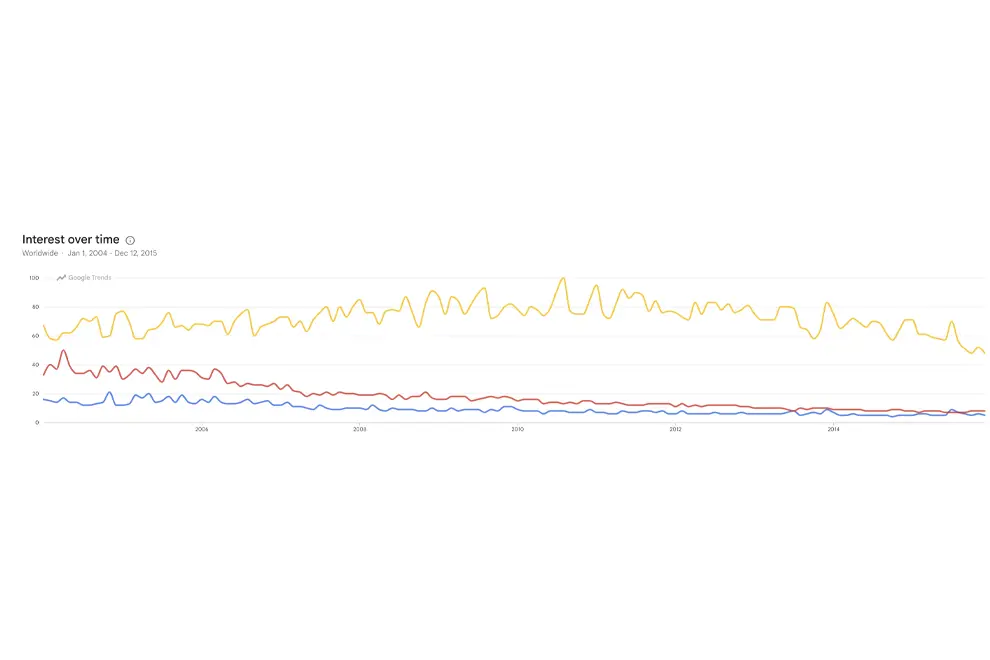
Google Trends searches for "song credits” (yellow) “liner notes” (red) and “album credits” (blue) between 20024 and 2015.
Between 2004 and 2015, there was a steady decline in searches for both "liner notes" and "album credits", with the former having been largely more popular than the latter.
However, this same time period also saw that "song credits" featured a relatively steady growth until it reached its peak of searches in August 2010. By comparison, "liner notes" reached its peak of 100 in April 2004, and "album credits" followed in November 2004.
These searches were relatively dormant for the majority of the past decade (though "song credits" remained more popular as general background noise), until June of 2025.
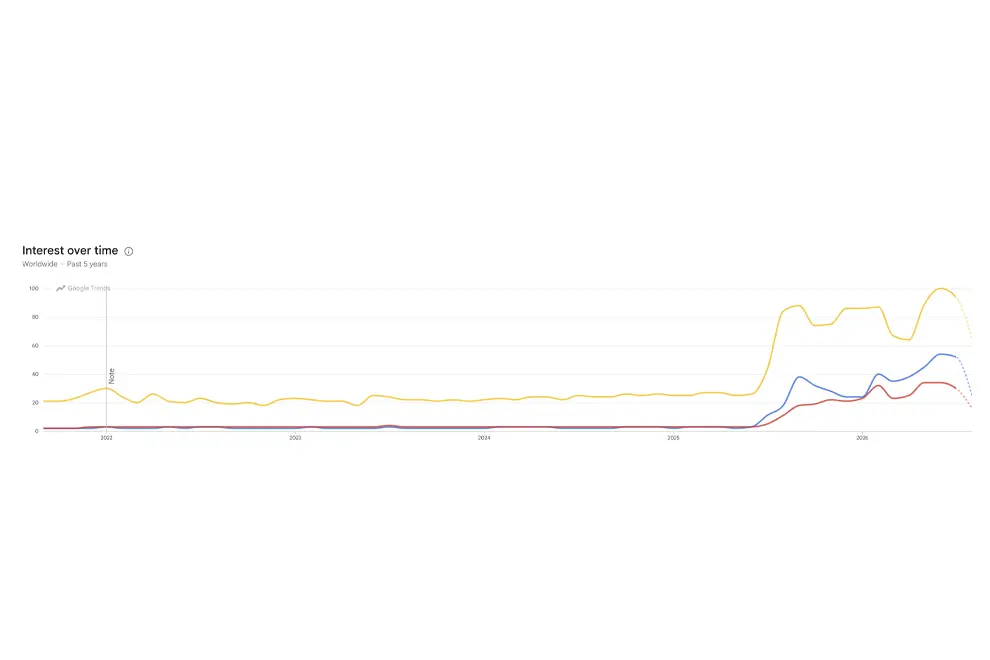
Google Trends searches for "song credits” (yellow) “liner notes” (red) and “album credits” (blue) over the past five years.
That was the point at which song credits lifted from its position of 26 on the scale to 43 the following month, and 88 by September. A few dips would follow, but it would jump right back up to a peak of 100 just two months ago in June.
By comparison, both "album credits" and "liner notes" found themselves at a position of 3 on the scale, before the former jumped to 38 in September 2025, and hit a peak of 54 in June 2026. "Liner notes" was a little bit different, having a slow rise until it hit 32 in February 2026, and dipped before a new peak of 34 in May 2026.
Could there be a rising demand for credits tracks on albums? Perhaps, but at the very least, it's clear that fans are showing interest in the folks behind the scenes on their favourite releases.
Could credits tracks become more popular as time goes by? Again, potentially. After all, they're relatively easy to make, they pad out an album's runtime, and they're effectively 'optional' in the grand scheme of listening to a record.
But what's clear is that fans are wanting to know who makes their favourite records possible, and as Sydney's Ratcat (who never made a credits track for their records, from what we can tell) once said, that ain't bad.