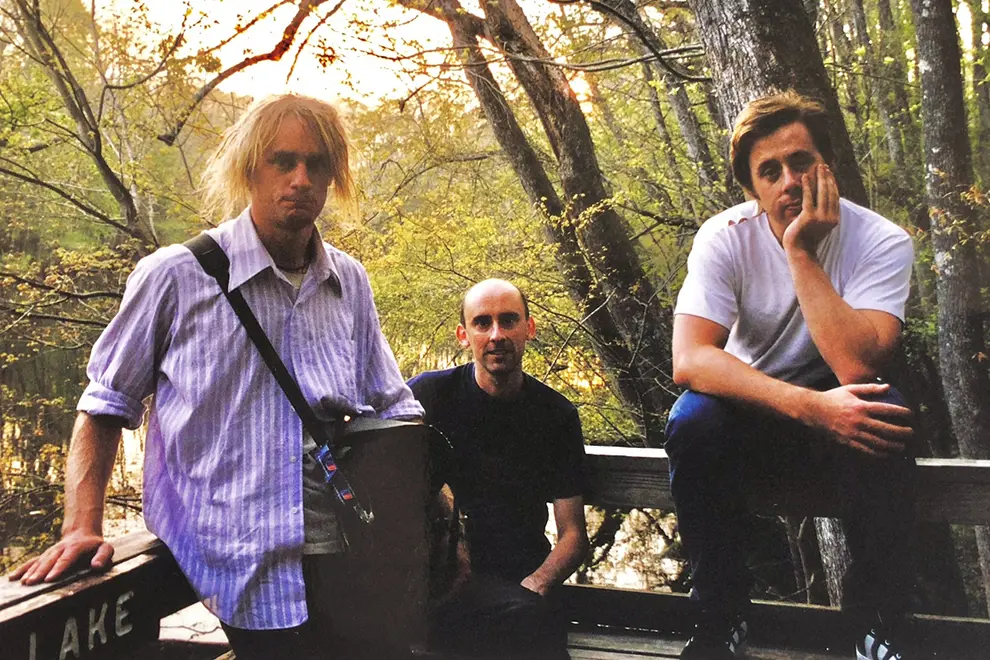
 Sandro Profile
On March 9th and 10th, 1996, Melbourne hosted its first Formula One Grand Prix. Months of angry protests led up to the cacophonous weekend, which culminated in a concert by John Farnham that brought another slew of noise complaints.
That same weekend, three friends hauled their gear into the Children’s Church of All Saints in Collingwood to make the quietest and most patient record they could. They had a handful of microphones, a few mates running leads and no plans to overdub.
A few kilometres away, cars screamed around Albert Park. When the band played the tapes back, you could hear the engines rumbling under the opening track, Racing Car Driver.
That album, Live By Rivers, came out that November on Candle Records and was reissued through Brass Companion a year later. It picked up admirers slowly, sold modestly and then, as was the case with most independent albums released in the mid-1990s, receded from view.
On November 6th, 30 years to the day after its release, Solar/Sonar is putting it out on vinyl for the first time, in an edition of 300 remastered by Mikey Young. Label head Tom Lyngcoln got a review copy in 1997, when he was editing a Hobart street-press paper. He says the record “has lived as a part of me ever since.”
Mark Monnone of The Lucksmiths was introduced to the band via proximity. His next-door neighbour was drummer Cameron Potts who, “would always be blasting his music through the wall,” Monnone says.
“Eventually I came over to sit on his bed and listen to some of his Midnight Oil records and talk about his favourite drummers. So, we were already friends and then my band started playing with his band.”
One day Potts played him a tape of a band called Milk Moustache. “I said, ‘What is this? This is great,’” Monnone remembers. Potts enthused about the band’s singer and songwriter, Gareth Edwards.
Later, Potts turned up with a new tape from the band. “He said, ‘We changed our name to Sandro, I’m on the drums, and we recorded this album in a big hall.’ I was just blown away. I was converted immediately.”
Recording in a big hall had been Potts’ idea. He worked as a cleaner at the Collingwood commission flats, where an old church doubled as a function hall. One afternoon, while mopping the floor, he began thinking about Cowboy Junkies’ The Trinity Session, recorded around a single microphone in a Toronto church.
He and Edwards had been looking for a way to strip their music back. “If we’re bringing it down to a screeching halt,” Potts remembers thinking, “maybe this could be a good place to do it. Put ourselves to the test.”
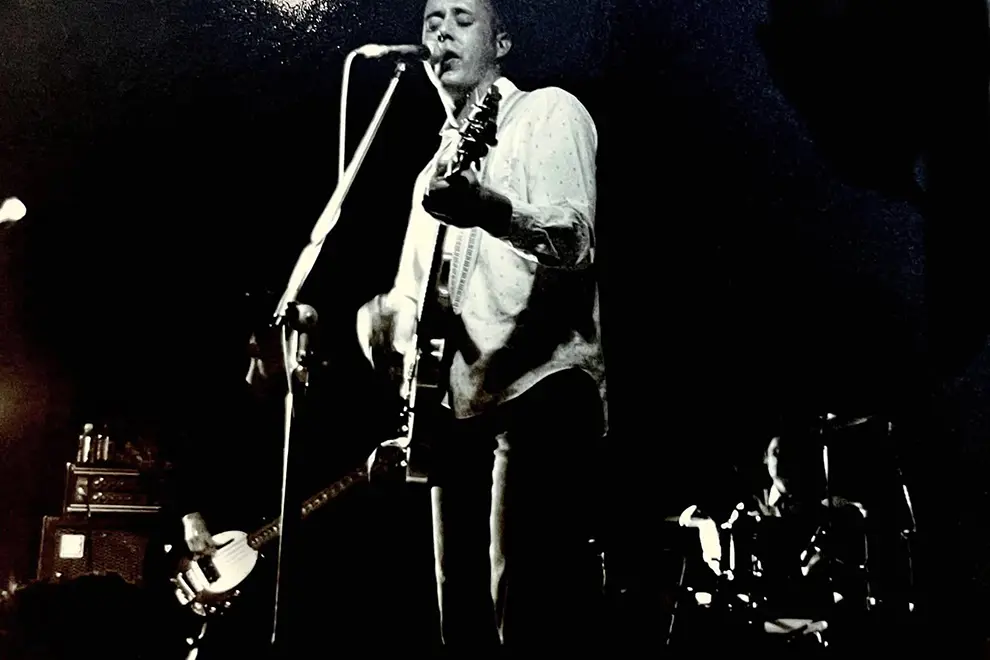
Sandro performing live. (Credit: Supplied)
Laura MacFarlane, who had played with Potts and Edwards in the Perth band Manic Pizza, remembers listening to The Trinity Session with them, along with other records that captured musicians playing together in a room.
“It seemed that Sandro were really trying to give that same depth to Live By Rivers,” she says. “And like some of those other recordings it feels so timeless.”
Edwards recalls early rehearsals with bassist Nick Carroll as “pretty loud, Sonic Youth kind of.” Tonight, now one of the album’s best songs, started life as “a jangly kind of pop song.”
Then they walked into the church. “As soon as we went in there and started playing, it was pretty obvious that it would be a good idea to take advantage of all this space.”
As anyone who has ever seen Potts play will tell you, he is a memorable drummer, typically extending the stick as far as possible from the drum to a theatrical degree before bringing it down, each hit filling his limbs with a joy his face cannot contain.
Playing with Sandro required a level of restraint he wasn’t sure he could manage, especially in a room whose reverberations returned every misjudged stroke and note.
“One little tap on the cymbal went everywhere,” he says. “I just played just below Gareth’s voice.”
You can hear that discipline across the whole album. The drums hang back, and everything bends around Edwards’ voice, which is pure even when his words are coarse, funny or mean.
When a guitar mistake slipped into The Villa’s Cursed, they kept it, because no other take sounded quite as strong.
Carroll, meanwhile, was pushing the band towards even greater restraint. “My memory of the way he approached it was to kind of create even more space than what we were trying to do,” Edwards says. “He had a lot of influence on the way things sounded.”
Potts and Edwards had grown up admiring Hüsker Dü, but where that band made a virtue of filling every available moment, Sandro were discovering what could happen when they left things out.
Carroll plays as little as he can get away with, letting notes ring until they become part of the room. There is tension in the arrangements, but it rarely comes from volume. The musicians sound as though they are waiting for one another, listening and responding.
As Potts says, “going into that church kind of made the band, I think, in some ways.”
The album they made sounds huge, a bit draughty, full of air. Listening to the raw recordings, Potts remembers thinking, “Fuck, this is fantastic.” Later, once the songs were collated onto a tape and tested on the car stereo, his hopes were confirmed: “Shit, this is actually good.’”
Making a record this quiet in Melbourne in 1996 was close to perverse. “Grunge was king,” Potts says. “We got pretty bored of seeing the same bands and hearing bands with the same sounds.”
Edwards had been listening to The Blue Nile’s A Walk Across The Rooftops and Uncle Tupelo’s Anodyne, then Red House Painters and Palace, whom Sandro would later support on tour, along with Bill Callahan’s Smog. He wanted to write songs that were emotionally direct, even if that was not an especially fashionable ambition.
MacFarlane first saw Sandro at the Corner Hotel late in 1996, after returning from Olympia where she had played drums with Sleater-Kinney. She had not seen Carroll, Potts or Edwards for a year or two, and the transformation surprised her.
Edwards still had his lyrical touch and immaculate guitar playing, Carroll’s bass wove perfectly underneath, and Potts played with what she calls “total feel”.
“It was beautiful music,” she says.
Watching them live, Monnone felt equal parts awe and terror. “I was in awe of Gareth, but I was scared of Nick.” As he tells it, Carroll’s stage attitude was: “‘Don’t mess with me. I’m the bass guy. Maybe I’ll do three whole notes in this whole song.’ The term badass hadn’t been invented at that point, but I thought this guy’s badass.”
And Potts? “The most flamboyant slowcore musician you could ever imagine.”
If you’re under 30, it’s hard to picture how far away Melbourne felt in 1996. Records from Olympia or Louisville turned up months late, if they turned up at all. In 1994, Woozy, the zine MacFarlane and Iain McIntyre ran for much of the decade, published an interview conducted by post with Perth zine editor David Gerard.
“Perth has a propensity for throwing up little bastard bands that aren’t quite like anything anywhere,” he wrote. “Because there is no effective market/industry, there is no point even trying to sell out … so bands develop in their own weird way. Then the weird little bastard bands cross-fertilise.”
Live By Rivers is what that cross-fertilisation sounds like. Everyone played in each other’s bands, recorded each other and moved between the same sharehouses, where, MacFarlane says, bands would practise and record. Sleater-Kinney’s first album was recorded in MacFarlane and Potts’ North Melbourne sharehouse.
Even Sandro’s US tour came out of a swap. Rhonda Simmonds of MacFarlane’s band ninetynine needed a recording, and Carroll agreed to make it if she booked them a tour instead of paying him.
The album credits read like a list of people who could have lived in the same sharehouse. It was engineered by Sandro’s live sound engineer Megan Jamieson, the late Paul Morris, and Carroll himself.
By Potts’ account, Jamieson was one of the first people in town to start a woman-only mixing collective, Decibelles. “She copped a lot of flak back then,” he says. “Guys going, ‘What are you doing? This is a man’s job.’”
He’s adamant the album only exists because the people behind the desk understood the band. “If we just got some lackeys in who didn’t know what they were doing, it wouldn’t have come out the way it did.”
Monnone became Sandro’s manager in much the same informal way. “I put up my hand. I was just like, ‘Do you guys need a hand with booking some shows or whatever?’ And they said, ‘Yes, please.’ And I said, ‘Oh.’” Monnone sounds crestfallen. “‘Oh, no. Okay.’”
He booked a handful of gigs and talked the band up to anyone who’d listen. “They called me their manager, but I don’t really know exactly what a manager does, because I’ve never had one,” he says.
“I was just a friend who was helping them out. I thought, ‘I know at least a few dozen people who would love this.’”
Show by show, more people came. “This is how it’s meant to be,” he remembers thinking. “This is a great band who is slowly building up this organic following.”
At least part of the appeal came from Edwards’ confessional lyrics. Songs on Live By Rivers are about breakups, regret and loneliness, but all shot through with a black humour.
“You’re the one/Who does it for me now/Drinking buddies, disco dancers/Let us shake it together/Shake it for me, one more time,” he sings over plaintive acoustic strumming on St Charles Song.
“We were all really quite close friends,” Edwards says. “It didn’t feel weird for us to sing about this stuff. People were a lot closer physically then. When you wanted to see someone, you went to their house or you spoke to someone on the phone, so we saw each other a lot and we just had really good friendships as a result.
"So me singing about the stuff I was singing about probably wasn’t all that surprising. Everyone was very emotionally naked around that time.”
In Melbourne at the time, the term ‘slowcore’ wasn’t regularly in use. “Whatever people put on it,” Potts says now, “that’s up to them.” Thirty years later, that label sticks to anything that takes its time.
Duster now pull more than three million monthly listeners on Spotify. The American record label Numero Group has built a healthy business resurrecting lost slowcore albums. When Perth band Bluetile Lounge reunited this year, they sold out the Brunswick Ballroom to a room full of fans, many of whom were born long after the band split up.
For a generation raised on algorithms, there is an intimate appeal to music made by friends, recorded by friends, in a room. Edwards says one of his adult children “actively seeks out music from the early to mid-’90s.” They have plenty of company.
Edwards, who now lives in Brisbane, says there won’t be a reunion. “It’d probably be too hard, like logistics-wise… It might be kind of a cool thing to do, but I just don’t know how we would pull that off.” He hasn’t heard the record yet because he doesn’t have a turntable.
Monnone swears he’s “not a nostalgic guy,” before immediately contradicting himself. “I just remember that as a beautiful time. That was the last beautiful time that I can remember experiencing.”
Sandro's Live By Rivers is reissued by Solar/Sonar on November 6th, with pre-orders available now.
This piece of content has been assisted by the Australian Government through Music Australia and Creative Australia, its arts funding and advisory body