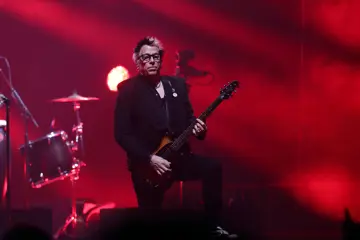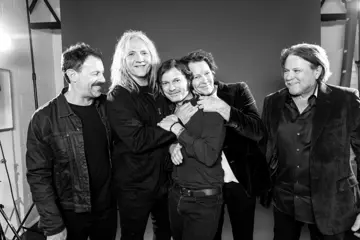
This year, the legendary British electronica supergroup Faithless will commemorate the 30th anniversary of their debut album Reverence, home to the iconic '90s rave anthems Salva Mea and Insomnia. Sister Bliss (aka Ayalah Bentovim) can't fathom it, either.
"It's awful, isn't it?" she laughs. "It makes you feel really like, 'Oh, my God…' It sort of sounds ridiculous to say it, amazing to say, there's been 30 years of a band. Most bands have a little moment, then they argue terribly, fall out, [and] never speak to each other again. So that says something – 'Tenacious buggers they were and the ones that held on to the bitter end!'"
Disinclined to capitalise on nostalgia, Bentovim maintains that "looking forward is important," even as Faithless fete the band's magnetic late frontman, Maxi Jazz (Maxwell Fraser). "We've got lots of new music, and I want to focus on that… I think there's a thing where you just keep looking backwards, keep looking backwards, and it's not healthy. We realise through losing our loved ones [that] life is short, and you lose people when you least expect to.
"What keeps you alive is creativity and not just yearning for past glories… I wouldn't go on tour if it was only old music. It would do my head in. I can't stand it!"
The mythic festival favourites are returning to Australia with a multi-dimensional live show for the first time since headlining 2011's stacked Good Vibrations on the back of 2025's album, Champion Sound – Fraser's voice sonorous on its preface, Forever Free. The East Coast dates are tipped to sell out.
"Blissy", as she goes by, is in London, taking a break from rehearsals at 9 am. Uncommonly for a musician, Bentovim logs onto Zoom early, joking about being "a Luddite" despite her evident studio prowess – all bookish glasses.
"I was just checking everything works, 'cause sometimes Zoom updates and you suddenly find yourself seconds before a meeting having to update the whole operating system." The chatty keyboardist pre-empts questions and digresses, magnanimous with stories and insights.
Faithless are mindful of the US-led assaults on Iran and the ensuing aviation chaos. "We've changed our flights about four times in order to avoid the war zone. It's been extremely stressful to even come. I've seen other artists cancelling shitloads of shows, 'cause they just can't get there."
Notably, the band have long aired anti-war protest songs like Mass Destruction, referencing the controversial Iraq War, off their first UK #1 LP No Roots. Bentovim, the daughter of Eastern European immigrants, decries that "we are riven with division."
A super-DJ in her own right, Bentovim has toured Australia solo. In late 2018, she DJed under the Faithless banner, culminating in an epic evening at Revolver Upstairs in Naarm/Melbourne. "It's an institution, isn't it?" Bentovim remarks. "I love that there's no gimmicks. I mean, the world of DJs and even bands has changed dramatically with the sort of huge pixel walls and CGI, and people really putting on extraordinary shows.
“[But] it's just a dark room; it doesn't even really have a strobe. It's just a dark, sweaty basement vibe in there where it is the music and the togetherness that takes priority. What can I say? That's a vibe. That's the vibe that we fell in love with the scene for – no tricks, no gimmicks, just great music, great people all night." She was back in 2023 for New Year's Eve.
Faithless had considered retiring from the circuit, but that DJ activity presaged their reunion – Bentovim & Co eventually reappeared at Glastonbury and gigging minus Fraser.
"We didn't really know at that point that we were gonna even play live again." But, DJing, Bentovim fully grasped how much goodwill there was for Faithless. "In 2024, we started to put together, weirdly enough, kind of from the grains of the DJ set, what a Faithless live show without Maxi could look like, that really honoured his life and his contribution to music – and to do it in a way that wasn't cheesy, was respectful; that wasn't sort of sentimental and mushy. But he was a powerful character."
Bentovim had also noticed that various acts were covering Faithless tunes, including Pete Tong and The Heritage Orchestra. "People would go absolutely nuts – and you kind of think, 'This is bananas that there's still love for this music,'" she says. "You just think, 'Well, other people are playing it live, that's semi-ridiculous, 'cause the band, we're all still here, apart from Maxi – perhaps we should have a go.'" They began to conceptualise a new incarnation – the process "extremely emotional" and "stressful."
Faithless' comeback at London's Roundhouse served as a memorial to Fraser (the group had previously headed 2010's iTunes Festival at the venue). "Loads of Maxi's friends came," Bentovim recollects. "It was an incredible atmosphere. Afterwards, my friend came up to me and said, 'I've never seen so many grown men cry…' So it was a heavy responsibility to make sure that translated in the right way, but was still a celebration for people to just come out and do what they've always done to Faithless – it's almost like soul-cleansing."
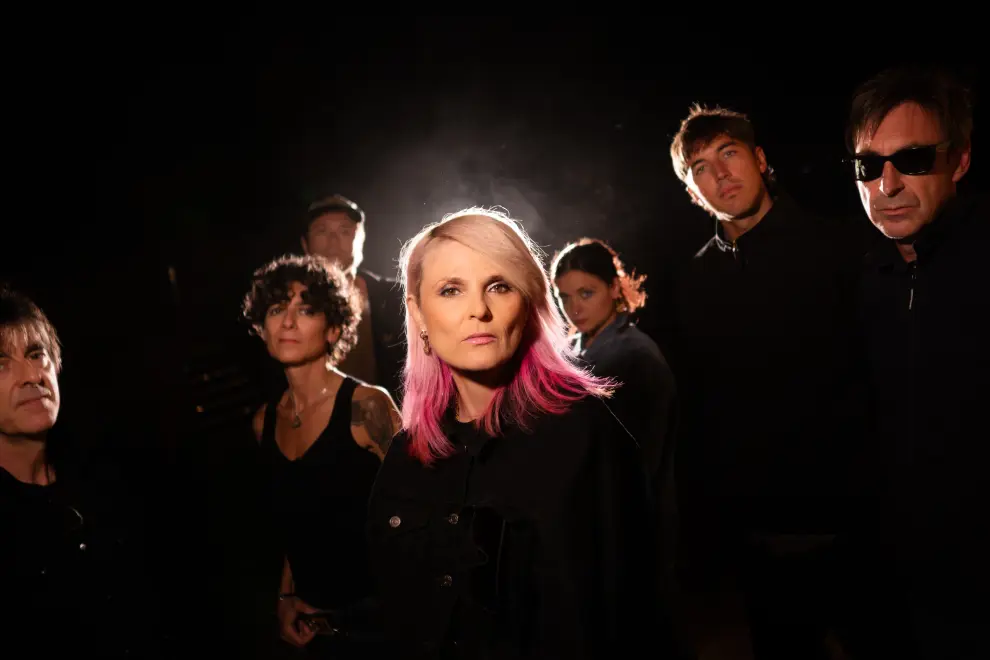
The new spectacular is no mere 'greatest hits' set. "We're bringing a seven-piece live band, and it traverses the Faithless classics and music from all eight studio albums – our most recent one being Champion Sound, which features Maxi's last-ever recorded vocal, which actually opens the show.
"But, yeah, we've just staggered out of rehearsals, I would say – fallen out of rehearsals! And it was such a great vibe to see everybody again, 'cause we haven't played for six months. We're bringing some fresh vibes to Oz, putting in some new music as well."
Faithless was formed in 1995 by Bentovim, an acid house DJ, multi-instrumentalist, and producer, and Rowland "Rollo" Armstrong, who was exclusively a studio member. They linked up with Fraser, who, active in the '80s hip-hop movement, emerged as their frontman, pioneering a neo-wave of spoken-word poetry.
He was entrusted with Faithless' socio-political messaging, which touched on topics such as war, displacement, injustice, capitalism, and spirituality. "Maxi was a hip-hop head," Bentovim explains. "It was just that British hip-hop, when he was making it, nobody gave a shit. But putting his lyrics in the context of electronic music, it unwittingly created something unusual – a kind of new hybrid."
Another co-founder was vocalist/musician Jamie Catto, who quit in 1999 to pursue his multimedia project 1 Giant Leap. Sonically, Faithless fused house, progressive, trance, dub, trip-hop and classical – their output enhanced by solid songcraft.
In 1996, Faithless released Reverence via Armstrong's Cheeky Records – "a total accident," according to Bentovim. "None of us had made an album before, so it was very free." Their second foray, 1998's Sunday 8pm, was trickier.
"When you get an audience, it becomes possibly less free – because you think, 'Well, what did they like the first time?' and then you're trying to anticipate giving them more of the same, but also pushing things forward. So it's always been a balance of the sound of Faithless – 'What is Faithless?'" The band surmounted that dilemma – Sunday 8pm, generating the banger God Is A DJ and nominated for the prestigious Mercury Prize.
They signed to a major label, Sony BMG, prior to album three, Outrospective. "In some ways, I think we're lucky; we didn't get pigeonholed in certain ways," Bentovim ponders. She acknowledges that many may perceive them as the electronic band behind Insomnia. "But people who've come with us on the journey over the last 30 years, they know that we've gone from reggae to opera to almost ambient music. I just hope it shows them, 'God, music – what a rich place.'"
Bentovim pauses to rhapsodise about ROSALÍA's theatrical performance alongside Björk at the BRIT Awards. "I am a massive fan of ROSALÍA – and what a wild, hybrid musical experience she has created. I love that. I mean, pushing the envelope – isn't that what it's all about?"
Faithless achieved fame but were never harassed by the UK tabloid press or paparazzi, unlike pop stars. "I feel like dance music escaped all of that scrutiny. Nobody followed me and Maxi around. We'd just get love. We'd walk in the street and [people would] go, 'Oh, it's him from 'Can't Get No Sleep'.' There was a very different energy around."
From the outset, Faithless' dynamics were those of a collective rather than a traditional band. "There's always been in Faithless other singers that are either a contrast or kind of complement to Maxi." In the studio, they've brought in guest vocalists such as Boy George and The Cure's Robert Smith and, on No Roots, sampled Nina Simone, while showcasing newcomers. Significantly, Faithless launched the career of Armstrong's sister Dido (he co-produced her hits Thank You and White Flag).
In 2016, Fraser left Faithless, 'passing the baton' to others as he introduced Maxi Jazz & The E-Type Boys. The band carried on, recording All Blessed, their first LP in 10 years, amid the COVID-19 pandemic, but were unable to tour to promote it. "So part of the decision of playing live again was actually we had a whole album where we never got to reimagine those songs live," Bentovim says.
When in 2022 Fraser passed from a longstanding illness, there was an outpouring of grief in the dance music scene and beyond. Bentovim lost a friend. How does she remember him?
"His energy is just with you all the time. I mean, my life is soundtracked by Maxi; by our conversations – not just the music we made, but conversations. I have a million anecdotes – 'cause it's like a marriage. It's like a long, long creative marriage – in a very dysfunctional family, I might add, but, you know, aren't all families? – and [that's] how we made sense of it through the music and our friendship, which existed outside of the band as well.
"He was just so curious about people and about life. He would sit down and talk to anyone. A lot of stars have a forcefield around them – like Maxi had this incredible charisma and incredible warmth. People all over the world would say, 'Oh, I met Maxi in Ibiza, just sitting in a bar.' He would have this remarkably non-judgmental attitude to humanity.
"He had an ultimate respect for life – I can't put it any other way. He was a practising Buddhist. [But] lots of things annoyed him – especially mosquitoes. He'd be saying, 'I know I'm a Buddhist, but mosquitoes, what is the point of them?' So, yeah, [he had] this very humorous kind of take on things. He would get very annoyed at the drop of a hat as well. There was plenty that would vex him, as we would say – a South London saying. But he put his energy into communication."
Bentovim most admired Fraser's groundedness and gift as a philosopher or interlocutor – recalling his humility and how he didn't "think of himself as some god walking around, bringing everyone together." He'd motivate, or "encourage", fans. "So he had this sort of generosity as a person and a generosity as a performer."
However, Fraser wasn't obviously didactic, and punters' cognition might not have been immediate at gigs. "A lot of people would come away, and they'd experience the lyrics later," Bentovim reasons. "They would suddenly connect with the deep message in what Maxi was saying."
She continues. "My experience of Maxi is so vast and varied, right to the very end – even to the last time I saw him, which was two weeks before he died. He was so full of life… He was funny. He had this unbelievably childish side – like his face would light up and I would see Maxi as a 10-year-old. And then sometimes he'd look like he'd been there forever – like he'd come from another planet; like he was a sort of wise old emperor… Yeah, some people light up from the inside – and I think Max was one of those people."
Last year, Faithless unveiled Champion Sound. Previewed in chapters, the album received strong reviews and entered the UK Top 20. The single Find A Way features conscious rapper Suli Breaks, with Dido gracing an alternative version. The most astonishing cameo? Bebe Rexha, "a bona fide pop star," on Dollars And Dimes.
"It was really exciting to have that on the album – people were being a bit like, 'Oh, Faithless, Bebe Rexha, that's a bit unusual,'" Bentovim admits. "But I think it's important to challenge people's expectations." As it happens, the Albanian-American singer has latterly sampled Insomnia for her single New Religion – "inspired by Maxi actually" – from an upcoming independent album, Dirty Blonde.
"She's been quite quiet of late recalibrating her whole kind of pop identity in a slightly crazy world – she's a very cool girl." Regardless, Bentovim is chuffed that, on Champion Sound, Rexha joins the same cast as leftfield Mancunian MC Antony Szmierek. "Isn't it amazing that Faithless can be a home for people from such different genres and still have the same underlying energy to what we're doing? I love making albums." She's grateful that, because of streaming, Champion Sound is constantly attracting new listeners.
Was there any notion of replacing Fraser as lead – especially with Leeds vocalist LSK (Leigh Kenny) in the fold since 2004? "No, absolutely not, no," Bentovim asserts. "We thought about it, and we talked about it, and we're just like, 'No – Maxi can only be Maxi.' Because of the technology that exists, we are able, with the blessing of his estate, to keep the songs that we made together in the set in a very specific and particular way."
It was suggested that Faithless use an avatar, influenced by ABBA's innovative virtual concert ABBA Voyage – which Bentovim deems fine for the sexagenarian and octogenarian Swedes but "ghoulish" in the case of the departed. "They make me feel sick!"
Today, Faithless' live vocalists are Amelia Fox and Nathan Ball. Armstrong initially collaborated with Fox, "a fantastic singer" who attended the same school as his son, for the downtempo side-project R Plus. Ball is a folktronica artist who's supported Ziggy Alberts. "He's got the most beautiful voice," Bentovim enthuses, "and, again, it's just been a joy to work with him."
Ball memorably first performed on the All Blessed single Synthesizer. "I think Rollo's working with him to help write some songs with him for his own album, and then asked if he wanted to write on these dance tracks – [as] he's almost more of a folk singer. And he goes, 'Oh, I love dance music.' So Nathan is absolutely wicked. He's also a brilliant DJ. Him and our new guitarist, Max "Rad" [Radford], are DJing with me at some [Australian] aftershows as well. It's gonna be like a Faithless onslaught!"
The group's mission is to "try and carry that torch" of Fraser, his presence felt. "But nobody is trying to recreate what Maxi did – and you just couldn't and you wouldn't. It would be the wrongest decision ever."
If anything, Bentovim envisages a novel arc for Faithless. "I hope that what we've done is also, as well as supporting our past, creating a future for the band." And, she confirms, more music is in the pipeline. "I'm in a creative purple patch at the moment. Maybe that's just because life is so mad. I'm just burying myself in the studio. But we have got a ton of new music coming. We're very excited and very inspired."
Marking their 20th anniversary in 2015, Faithless curated a remix compilation, Faithless 2.0 – Avicii remixing Insomnia at his peak. Yet, again, they have no intention of replicating that for the 30th anniversary, Bentovim stresses.
In November, Faithless did release Disclosure's Insomnia edit, which brothers Guy and Howard Lawrence had dropped as a "tribute" at 2024's Glastonbury, leaving Bentovim "totally surprised."
"I was like, 'Well, why don't we see if Disclosure would be up for putting out that Glastonbury edit?' – because you could just see how mad people went. It was almost like a viral moment, anyway." Aside from that, the band offered an exclusive zoetrope vinyl edition of Insomnia ("I haven't even got a copy, they sold out so quickly"). But that's it. "The 30 years of Insomnia was kind of celebrated. I think it's enough, really. You can't just sit there and rinse things again and again and again."
In 2026, Bentovim is among the highest-profile women in EDM. But, while declaring that "the problem is the [music] industry's rife with misogyny and ageism," she has had predominantly positive encounters in dance, which, though less ageist than popdom, still has gender disparities.
"I only have my experience to go on, which is I have a great time, nobody's fucked with me – and they wouldn't. I've had great working relationships with male colleagues. I've not had equal pay, which I have spoken out about before – you know, this was about 20 years ago, and I found out, even when Insomnia was a global hit, I was paid less than my male counterparts, and this is as a DJ.
“But, as you're all kind of freelance, there's no transparency about wage structures. It's like you used to get a bit of cash in an envelope and some weed, and you're like, 'Fuck me, I'm happy with this – I'm getting to play music to people.' It wasn't the great aspirational career that it is now."
Bentovim is appalled at recent allegations of sexual assault by DJs in the hard techno – or hardcore – scene (she asks quizzically, "What genre is 'hard techno'?").
"I'm reading horrible articles about people getting their drinks spiked; sexual assaults," she rues. "A bunch of guys are being called out on their sexual abuse of women. It's not pretty, but life's not pretty – you're gonna find rotten apples in certain places. But that's also part of a wider trend of patriarchal attitudes. We have to learn, we have to treat each other with respect, we have to educate boys about how to be around women, especially while the kind of manosphere is wielding this influence, which is somehow really reaching boys."
The early rave subculture was a sanctuary. "I just can't sit there and demonise the whole dance scene – that's not my experience," she reiterates. "In my career, I would say I've met with 99.9 per cent respect – and I'm really lucky. That's not to say I haven't encountered violence as a woman from men, but that's not been inside the scene."
Bentovim welcomes that, post-#MeToo, women now have a platform to expose toxic masculinity in EDM. "I think the fact that women feel they can speak out and they can use social media to call this stuff out – that's powerful." She praises Belgian techno DJ Amelie Lens for sharing "her own experience of bro culture."
"That kind of bro, muscly, steroid-y, disrespectful culture – that's nothing to do with house music," Bentovim states. "That's not the church of acceptance that I fell in love with – and it's not my experience when I go out and [in] the places that I play, which are, I must say, multi-generational. They're not just old farts from my era. I see people who're like, 'Oh, my mum and dad love Faithless, you're so cool.' I'm like, 'Fuck, this is wonderful.'
“So, I would say the scene is – and maybe I'm walking around with rose-coloured spectacles – incredibly inclusive, as you say, probably more so than hip-hop and pop music." But there's work to do. "Behind the scenes, a different story – not enough women, not enough women CEOs, not enough female managers, not enough women on the line-ups and so on. Yeah, we've got a diversity problem, but it's a conversation that it certainly wasn't 20 years ago."
Australian EDM superstar Alison Wonderland has opened up about how an associate discouraged her from starting a family (she fired him) – and Bentovim is empathetic. Back in 2006, she toured with her baby son, Nate, his birth prompting the title of the album To All New Arrivals. "It could be done if you've got money; it could be done if you can pay someone to look after your child while you're on stage…"
Bentovim decided to try for a child during a hiatus. "I thought it was a miracle. I got pregnant very quickly, which I didn't expect at all. God knows why, but a life of raving makes you think your body isn't really necessarily fit to carry a child. But I was very lucky and had a pretty trouble-free pregnancy. And I took Nate on the road with me when he was six-months-old."
"I didn't have a baby so I couldn't be with him. I had a baby, so I could bring him up and be his mum. [But] being a self-employed touring musician with all that kind of financial instability and never knowing what's coming next – that's a very hard environment to be in. Also, you wanna have fun. You can't have fun when you've got a baby there.
"I didn't enjoy some of the early bits of touring, because I'd never employed anyone before as well. My nanny kind of wanted to go off with the band and do stuff and go out to clubs… I'd be like, 'That's OK, that's OK, you go off and do whatever', and I would be sitting in the hotel room on a day off with him, going to bed at seven o'clock in the evening."
Bentovim ended up raising Nate as a single parent after splitting from her partner, who relocated abroad. "That was really difficult." Juggling a vocation and parenthood proved an ongoing logistical test. "You feel a great push-and-pull; you feel guilt because of society's expectations and all the rest of it."
In fact, Bentovim had two offspring – "the other baby" being Faithless. "It is huge – it occupies a lot of mental space, as does my son, so it's fucking nuts. But I never sat there and complained about it. I never really talked to the media about it. You just get on with it." Fortuitously, she had a support network. "My manager was amazing. He showed us how to use the carseat – 'How do you get this bloody thing in?' He's like, 'Look, Blissy, you've got it the wrong way around.'" Nate is currently studying film at college and has worked for Faithless.
In a polarised climate, Faithless' progressive values are as relevant as ever. But isn't it idealistic to imagine that music can unite people, let alone change the world?
"Yes – but if we don't have ideals, what are we?" Bentovim responds. "Who are we? If we don't have some kind of ideal that there is a better way to be and to treat each other, you know, kindness is everything; mutual understanding, self-love, which sounds like a self-help manual banal quote, but it's not.
“It's a really profound thing when you start to like yourself – and that's when you won't tolerate people spiking your drinks or belittling you. It's a powerful place to be; to sort of stand in your own power. And that doesn't mean you have to be a brute with it. It means you recognise something in yourself and you can share it with others and bring people up with you. I think that was Maxi's legacy."
Faithless tour across Australia this month. Last-minute tickets are available on the Untitled Group website.
This article mentions sexual assault allegations. If you or someone you know is affected by these experiences and needs to contact someone, please contact 1800RESPECT on 1800 737 732 or visit 1800RESPECT.org.au.
FAITHLESS
AUSTRALIA AND NEW ZEALAND 2026 TOUR
Special guests to be announced
Friday 13 March - Hordern Pavilion, Sydney, NSW
Saturday 14 March - PICA, Melbourne, VIC
Tuesday 17 March - The Tivoli, Brisbane, QLD | SOLD OUT
Wednesday 18 March - The Tivoli, Brisbane, QLD | NEW SHOW
Saturday 21 March - Synthony Festival, Auckland, NZ
Tickets and info from synthony.com