Record fairs are common enough in Melbourne. Much less common is something like the Independent Music Exchange, a two-day market focused on Australian indie labels. After debuting in 2023 as part of The Eighty-Six Festival, IME is returning for a second outing across June 6 and 7 at Northcote Town Hall, presented in part by the Victorian Music Development Office (VMDO).
While it remains free and open to all ages, IME is expanding its educational slate this time, with panels and workshops thriving along with a curated online music broadcast via Skylab Radio. And that’s on top of the central marketplace aspect, which will see label owners offer their wares directly to fans.
That means not just a slew of cool vinyl and shirts, but test pressings, signed merch and other rarities.
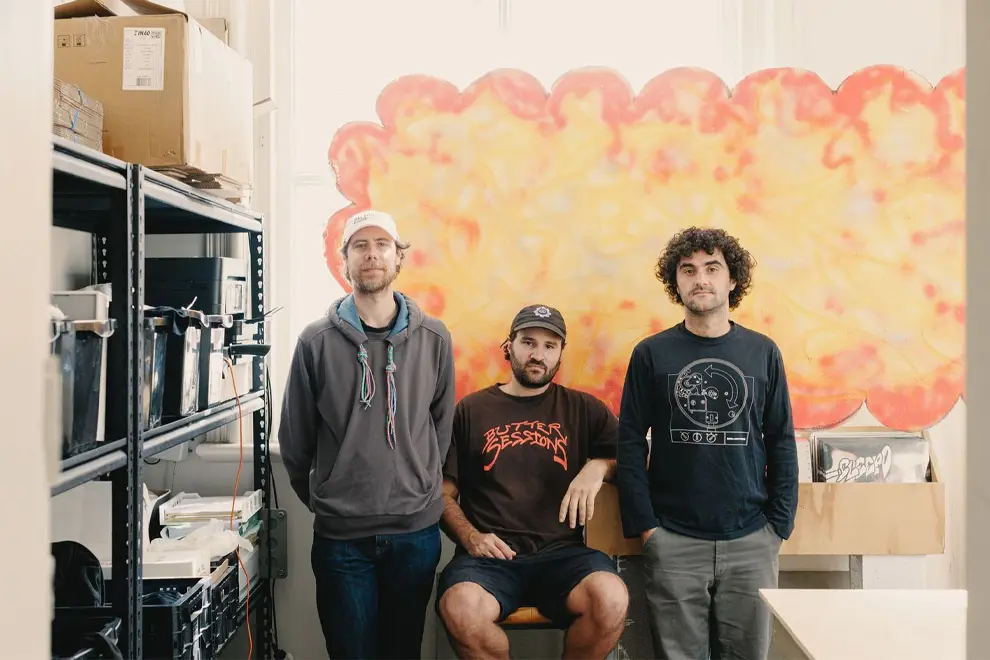
The brainchild of Butter Sessions owners Maryos Syawish and Corey Kikos – who also comprise the popular electronic duo Sleep D – and Efficient Space founder Michael Kucyk, IME is showcasing more than 50 labels this year, including Blossom Rot, Dot Dash, NLV, Chapter, Domino, and Impressed.
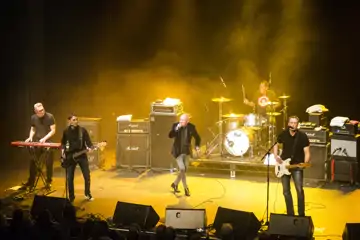
Eddy Current Suppression Ring will even have their in-house label Suppression Records – and they’ve got a brand new album that just dropped by surprise.
As for the panels, Ethan Holben from Audience Strategies – who delivered last December’s high-profile VMDO report on Melbourne’s vinyl ecosystem – will sit down with several label owners on the Saturday for “How to Run an Indie Label”. A couple hours later, ethnomusicologist and musician Isobel D’Cruz Barnes will host a panel called “Platforming Underrepresented Voices”.
On the Sunday, Adrian Sherwood – founder of the respected English dub label On-U Sound – will appear in conversation as part of the Rising program, before My Golden Friend founder Lorrae McKenna hosts a panel with other label owners around “Taking Independent Music Overseas”. All of these talks are free, with no RSVP required.
Ahead of IME, we asked four Victorian label owners about the challenges and triumphs of running an independent label in 2026, from streaming and shipping to the importance of physical media. And most crucially: their advice for new labels.
The Role Of Labels Today
For many decades, a record label was something you could rely on as an official stamp of quality. That was as true of classic soul labels like Motown and Stax as it was for 1990s indie rock labels like Sub Pop and Matador.
But the centralised nature of most streaming services (apart from label-focused ones like Bandcamp and Subvert.fm) can make it harder for that degree of loyalty to exist in 2026. So do listeners still recognise and follow specific labels?
“I can tell you firsthand that they do,” says IME co-founder Michael Kucyk, who also runs the label Efficient Space and has a strong background in community radio. “I see the same customer names coming through our webstore orders time and time again.
“Careful curation is a big part of what we do … I think people recognise that and have faith in taking a punt on the new artists we’re spotlighting.”
Andrew Hayden from Poison City – a long-running Melbourne record store and label that’s been home to everyone from Camp Cope and Body Type to Cable Ties and Leah Senior – still sees the spirit of discovery driving fans to really follow the labels they love.
“I often reflect back to my formative years of discovering specific record labels that you begin to really dig and trust their catalogue and direction,” says Hayden. “For me that was labels like AuGoGo, Dischord, Creation, 4AD, SST.
“I’ve always wanted Poison City to be one of those labels that isn’t defined by a specific sound, but a diverse music community that moves and evolves along our journey.”
Again, it’s all about discovery. That might mean falling in love with a certain band and finding out which bands they play with – or are inspired by. And that includes learning what label they’re on, and what other bands are also on there.
“I think a lot of music fans like to put music in context, and a label helps provide that musical context,” says Lachlan Stuckey, who co-founded the prolific Coburg-based label College of Knowledge with his Surprise Chef bandmate Jethro Curtin.
“Connecting the dots between different artists and records helps support a deeper understanding and consequently a deeper connection with the music.”
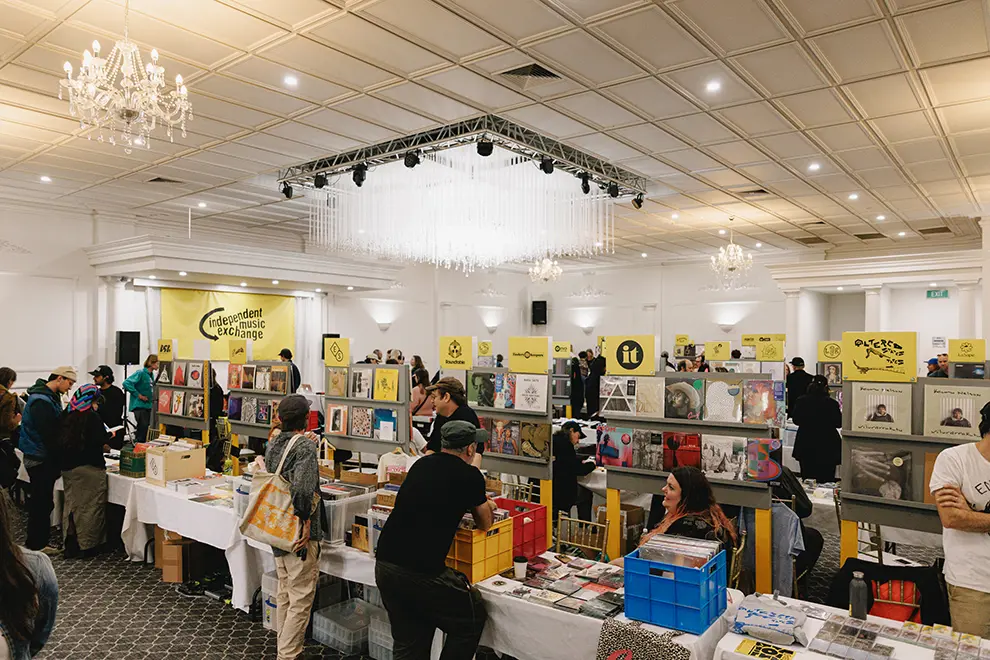
Independent Music Exchange 2022. Credit: Chip Mooney.
Logistical Hurdles
It should come as no surprise that for independent labels that make the bulk of their income from physical media, costs like vinyl pressing and shipping are constant concerns. Joe Alexander, who co-founded the labels Bedroom Suck and Music In Exile, points to high postage costs and pesky customs forms when posting orders to America.
Kucyk echoes sentiments, pointing to skyrocketing international freight prices due to the war in Iran and other global developments – not to mention the sheer difficulty of maintaining an international presence when Australia is so far away from so many other countries.
As pressing plants in Europe become more cost-prohibitive, however, Australia seen several plants open up here for the first time, including Program, Zenith, and Suitcase.
As Hayden explains: “It’s nice to be pressing with Program, where we can pop down the road to discuss jobs, chat through options and pick up stock the day it’s ready – rather than [deal with] international time differences, crazy high freight costs [and] import duties and potential for stock damages along the way.”
Both Hayden and Stuckey lament the necessary evil – and total time suck – of navigating social media and large-scale streaming services. “Take me back to the days of photocopied flyers and mail-order catalogues in the post,” says Hayden with a laugh.
“It’s difficult to navigate music in an increasingly digital world,” adds Stuckey. “Social media and digital marketing are more complex than ever, and best practices are constantly changing. Trying to jump through the hoops of the internet is one of many struggles.”
Yet he admits that streaming has helped College Of Knowledge bands to secure more of a global audience.
That’s no such much the case for Efficient Space, which is largely a reissue label. “The streaming economy doesn’t really serve us,” says Kucyk. “We’re often reintroducing unknown or overlooked artists with no touring activity or social media presence to entice editorial support.
“I think that’s a systemic farce. Good music should be supported regardless of stats.”
The Power Of Community
But all hope is not lost. As the first Independent Music Exchange proved in 2023, there’s a strong audience in Melbourne (and beyond) for fostering musical community and buying records directly from Australian indie labels. That also includes this wide constellation of labels supporting each other, both in spirit and via record trades.
“[It] was really nice to be in the same room as so many independent labels, [with] lots of trading of stories and records across the tables,” Alexander recounts. “It’s always great to see what everyone is working on.”
Hayden has similar memories of the first instalment: “To me it demonstrated the wonderful array of independent/DIY labels that exist in our music-loving city, away from the majors [and] mainstream music world.”
“We expected it to be a standard record fair kind of scene,” adds Stuckey, “but it was way cooler. Running a record label can be a solitary pursuit at times, and the IME was a rare opportunity to hang out with other people who also walk this funky path.”
As one of IME’s co-founders, Kucyk has especially strong memories from 2023. “It genuinely felt like we’d engaged a community often overlooked by more conventional music conferences,” he says. “I blasted the Skylab radio archive of label-head selections for months afterwards and even ended up taking on distribution for new friends La Sape.
“I still recall the thrill of Fetus Productions buying a few CDs from our stall neighbour It Records, while our photographer Karl Halliday still talks about being able to casually buy HTRK gear directly from the source.”
Long Live Physical Media
Vinyl remains the lifeblood of most modern indie labels, despite the costs of pressing and shipping the format.
The resurgent interest in proper records – including colourful varieties of pressings and more eco-friendly alternatives to packaging, both of which have been espoused by bands like King Gizzard & The Lizard Wizard – has helped to connect the dots between live gigs, DJ sets, record stores, and listening at home.
“Wax has always been at the centre of what we do,” confirms Stuckey. “We are usually thinking about things through the lens of a record store experience.”
“We’re very much physical-first,” adds Kucyk, “and a number of releases have gone into multiple represses, with some now reaching sixth pressings. Merch works too, provided you don’t overdo it.”
“Like most independent labels that have been around since early 2000s,” says Hayden, “Poison City has mostly relied on physical LPs, CDs, T-shirts, etc. I can appreciate the wider appeal and ease of listening to music digitally, but that’s never been our priority.
“A physical record still holds more meaning and offers a deeper connection to music and art, in my mind.”
Both Poison City and Efficient Space still manufacture and sell CDs too, albeit in more modest quantities. Whether or not that format comes to enjoy a renewal in line with the vinyl revival, CDs definitely offer a convenience angle that exists in squarely in between the careful ritual of vinyl and the relative ease of streaming.
“We haven’t really had much luck with CDs,” notes Alexander, “but I know the heads are out there. A lot of folks [are] still rocking CDs in the car, me included.”
Wisdom For Future Labels
Given the collected experience of these indie label heads, what advice would they give to someone starting a label today?
“Artistic integrity,” says Alexander. “Just really believe in what you are doing and put care and effort into it. It’s a labour of love, so you may as well love the process [and] the outcome. Love the people too: they are the best part about it.”
“Start out as a hobby and build things slowly before diving in too deep,” offers Hayden. “I think building up a creative community around your label is paramount: putting on local shows, helping out interstate [or] international bands [and] working with local venues, artists [and] festivals really helps growing your audience and interest in the music you’re releasing.”
That slow, careful build is also the advice of Kucyk: “Start small. I often see new labels over-press their first release, glamoured by the economies of scale that come with a run of 500. It’s not actually that economical when you’re stuck with 200 copies under your bed for years.”
As for Stuckey, he doubles down on the wisdom tip. “Talk to your elders,” he says. “Most of the time they have the answers and are down to help. The music industry is often opaque and overwhelming, and your peers are your best support.”
The Independent Music Exchange runs 10am-5pm June 6 and 7 at Northcote Town Hall. Full details are available via the IME’s website.
This piece of content has been assisted by the Australian Government through Music Australia and Creative Australia, its arts funding and advisory body