gaga: five foot two

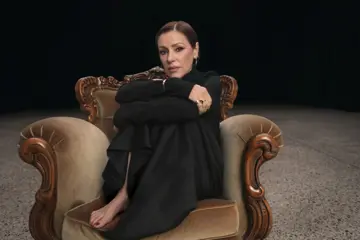
“You can use none of that footage,” says the titular subject of Gaga: Five Foot Two, to the camera, mid-movie. Lady Gaga has just been sitting on a Los Angeles curb, smoking, talking candidly to a drinking-buddy about being a woman in music, and the dynamic between the male super-producer and the female singer, and how this echoes power relationships between genders. She’s talked about Madonna, who once dismissed her as a “reductive” imitator; and the spectre of Amy Winehouse arises when talk turns to people destroyed by fame, though Gaga can’t bring herself to say her name aloud.
The fact that the footage made it to the film is suggestive of a greater ideal, likely endorsed by its star: that, in its collection of offhand, unguarded moments, Five Foot Two is a shrine to truth. Here, the subject is exposed, sometimes quite literally: we see her in a fashion-planning meeting that’s taken topless and poolside; changing in and out of costumes; laid out on a massage table. We also see her in pain, with a degenerative hip condition that requires much recurring treatment. Gaga spends much of the film in tears; though, for every cry, there’s a hug in waiting.
It’s a warts-and-all portrait of her life, rattling from moments of Osbournian domesticity to scenes of chaotic, centre-of-a-storm celebrity. This observationist portrait of a wildly-famous artist-at-work can easily be traced back to Madonna’s Truth Or Dare/In Bed With Madonna. Only, gladly, it isn’t reductive.
For the cynical, Five Foot Two could be seen as simple publicity: it’s produced by Live Nation, who’re clearly hoping it can help juice concert-ticket sales, and even the keeping-it-real aesthetic feels like cross-promotion for her 2016 LP Joanne, in which the singer offered a rebranding big on sincerity. Scenes of simple emotional profundity —Gaga plays her grandmother tearjerker written about gran’s tragic past; a fan wins a meet-Gaga competition, and both artist and acolyte end up crying— can feel a little bit stage-managed, here to show that the woman most famous for the ‘meat dress’ has turned a conceptual corner; is making something more emotional, more human.
But director Chris Moukarbel announces his own artistic ambitions with the opening shot of Gaga: Five Foot Two, where a pair of bedazzled, knee-high boots hang in the air, like a mysterious object. Eventually they lift up, skyward, soaring towards the rafters of a stadium. As well as the many behind-the-scenes moments —meals, meetings, rehearsals, recording sessions, workouts, denting the bumper of Mark Ronson’s car, having “a little baby meltdown” on set of American Horror Story— Moukarbel recurringly turns to scenes of pure lyricism; as in an amazing slow-motion baptism, gathered family clad in Catholic kitsch, the neo-retro sounds of Richard Swift on the score. When Five Foot Two stages purely-cinematic sequences, it’s rare that Lady Gaga herself is heard playing; instead, there’s great song-placements for Colin Stetson and Anna Meredith.
Befitting its fly-on-the-wall brief, there’s no voice-over, no imposed narrative, no explanation of who this person is, any need to make a capsule of their career. It’s a film that dwells almost entirely in the present, save for an inspired moment in which Gaga’s giddy history of gaudy costumery is shown, in but a blink. As she walks, in the present, from a door to a limo, through a teeming mass of fans, Moukarbel delivers bursts of rapid-fire montage, showing countless previous walks-of-fame, through years of braying crowds, where she’s clad in all manner of ridiculous outfits.
Five Foot Two is about the relationship between that past and this present, between the caricature that a singer created and the human beneath. There’s another great montage where the voices of endless interviewers are turned into an aggressive din, and the repetition of Q&A answers leads to one word being spoken ad infinitum: “personal”.
It’s a word —and a sentiment— that means everything and nothing. Moukarbel was a visual artist before turning to documentaries; his prior two pictures, Me At The Zoo and Banksy Does New York, chronicling weird intersections of the internet, celebrity, art, and mobilising mobs both online and off. So, here, he’s happy in the intersection between fame and the mundane, walking over the collapsing boundaries between art and life, performance and being-present, narrative-fashioning and observationist documentation.
His film, in turn, is both myth-making and myth-deflating; celebrity unfathomable validation en global masse, yet also a glass prison of existential loneliness. Five Foot Two, in turn, can’t be dismissed as cynical promotional exercise just as it can’t be purely praised as work of therapeutic revelation, because it’s both those things at once; a film that’s interested in multiplicity, not reduction.
the go-betweens: right here

In a 2015 interview, Robert Forster told me that, instead of the standard rockumentary, he hoped a fictional film be made about The Go-Betweens, the cult indie act he formed in Brisbane in 1977. “I’d prefer a filmmaker —maybe Richard Linklater, who did Boyhood— to come in and make the story of us as a band,” Forster said, dreaming out loud. “I’d prefer Benedict Cumberbatch to be playing me in a film rather than just be making another documentary where the band sits around and talks about what happened.”
Who knows if Forster’s dreams will ever come to life. Perhaps, someone will take his duly-lyrical memoir, Grant & I, as prime source-text for a feature film. But, those dreams will have to wait. Here, now, in their stead, is what Forster feared: Another documentary where the band sits around and talks about what happened.
Behind the camera on The Go-Betweens: Right Here is Kriv Stenders, who directed the band’s Streets Of Your Town video in 1988, and, in this century, has tended to a wildly-uneven film career, highlighted by the commercial success of his Red Dog movies. Stenders approaches the prospect of documenting the Go-Betweens with nary a note of formal inspiration. Instead, he fits their narrative, and their music, into the most-formatted of formats.
There’s talking-heads, archival photos, music videos, old interviews. There’s origin stories, old memories, tales of drug use and band beefs. There’s, endlessly, people telling you why the music was so great, rather than just sitting back and listening to it. When the film opens with Cattle & Cane, you’re ready to fall under The Go-Betweens’ spell. Instead, their history is spelt out. There’s much talk of how the band’s music was idiosyncratic and unusual, how they never fit into a neat package. And, yet, here the band are packaged in the most predictable, familiar, and conservative cinematic format: the history-of-a-cult-band rockumentary.
In his wry essay collection Censorship Now!!, Ian F. Svenonius (himself an underground-rock cult-hero) mocks the rockumentary as a “desperate advertisement”, out not to just burnish legacy, but to sell an old product to a new audience. All the talking-head explication and storytelling simplification, therein, is out to communicate to those who missed out at the time; the people who’d never go find their own scenes, their own stories, their own avatars of on-the-ground, in-the-moment revolution.
These films, essentially, seek to turn an uncommercial entity into a commercially-viable one. Much conversation, in Right Here, dives into why The Go-Betweens, this band who wrote such great pop-songs, never had a hit. That seems, to me, the least interesting theme that could be addressed; and, sadly, it’s addressed via what’s becoming the least-interesting of all cinematic sub-genres.
beatriz at dinner
American society is growing increasingly stratified, with the haves and have-nots so divided they rarely meet. In a simple dramatic device, screenwriter Mike White and director Miguel Arteta (who’ve previously collaborated on the early-’00s indies Chuck & Buck and The Good Girl, and White’s incredible TV series Enlightened) give us Salma Hayek’s titular character, a new-age therapist who’s a long-time visitor to the palatial mansion of Connie Britton and David Warshofsky. When her car breaks down right before a dinner-party, Britton invites her to say; throwing a spanner into the carefully-planned works.
The dinner —populated by Amy Landecker, Jay Duplass, Chloë Sevigny, and John Early— revolves around John Lithgow’s billionaire tycoon: a real estate developer, smarmy raconteur, and proud jerk. He sees anyone beneath him as being but a peon, looking at others with a smirking condescension that suggests his old-white-male entitlement, the thoughts or rights or feelings of anyone else a kind of trivial bemusement. It’s when Lithgow’s boasting of shooting a rhino, on an African safari, that Hayek —a lover of animals, a humanist, a healer— snaps. The two, invariably, end up in a standoff: screenwritten symbols (the Trumpian plutocrat, the Mexican immigrant) given complexity and life by a pair of fine performances.
White’s script is essentially a social satire, but it’s not beholden to, say, its wry portrait of the lifestyles of the fabulously wealthy. In some ways, it plays better as tragicomedy, with Lithgow playing a figure whom deserves comeuppance, yet seems unlikely to get it. White knows how to mix empathy, comedy, cruelty, and pathos; the tone, here, often feels like Enlightened, with the details just as pleasingly strange and dramatically unafraid. It’s a small film: just 82 minutes, 1 location, and a single idea. But White and Arteta know what they want to say, and get there with economy and grace.
the belko experiment
How’s it possible to make a satirical film minus any satire? The Belko Experiment is a horror film set in an office, in which the workers are —by some anonymous, distant bosses— set against each other in a kill-or-be-killed Battle Royale. The premise makes it sound like a critique of corporate culture: the rapacious nature of capitalism, the inhuman practices of corporations, the cut-throat nature of office politics, the fatal culls of ‘downsizing’.
Except, there’s barely a note of satire herein. Writer/producer James Gunn (yes, the Guardians Of The Galaxy guy) seemingly chooses an office building —and one in the remote outskirts of Bogotá, at that— as only a self-contained location, not as any great symbol. When descending metal walls around the building turn the office into a prison, the employees are instructed to start killing each other, or be killed. And, minus any real social commentary, what’s left is just the killing: following the horror-movie brief of picking people off, starting on the fringes of the cast, and then working their way up.
Director Greg McLean (yes, the Wolf Creek guy) treats the film as an excuse to stage an ongoing parade of bloody deaths. Often these are played for laughs, though suggesting that there’s any humour at play is being too kind. McLean seems excited at coming up with inventive ways to off his luckless office workers, but only the most ardent splatter-fan with the lowest of expectations would share that excitement. If some of that invention were applied to the actual screenplay, maybe we’d be getting somewhere. As it is, The Belko Experiment is one minor idea, cheaply done; barely having the juice to make it to 88 minutes.
mountain

Last time we saw Jennifer Peedom, she was finding cinematic magic up a mountain. Her 2015 film Sherpa was a workplace-dispute documentary set on Everest; in which the events she chronicled —the mobilising of the local Sherpa for better pay and conditions— spoke of greater themes of colonialism. Here, Peedom returns to the highest heights, for a more abstract, artier, and, ultimately, less-meaningful work.
Mountain is a host of incredible visuals in service of a vaguely-defined theme. Willem Dafoe’s narration speaks poetic homilies aloud (“the mountains we climb are not made only of rock and ice, but also of dreams and desire”), but matching his gravely-intoned words to scenic shots of icy peaks doesn’t amount to much.
Gladly, Peedom doesn’t just stop there, setting out to both capture and crowdsource amazing at-altitude images; Mountain finding its calling not as it gazes romantically upward, but as it watches on at extreme-sports types going to extremes daredevil, death-defying, and ridiculous. This gives Mountain a shot of energy; helping the slight idea make its way to a 70-minute running time. But it also means that, at essence, this is an art-movie riff on those old Warren Miller movies.
the dancer
The Dancer has spectacle on its side. It’s a period-piece epic on a big enough budget to allow for grandeur; debutant director Stéphanie di Giustio bringing to screen a dramatic biopic, full of flights of fantasy, in both the storytelling and the direction. It’s based, loosely, on the life of Loïe Fuller; which means that it has all the familiar hallmarks of the awards-season biopic. Yet, The Dancer also has moments where it strives for outright lyricism; where it throws off the shackles of the genre and takes flight.
This echoes Fuller herself, a dancer who became the toast of Belle Époque Paris; whose shows matched workmanlike grunt to flouncy expressionism. Fuller was no balletic sprite, but a Midwestern American who travelled across the world and willed her career into being. Her famous ‘Serpentine’ dance saw her twirling surrounded by cascading reams of illuminated fabric, but what appeared feather-light and butterfly-like to the crowds at the Folies Bergère was actually a gruelling endeavour; the costume a brutal contraption destroying her body.
In turn, The Dancer is a portrait of suffering for one’s art; where artistic creation is a mixture of self-made mythos and selfless self-destruction. Di Giusto contrasts the stoic, teeth-gritting, pained heroine with the arrival of Isadora Duncan, the natural-born-dancer who cavorts into the frame, and pushes Fuller out of it. The Dancer delights in portraying the pair’s relationship as one of exploitation, manipulation, flirtation, obsession, transgression; Duncan the femme fatale who can wrap anyone around her finger, who makes our heroine fall, foolishly, for her. The casting, and performances, speak of this: Soko, the oddball popsinger, playing Fuller with a dark scowl; Lily Rose-Depp, herself the new ‘it’ girl of the French arts, floating as if above it all.
heal the living

The premise sounds like the most flagrant, fragrant Oscar-bait: a web-of-interrelated-characters ensemble-movie in which the ensemble is brought together by a tragic accident and an organ transplant. But director Katell Quillévéré —adapting the novel by Maylis de Kerangal— has no interest in the kind of shameless plot contrivance and heavy-handed emotional manipulation that usually populates the genre. Instead, her film is quiet, thoughtful, respectful; as interested in human psychology as dramatic narrative. The tone is set with an artful opening, in which the lull into sleeping whilst driving, and the attendant accident, are told simply, with bold imagery.
From there, things proceed with gravity and grace: Gabin Verdet lies in a coma, brain function having ceased, and his parents (Emmanuelle Seigner and Kool Shen) have to decide what to do with his organs. Tahar Rahim is the organ transplant doctor; above and below him, in the hospital hierarchy, are Bouli Lanners and Monia Chokri. The lot of medical professionals, as always, is their proximity to life and death, the way that colours all of their life, even at home. On the same knife-edge is Anne Dorval, a musician whose failing heart needs replacing, who’s forever one phonecall away from possible salvation, one step away from death. As these characters have their own life, so did Verdet: we trip back into the past, to see his formative, fleeting romance with Galatéa Bellugi (who was so great in Guillaume Senez’s Keeper), which is both cute and tragic, a bittersweet current trickling through the picture.
After taking us into the personal, when Heal The Living reaches its denouement, Quillévéré pulls back into the procedural. There’s due awe given to the logistics of a heart transplant: the complexities not just of the operations to remove and then graft, but the greater operation, and just how many people are involved in the medical procedures, the matching of donor to recipient, and the transportation of the organ. It’s a reminder that, though such operations have grown commonplace, they’re still medical miracles, and need no melodrama to prop them up.