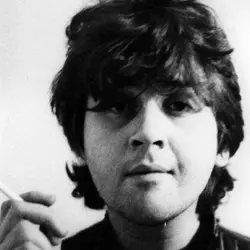
 The Saints Profile
On that Tuesday night in Brisbane, no one knew that an earthquake was about to rock the music world. Though the neighbours could certainly feel the tremors.
The studio didn’t get to work with many bands; their core business was commercial jingles. So Mark Moffatt was surprised when the drummer and bass player turned up in their transit van and said simply, “We’d like to make a record.”
After a stint in London, Mark, an aspiring record producer, had landed a gig at his mate Bruce Window’s recording studio in West End, on the south side of the Brisbane River.
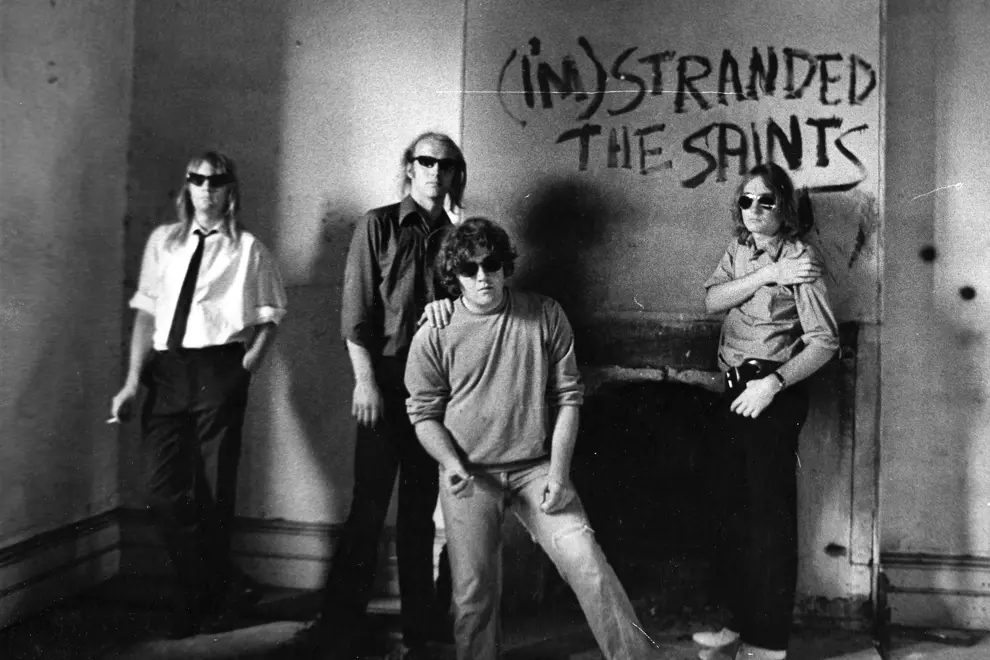
When the band – singer Chris Bailey, guitarist Ed Kuepper, drummer Ivor Hay and bass player Kym Bradshaw – turned up that Tuesday night, Mark didn’t quite know what to expect.
As they started playing, he could sense something was happening, though he felt that Ed’s amp wasn’t up to the job, so Mark plugged in his own Fender Super 60 and turned it up to 10.
“And suddenly, bang!”
The 16-track studio had a concrete hallway, which made the record sound even angrier and louder.
The next day, Mark mixed the single and the B-side. And just like that … music history was made – for a total cost of $170.
Bob Geldof says that three bands changed the face of music in the ’70s – the Sex Pistols, the Ramones, and The Saints.
“There was a sense that something had fallen into place,” Mark Moffatt told The Music 48 years later. “It was like Sun Studio and Elvis Presley. That, to me, was a happy accident. Elvis just turned up and then, boom.”
The Saints even made a video for the song, teaming up with a Channel Seven editor named Russell Mulcahy, who would go on to become Australia’s most famous music video director, making groundbreaking videos for The Buggles, Duran Duran, Elton John, and Bonnie Tyler.
(I’m) Stranded was one of Russell’s first videos.
The band pressed 500 copies of the single on their own label, Fatal Records. The story goes that Ed had wanted to call it “Fay-Tel”, sending up the K-Tel label.
Curious music fans could buy their own copy, by mail order, for $2.
Three months after the recording session, the single made its way to the UK. The Sounds reviewer, Jonh Ingham, was born in Australia to English parents, so perhaps he was intrigued to receive a package from Brisbane.
The song blew his mind.
Ingham called it “Single of This and Every Week”.
“You like [Status] Quo or the Ramones?” he asked. “This pounds them into the dirt. Hear it once and you’ll never forget it.
“There’s a tendency to blabber mindlessly about this single,” Ingham wrote, “it’s so bloody incredible. This Queensland combo had to record and release on their own label; for some reason Australian record companies think the band lack commercial potential. What a bunch of idiots.
“The singing’s flat and disinterested, the guitars are on full stun. There’s no such thing as a middle eight. It’s fabulous.”
The review made the ABC radio news in Queensland: “An unknown band from Brisbane, by the name of The Saints, has earned rave reviews in England for a record it made itself.”
EMI in the UK contacted their Australian branch to demand that they sign The Saints. “Um, who?” the local label replied.
The band learned about their new-found fame in the UK via the ABC. “I was actually listening to the radio at the time and I thought, ‘That’s odd. I’m in that group, I don’t recall becoming instantly famous in the UK,’” Chris Bailey told Andrew Stafford for his seminal book on Brisbane music, Pig City.
“And then Ed called up and said, ‘Have you heard the news?’ and I said, ‘Yes, it sounds a bit weird. What’s going on?’”
Locally, (I’m) Stranded was met by a wall of indifference. Brisbane’s 4ZZZ played it, but it polarised listeners.
Announcer Stuart Matchett, who would later move to triple j in Sydney, recounted this tale in the book Generation Zed: “There was a guy who was a big fan of the station who’d ring up every night and ask about music and stuff.
“And it was when I played (I’m) Stranded that this guy rang up and said, ‘How can you be playing this complete and utter shit by these guys who cannot play?’”
Nick Cave loved ’em.
“The Saints was a band that would come to Melbourne and we would see religiously,” he says. “They were kind of god-like to me and my colleagues. They were just always so much better than everybody else. And a great singer; he could actually sing.
It was extraordinary to go and see a band that was so anarchic and violent, with a singer that could actually sing. It was amazing.”
Paul Kelly was not so sure. “The Saints’ first two records, despite the raves, underwhelmed me,” he admits.
“They sound great to me now but at the time all I heard was the sneer. With the release of their third album, Prehistoric Sounds, I got it.”
In the draconian days under the tyrannical rule of Joh Bjelke-Petersen, not many places in Brisbane would book The Saints, so their preferred venue was drummer Ivor Hay’s house, which they called Club 76.
The Courier Mail’s legendary music writer Noel Mengel says, “Every time I drive past the corner of Petrie Terrace and Milton Road, one of Brisbane’s busiest intersections, I look over and give a little grin. ‘We know, dad, you told us,’ the kids say. ‘That’s The Saints’ party house!’”
The late-great music journalist Andrew McMillan wrote about the “party house” in a piece for RAM headed “The Saints Versus The World, Part One”.
“The Saints are based on Petrie Terrace,” the story started. “And if you’ve ever been around Petrie Terrace, then you’ll understand the forces behind their music.
“Petrie Terrace is one of those inner-city don’t-go-near-there-Johnny areas. A notorious piece of turf in the midst of condemned buildings, railway yards and streets that lurk in the shadows. It is home to winos, derelicts and vicious brawls.”
McMillan captured the brutal beauty of The Saints live: “As you push the door out of your way, the sound hits you, knocks you to the floor and stomps you through the boards.
“Without warning, your brain is bombarded, shattered, trampled on and kicked, pounded and torn apart by grinding guitars and an iron-grate voice. The Saints are on.”
(I’m) Stranded landed in September 1976 – more than two months before the Sex Pistols released their debut single.
A month after (I’m) Stranded, Radio Birdman’s Burn My Eye EP appeared.
(I’m) Stranded also landed a month before The Damned’s New Rose – the song that’s seen as UK punk’s ground zero.
The Damned’s Rat Scabies recently reflected, “One of the things that made punk very valid was, when you consider The Saints were doing the same in Australia at the same time and the Ramones in New York, it was obvious that people wanted to do it all over the world.
“The Saints were totally removed from anything going on anywhere else.”
Remarkably, the Ramones’ self-titled debut, featuring Blitzkrieg Bop, was released in April 1976.
In 1977, Ivor Hay told Clinton Walker that the Ramones record had no influence on The Saints. “No, certainly bloody didn’t. It kinda shitted us that this New York band was doing the same stuff as we were.”
Ed Kuepper would later tell Clinton for his book on Australian independent music, which he called Stranded: “One thing I remember having a really depressing effect on me was the first Ramones album.
“When I heard it, I mean, it was a great record, to an extent, but I hated it, because I knew we’d been doing this sort of stuff for years – there was even a chord progression on that album that we used – and I thought, fuck, we’re going to be labelled as influenced by the Ramones, when nothing could have been further from the truth.”
The Saints arrived in the UK in May 1977. The buzz was so big that Seymour Stein signed the band in the US to his Sire Records, home of the Ramones.
In July 1977, The Saints entered the UK Top 40 with This Perfect Day. And they appeared on Top Of The Pops.
The Saints wouldn’t have a Top 40 hit at home until nearly a decade later, when Just Like Fire Would rose to number 29 in 1986.
Bruce Springsteen would later cover Just Like Fire Would, calling it “a song from one of my favourite early Australian punk bands”.
Henry Rollins bought the (I’m) Stranded album in America in 1977. It rocked his world. “It is one of the hardest-rocking incendiary original rock albums ever recorded,” he says. “I listen to it all the time … it is essential.”
Magic Dirt covered (I’m) Stranded for the Mushroom 50 celebrations in 2023.
“This song and the album were a part of what essentially cemented Australia’s reputation as punk/alternative rock pioneers,” Adalita said. “The gates burst open with this tune and everyone else followed.
“Its attitude and subject matter are instantly relatable – well, for us at least: alienated youth, looking for a way out. It’s frantic from woah-to-go, relentless! It keeps weaving and spinning, pummelling you into a frenzy, it’s so good.”
America’s Violent Femmes put their own spin on the song when they did it for triple j’s Like A Version.
And Jello Biafra joined the Celibate Rifles to do a killer live version of (I’m) Stranded at 2019’s Damo The Musical, a celebration of the life of Damien Lovelock.
Looking back, there was something serendipitous about that Tuesday night in Brisbane in 1976. As Ed Kuepper would note, The Saints were lucky that Mark Moffatt was in the producer’s chair that night “and not some drone”.
“I’d seen the New York Dolls,” Mark explained, “and I’d been around the early British pub rock scene, with Ducks Deluxe and Brinsley Schwarz. It all made sense to me, which is why I didn’t dismiss these guys as just a bunch of noise.”
He captured the raw power of the band, including the sound of Ivor Hay knocking over a bottle, which can be heard at the end of the track.
Mark also dug No Time, which became the B-side of (I’m) Stranded. “That even rocked a bit harder. Ed’s guitar playing in that was just so great.”
In 2007, (I’m) Stranded was one of the first 20 songs added to the National Film and Sound Archive’s Sounds of Australia registry.
“No argument,” Noel Mengel says. “This is the most important record ever made in Queensland.”
Five decades after The Saints called it home, Petrie Terrace has long since been gentrified.
And the guy who wrote the review that would change The Saints’ life? Jonh Ingham conducted the first press interview with the Sex Pistols, before leaving music journalism to co-manage Billy Idol’s Generation X. He then relocated to the US, where he managed The Go-Go’s.
Ed Kuepper exited The Saints after their third album, 1978’s Prehistoric Sounds.
Chris Bailey continued releasing records as The Saints. He died in 2022, aged 65.
Looking back on (I’m) Stranded, Chris said: “These days, the song is more of an aural photograph and a reminder to me of the joys of a misspent youth.”
In 1977, Ed said, “We didn’t wait for things to catch up in Brisbane. Rather than wait for trends, we’ve set them.”
“Had The Saints not been sequestered away in Australia, they might have had more impact on the international scene,” Clinton Walker concluded.
“By the same token, it was perhaps precisely because they developed in isolation that they boasted such a wilful individualism and weren’t feted and fucked-over before they’d even got out of the blocks.”
The Saints changed the world from Brisbane – 16,540km from London, and 15,508km from New York.
They were inducted into the ARIA Hall of Fame on September 11, 2001, an event that was overshadowed by tragic events in New York.
Chris Bailey thanked ARIA for the butt plugs, while Ivor Hay remarked, “If we had this interest back in 1978, perhaps things would have been different.”
Ed Kuepper ruled out a reformation, saying: “We have come to bury the Saints, not to raise them.”
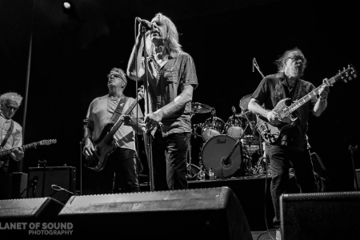
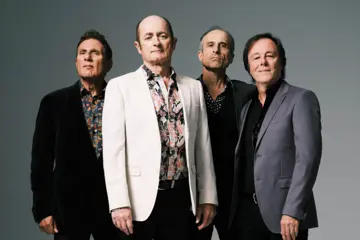
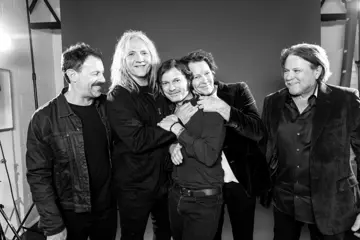
25 years on, Ed has reunited with Ivor Hay for The Saints ’73-’78 tour, which will kick off in Newcastle in January next year, following a UK tour with The Damned in November and December.
A live album, recorded at Club 76 in September 1976, will be released on November 20.
After recording (I’m) Stranded, Mark Moffatt went on to become a major record producer, producing everything from Pat Wilson’s Bop Girl to Yothu Yindi’s Treaty.
He died of pancreatic cancer in 2024, aged 74.
Not long before his passing, Mark reflected on the seismic success of (I’m) Stranded. “I’m really thankful that I had one of those in my life,” he smiled.
“The stars aligned and I’m glad it was in Brisbane.”
This piece of content has been assisted by the Australian Government through Music Australia and Creative Australia, its arts funding and advisory body