
 Parkway Drive Profile
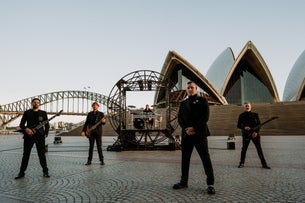
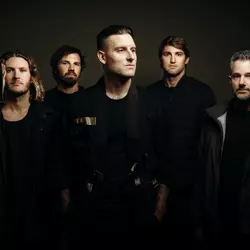
Australia’s biggest metal band, Parkway Drive are set to release their feature documentary HOME in cinemas on Thursday 12 November.
The documentary – directed by Allan Hardy (Viva The Underdogs) and Macario De Souza (Bra Boys) and produced by Hype Republic – follows the band’s one-night-only performance at the Sydney Opera House, accompanied by a full symphony orchestra for reimagined versions of their discography in a formal black-tie setting.
Woven in between the performances of these new renditions of classic songs are the stories of fans who have travelled from around the world to witness this one-of-a-kind experience. The band put an open call out to their fans over social media, asking for any stories of how much the band means to them and how the music has impacted their lives. They were inundated with thousands of stories.
The documentary dives deep into some of these stories of fans who have used Parkway Drive songs to send off their children at funerals, who have found support in the band’s music as they journey through five years of sobriety and the story of a police officer who used the music to create common ground between themselves and a suspect.
These stories are heavily prominent throughout the documentary, to the point where once the first edit was created, the filmmakers weren’t sure that this was what the band was expecting. However, the band were thrilled, emphasising that they wanted the film to be about the fans, their stories and the human connection of the night. The first edit ended up being very similar to the final product.
“We couldn't anticipate any of this,” frontman Winston McCall shares from home in Byron Bay; he’s just returned home after Parkway Drive headlined the Hellbound Cruise’s maiden voyage.
“It was very humbling for us to even understand this, because, like, we didn't see these stories until the first edit as well. We knew the background of the stories, but we didn't actually see the filming and documentation of it until the first edit came through, and we were completely blown away by it.
“It’s very hard to even describe what that makes you feel. Because this is such a personal thing, and we do everything we can to help resonate and bring people in and empower them and provide something positive for people, but to hear that it reaches this level is just like, fuck. Like wow. It just really is like it knocked us on our ass. Like it really knocked us on our ass, like to the degree of, like, we didn't anticipate the movie being like this.”
The documentary opens with McCall performing his audacious, history-making stunt of rappelling down from a helicopter onto the Sydney Opera House. It was a stunt deemed so risky that not even Tom Cruise was approved to do it, so how did the surf-rats from Byron Bay get approved?
“We know the right people,” McCall cackles.
“I mean, that is all credit to the team that got it through CASA, the Civil Aviation Safety Authority. That was literally it. It doesn't come down to me. My job was literally to make it all look safe and good and make it look stylish. That was it. The stunt team and everyone getting it signed off were the people that made this thing happen; that's the thing. Like the pilots, the people doing the paperwork, the whole team behind it.
“Because this thing went all the way to the top, like to the top. People going, ‘I'm not signing off on this, hell no, hell no, hell no.’ And we had other people that were in either the stunt industry or that did helicopter rescues or police training or something that were like, ‘There's no way in hell you're doing this. They won't even let us just do stuff in the city, let alone on the Opera House.’ So everyone, whenever it got signed off, the whole industry was just like ‘holy shit, I can't believe you guys are doing this.’ No pressure, don't crash into the opera house.”
McCall shares that he hears they’re planning to do the stunt for the new James Bond film as well, “If the new Bond has this stunt, you know who did it first,” he points to himself cheekily.
With the status of the new James Bond still currently up in the air, The Music had to confirm that McCall wasn’t in the running to be the new 007… just to be sure.
“I won't confirm or deny that,” he teases.
HOME was self-funded by the band at a scale normally reserved for an entire European arena tour. Parkway Drive seem to be a band who are always seeking the next mountain to conquer and risk to take. Whether that’s massive arena tours where they go all out on their production or creating their own Park Waves festival - which unfortunately got cancelled.
Even changing their sound in 2015 when they released IRE was seen as a risky move at the time; ultimately, it was the move that started their climb to festival headliner status. So why are the band still taking these risks and not just coasting as Australia’s biggest metal band?
“Where's the fun in that?” McCall chuckles.
“We only do all of this stuff because it's interesting and we love doing it, that's it. The magic of what we have is a combination of being able to create a genuine energy between five people who have different perspectives of what they love in music and what they create. That works together to create what Parkway sounds like and looks like and operates; all of these things, it really is a collaboration.
“And it's a collaboration that is born out of just us finding things fun and interesting and wanting to give that energy to something which will resonate with as many people as possible. The fact that it always seems to connect is what's led to the growth, and that also adds to the enjoyment of it.
“It’s this cycle; there’s no point where you really want to stop it,” McCall continues. “I don’t want to deliver something that isn’t honest or heartfelt in terms of our creation, and I don’t think people want that from us in the first place. There’s no point in coasting; I’d rather just not do it.”
In 2025, Parkway Drive performed HOME at the Sydney Opera House and then the following year they toured the country for a string of back-to-back shows performing their – now classic – albums Killing with a Smile (2005) and Horizons (2007).
Through these performances, the band realised that they love everything about what they do and they don’t want to leave any of it behind. Although they don’t want to retread old ground, they can still be inspired by what they’ve done and recapture the energy of where it all started, performing in community centres in front of 30 people.
“It's weird, like right now we're essentially the biggest arena band that we could possibly be. We can play arenas internationally, and headline festivals with this insane stage show, but we're also a band that can play to a thousand people and just play hard, fast songs, or we can play with a symphony.
“And all of those things exist at the same time, and all of those setlists we can play, and I'm like, ‘How's that one band?’ That's a really cool thing for it to just be one band and not having to shift and morph the whole thing as one. We’re like ‘cool’, it's like you just grow another arm if that makes sense. It's the multi-limbed beast at this point.”
Outside of these performances, there has been an ongoing conversation and media story mentioning the band. In late May, Jed Daniel Gordon – who is the brother of Parkway Drive drummer Ben Gordon and who has previously been described as the band’s “ex-merch guy” – was given a three-year community corrections order and 300 hours of community service, in addition to a two-year apprehended domestic violence order and placed onto the child protection register after having plead guilty in March to having sexual intercourse with a minor.
The incident in question is reported to have occurred between November 1st, 2002, and July 11th, 2003. At the time of the incident, Gordon was in his early 20s, while the victim was aged 15.
NSW Police have since reportedly launched a task force intended to investigate claims of historical sexual abuse in Byron Bay.
On 24 March 2026, following Gordon’s guilty plea, Parkway Drive posted a statement of McCall speaking to camera to express their support for the victim and their condemnation of Gordon’s actions.
In the video, McCall reflects that the Byron Bay hardcore scene grew out of an already toxic Byron culture, where McCall says the hardcore scene tried to create a sanctuary for young people to escape this. He goes on to say, “We as men need to do better; we need to stand up,” as well as encouraging men to speak up, not stand for bullshit and look at your mates, friends and peers while asking the hard question.
When speaking to McCall, The Music reflects that compared to the 2000s, there has been cultural improvement in people speaking about these situations and younger generations being much better at having open conversations. Has McCall seen this improvement over time in the scene?
“It's an interesting one. I think I've seen improvement, but I've also seen, like, I think as a society in general, I think it's something we constantly have to address and stay on top of and work on because society changes and technology changes.
“For all of the wonderful progress we make, you also have – and I mean as a society and technologically – there's the ability for cruelty and ill intent in so many humans on this planet. Like, most humans have the ability to do that, and the further we go down [with] technology, the more tools enable people to act in those ways.
“And as much as I would like to go, ‘Yeah, we see all of this progress.’ Like at the same time you have AI creating some of the most horrible tools possible to torment people. And I'm talking about, like, deep fakes and auto strip bots and all of this kind of stuff in terms of what you can manipulate with.
“I think it's just imperative for all humans to realise that,” McCall continues.
“Like, this isn't just like ‘Hey, call things out,’ just like in general, I think people just need to look at the idea that until we understand how cruel we can be and if we don't hold ourselves to that account of that not being okay, there will always be work to do. There will always be work to do, specifically on abuse towards women or anything to do with gender-based violence or anything like that.”
McCall believes it’s always going to be ongoing as the environment continues to change.
“Generations are born into a new environment, and the environment doesn't get less prickly,” he says. “It's beholden on everyone just to do the best they can; I'm not going to say ‘call it out,’ but to be aware of, because it's not just calling it out; it's literally being aware of what the environment is and how people are able to act and will act in an environment that changes.
“I mean, that’s a really long answer; it's not simple, that's the thing. Like, my sister's a mental health nurse, and she, like, fills me in on so much of this stuff, and she's like, ‘it's fucking psycho how kids are brought up these days’ just with technology, and it just does your head in.
“Yet times change from where we were, and times change now, and like fuck if I was brought up in the age of today, I'd be like, ‘Holy shit’, how would I even cope with that? How would I cope with what kids can do and do to each other? It's like, it's psycho.”
Parkway Drive continues to take on new challenges and cross things off a bucket list they never even made. In their 2020 documentary Viva the Underdogs, the film ends with them achieving the film’s goal of headlining Wacken Open Air festival.
Fast forward to 2026, and they were just announced as co-headliners, just below Bring Me The Horizon at Rock Am Ring. Is the goal and the drive to be number one everywhere they go?
“Yeah, but it's not so much number one; I just feel like there's more potential, there's more creative potential in what we have to do. I still think that there are more people in this world that would love to experience what we do that don't experience it yet.
“I still think that there's ways of bringing this music to more people. That's kind of it. And the thing is, all of the other crazy stuff, they're just opportunities that come along the way, and yeah, they're like a bucket list of ‘Oh my god, I can't believe we believe we played the Opera House.’
“But they're not things which you necessarily are like, ‘Okay, write up a list. Let's tick them off as they go.’ It's just like, ‘fuck, this moment's come along? Oh my god. All right.’
“But basically, until the inspiration runs dry,” McCall continues, “We still have that one goal: just trying to meet and connect with as many people as possible and create moments for people which are just worth their time.
“If you come to a Parkway show, I want you to walk away going, ‘Holy shit, I can't believe I experienced that.’”
Parkway Drive: HOME is in cinemas Thursday 12 November.
This piece of content has been assisted by the Australian Government through Music Australia and Creative Australia, its arts funding and advisory body