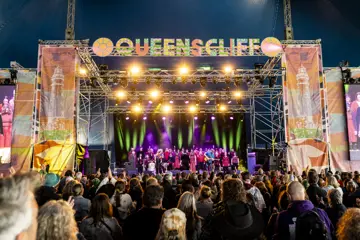
Last time this scribe interviewed Eliza Hull for The Music was in person at Live Nation’s Australian headquarters in Collingwood, ahead of the final instalment of 2025’s Ones To Watch series.
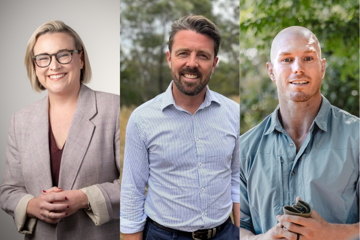
To mark the United Nations-observed International Day of People With Disability (IDPwD), which is celebrated on December 3rd, Hull curated and hosted this event that was designed to amplify the voices of people with disabilities. We marvelled at the talents of Mathilde Anne, Cooper Smith and r.em.edy that night, before Hull herself performed to close out the evening.
Prior to performing Running Underwater that night, Hull explained this song is “very dear to [her] heart”.
“I wrote this song about living with my disability [Charcot-Marie-Tooth],” she continued, “which is a neurological condition. And I was told by my producer, very early on – I never worked with this guy again, but he said, ‘Don’t ever walk in your music video, because nobody will ever listen to your music.’
“So when I decided to put this song out, I did that – I walked in my music video. And I also had an incredible dancer called Roya The Destroyer, who has one leg, and she fully embodied this song in the most incredible way. And I feel like this, to me, is kind of my step forward of trying not to hide a part of me that has existed for so long that I was really afraid of, because people do stare, people do hold assumptions about what it is to be a disabled artist and this song is really pushing against that, it’s celebrating who we are.”
There wasn’t a dry eye in the house when she sang Running Underwater’s closing lyrics: “Take the weight off me/Show my bones for you to see.”
“Pushing Back On What You've Been Told You Should and Shouldn't Do to Succeed in the Music Industry”
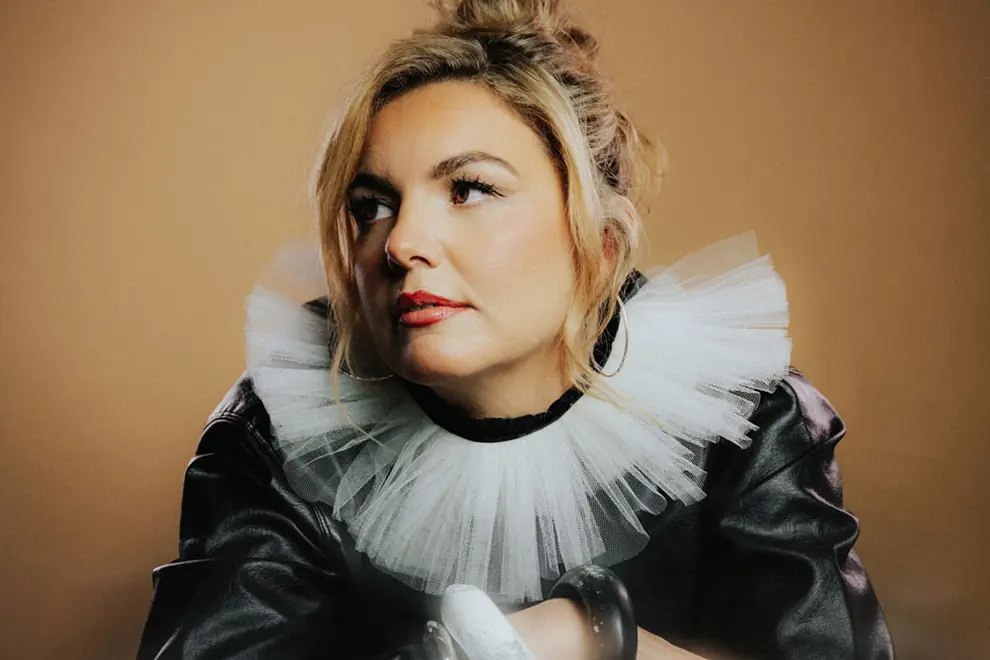
Hull’s latest and second album, You’d Think We’d Be Used To Change By Now – which she co-produced, for the first time, alongside Pip Norman – is scheduled for release on December 4th – the day after IDPwD.
The music video for the album’s lead single, Hotel Room, opens with Hull walking down a corridor and entering a hotel room – a powerful statement in light of the aforementioned producer’s unsolicited ‘advice’.
“Yeah, exactly,” Hull concurs, “because I guess it's, like, pushing back on what you've been told you should and shouldn't do to succeed in the music industry. And that [producer’s ‘advice’] was very early on in my career.
“So I think I’d just moved to Melbourne from regional Victoria and he was a producer that was, at the time, quite well known. I trusted him and, yeah – in that moment – I probably just agreed with him because I didn't know any better.
“I Wanna Walk In Front Of People”
“But now – as an artist that I guess identifies as having a disability and says, ‘You know what? I don’t care anymore; I wanna be myself’ – I wanna walk in front of people.’ And so, yeah, having a statement of walking into that hotel room was definitely part of that plan to really just be okay with who I am.”
This action feels representative of her current career phase: laying it all out there, unafraid to show her full self, including aspects she’s chosen to hide in the past. Would that be quite accurate?
“Yeah and I think, in a way, I've kind of always seen myself as having three stages. And one stage – in the music space – I was hiding my disability and not talking about it; making sure that I was sitting down when I met people, pulling the curtains so people in the audience couldn't see the way that I walked on stage.
“Then becoming more of an advocate in this space and speaking quite a bit about – working with lots of different organisations – like the ARIAs and APRA – to make it a more equitable industry for artists with disability.
“To then, I guess, making this record [You’d Think We’d Be Used To Change By Now] – it's not really about having a disability, it's about lots of other parts of my life. But I think, no matter what, it's just who I am; it's always gonna be a part of who I am.
“I Probably Would Sing Very Differently If I Didn’t Have A Disability”
“I actually think I probably would sing very differently if I didn’t have a disability and it always brings emotion to what I do. My music is pretty emotive. And, you know, there's only one song on the whole record that really touches on it and it's called Words Got Louder.
“Other than that, the record's really about relationship with myself and relationship with others, and the changes that we go through in life. And how even when we go through so many changes it can still feel scary at times, to make changes. And the theme throughout the whole record, really, was around the many changes that we go through in life.”
Listening to You’d Think We’d Be Used To Change By Now made me feel really emotional. Suppressed memories of difficult life events that I’d stored away and hadn’t thought about for years, which I probably still need to forgive myself for, rose to the surface.
It also made me think about times when I've dimmed my own light while trying to feel accepted or make a relationship work, losing my own identity in the process. I soon found myself in floods of tears.
“That is exactly what this record’s about, really,” Hull acknowledges. “And I think also, as women, what I've realised is that the desires of our inner lives are actually kind of like a life force. I know that sounds odd, but the more that I tapped into looking at what I really want in my life – and looking at how I’ve tried to be quiet or fit in or not walk in front of people or not speak my mind, even in my own really personal relationships – I’ve realised that you kind of just keep squashing down who you are, deep down.
“And the more you unravel that, you actually start to discover that those desires you want in your life – you know, you might be wanting somebody else in your life, or wanting something in your life, but actually what you really discover is it’s not really about another person, it’s not really about that thing over there, it’s actually – I know this sounds a little bit cheesy – deep down, it’s really what's in you and the energy that you bring to your own inner life.
“And I think what I discovered is that actually it's a beautiful thing to desire – and to want and to crave and, yeah! To be more yourself and start listening to your inner self, even when it can be a little scary and daunting.”
“Questions Around All the Things That We’ve Been Told We Should Do, As Women”
Hull turned 40 this year, which is a milestone that often sparks reflection.
As women of a certain age, we were brought up with a very limited view of the kind of futures available to us. Nowadays, everything's really opening up for young women who dare to follow more unconventional paths.
“I think you’re right and I think that’s quite a privilege really, isn’t it?” Hull considers. “To have possibility. And historically – you’re right – women have been suppressed and not enabled to speak their minds and not enabled to push, go outside the box, do things differently.
“So I think it is quite a privilege to even have these songs that are the questions around that, the questions around all the things that we’ve been told we should do, as women.”
Co-Producing for the First Time: “I Just Wore My Heart On My Sleeve, Lyrically And Instrumentally”
Every single word and instrumental element on this record seems considered and essential.
“I think you're right, every instrument was really purposefully thought about, and this is the first record that I've co-produced. I was even looking back at old videos of me making my last record [2015’s The Bones of Us] – the producer was the same as on this record, Pip Norman.
“And whilst I wrote all the songs and wrote all the lyrics, I still was very much sitting in the back of the studio, for no other reason but, in a way, I just probably didn’t really feel like I could come to the fore and speak my mind.
“Whereas this record, there was a real shift, a real change of – I really wanna be involved in every single element of this record and every single note of the record. Yeah, that has been a bit scary as well, because I think I really care about this record so much because of that, you know? I just wore my heart on my sleeve, really, lyrically and instrumentally.
“I was very much part of all the decision-making and at the front of producing the drums and producing the bass and, you know, getting the guitar right. And so I think, because of that – yeah! I do feel like everything's got its place – everything's purposeful – which I'm really proud of.”
London Songwriting Trip Triggers Crisis Of Confidence
“I went to London with the idea that I’d write with 12 songwriters in 14 days, so I didn’t really give myself enough time to land [laughs]. And, you know, I was leaving my kids so I had to do it quite quickly. I really pushed myself to reach out to songwriters that I wanted to work with, and I landed there and just had a full, like, ‘What am I doing here? Am I even a good singer?’
“I even started to listen back to old songs of mine and really just questioning – almost like, yeah, I can’t describe it other than that it was a very bizarre experience of real self-doubt, of like, ‘Has this just been a complete lie? Am I any good? Why am I here? Why am I leaving my family?’”
Did this crisis of confidence get Hull wondering whether she even wanted to continue making music?
“Yeah, that too. It's not an easy industry and I’m sure you hear that all the time, but it’s really not. And I think when you have a disability as well, it’s really not an easy industry. And meeting new people each day, where I have to think, ‘Am I gonna be able to get in the studio? Are there stairs to get in? If there’s stairs, is there a railing for me to hold on to?’ Otherwise, I’m gonna literally have to crawl. ‘How do I tell them about my disability, but not talk about it too much?’
“And, you know, how do we not make that a focus when I’m trying to make a record about being a woman and relationships? That’s anxiety-provoking and I think that really fed into that self-doubt. And I would kinda come home each day and listen to the demos that we were creating and, to be honest, not see any good in them, because I think I was just feeling so much negativity towards myself at that time.
“But then when I got home I met up with Pip Norman, who's really been the executive producer with me, and he was like, ‘You’ve got a record here. These are some really great songs’.
“And I think especially working with Liam Howe, who used to be in a band – well, they’re still together – called Sneaker Pimps, they were a ‘90s trip-hop band in a similar vein to Portishead and Moloko. And, yeah, that was pretty great, because he's worked with so many great artists like FKA twigs and Marina. And I was pretty nervous meeting somebody of that calibre, but he was so, so kind and so lovely, and was very much like, ‘Let's just hang out for a bit. Let's not do music, let's chat’.”
“So we just sat there and chatted for a while, and then he was a very quick worker. So we had recorded the whole song, Balcony, and one of the songs that’s about come out, Places, in hours. He's just very quick and like, ‘Let's just record your vocals straight away. Write the lyrics straight away, record them,’ and not go back at all and re-do them.
“So I think that was also something that we – Pip and I – were really protective over, over the whole record, was, ‘If it feels good – and it hopefully sounds good – let's just keep it. Let's not go over and over and record another vocal and another vocal and another vocal,’ which, in the past, I probably have wanted to do a hundred vocal takes [laughs]. This was very much like, ‘Let's just record what's in the moment and hopefully that kind of heart will come through the record,’ because of that instant feeling, ultimately.”
When asked how she initially reached out to Lowe, Hull recalls, “I think it was a cold email. I didn’t get a reply for a long time and then I just pushed a little harder. I sent maybe two or three [emails], actually. I mean, I loved that band, Sneaker Pimps. I didn’t discover them in the ‘90s, because I was in primary school [laughs[.
But when I went to uni in Melbourne, we would go out dancing and then come home and put that record [1996’s Becoming X] on as a morning kinda thing. And, yeah, it was just such a beautiful record. So I’d always hoped to work with him, ultimately.
“So for him to reply was like, ‘It’s happening!’ And in fact, that very morning, I sat in a café before I met him and, again, really questioned, ‘How do I do this?’ – to a friend. Luckily she was up, because it must’ve been night in Australia, and she gave me a real pep talk and was just like, ‘You can do this,’ so yeah! I think at that time I was really struggling with my confidence, but I’ve come through.”
“Luckily Nobody Was A Dick In England”
Was Hull also worried about working with one of her heroes, on the off chance that he was a dick, which might take some of the enjoyment away from listening to one of her all-time favourite albums?
“Exactly, yeah! Luckily nobody was a dick in England. In fact, everyone was kind – just so incredible. And I think it was more me, you know? It was more my inner critic that was getting in the way.”
Perhaps if she didn't conquer that self-doubt – instead walking into the session brimming with confidence – the songs would have turned out differently.
“True. That's a really good point. Yeah, I love that.”
Daniel: The Song That Broke Me
Pretty piano melodies circle Daniel (“...will you forgive me for what I’ve done”). Purposeful drums heighten the second half, then Hull’s closing primal wail exposes a deep well of hurt. We’re left feeling crushed, like hearing Laura by Bat For Lashes for the very first time.
I was hesitant to even bring this up during our interview, because it felt too personal to discuss.
After telling Hull her song moved me deeply – dredging up some suppressed memories about decisions made in my twenties – I unexpectedly burst into tears and apologise.
“No, that's okay,” she reassures. “What did you get from that, if you don't mind me asking? It’s a song about losing a child.”
Being a Mother With Disability: “There Was Just So Much Discrimination”
Over 15% of Australian households have at least one parent with a disability.
Hull is a mother of two children, Isobel and Archie. When she told her neurologist she wanted to have children, he advised her against it.
As a mother with disability, Hull reflects on the stigma she faced: “Yeah, it's very hard. And I haven’t really thought about it until yesterday – I had some people here interviewing me about that very subject.
“I guess because I spoke about that very thing for quite some time, now I’ve just tried to let it go, because you realise that those medical professionals just don't have any sort of disability awareness or ability to say, ‘Well how can I support you to be a great parent?’ Instead of going straight into deficit – ‘fix it’, you know? ‘You can't be a parent, because you might fall over…’ [CMT disease affects balance, walking and muscle strength] – all of those things are, like, very much what could go wrong instead of, ‘How can we make this right for you?’
“I think a lot of that is to do with a lack of representation, that we haven't seen many – if any – disabled parents on our screens, in all sorts of spaces. But, also, often these medical professionals aren't given the adequate training of, like, ‘How do we look at the social model of disability?’ which is that the world is disabling, and not like, ‘Let’s go into the medicalised model,’ which is that disability is to be fixed.
“So, yeah, I guess sometimes I try not to blame that neurologist, because I think – in a way – it's probably how he was educated. But in saying that, it really did create a fire in my belly, because I realised that if that is what I’m facing, what are all these people with disability facing in the country when they decide to be a parent, and why? And the more I discovered, [I realised] I was not alone. There was just so much discrimination.”
“We Make Great Parents As People With Disability”
While Hull was pregnant with her first child, she was alarmed by the lack of positive representation of parents with disabilities. So she edited a book, We've Got This: Stories By Disabled Parents, which collates contributions from 25 parents who identify as Deaf, disabled or chronically ill. The highs and lows of their parenting journeys are discussed, revealing that “the greatest obstacles lie in other people’s attitudes”.
“Parents with disability were thriving when they had a child,” Hull says of her findings, smiling broadly. “It was actually just society that was creating those barriers; discrimination in medical spaces and out in the community.
“But what was happening in the home was, yeah, they do things a little differently, but actually people with a disability are incredible creative thinkers, problem solvers – adaptable. And that is really what skills are required for parenting, ‘cause it’s an ever-changing landscape of knowing your baby, but yeah! I think, ultimately, what I discovered – which I always deep down knew – is that we make great parents as people with disability.”
Hull also co-wrote a highly-accessible children's picture book with her close friend Nas Campanella – the world’s first blind newsreader and ABC Disability Affairs Reporter. "Vividly evoking a blind child's joyful experience of a day at the beach", All The Ways I See utilises a range of innovative accessibility features to suit all readers.
“Write A Song Without A Chorus”
As well as being heart-stoppingly poignant, Who Am I (If I'm Not Your Lover) – the record’s duet moment – reminds us of Hayden Calnin‘s vocal majesty.
Built from stately piano chords and sustained bowing on strings, the somnambulant Who Am I (If I’m Not Your Lover) reunites Hull with Calnin (they previously duetted on Ghosts). When Hayden first comes in – “I’m so worn-out like secondhand air…” – it’s devastating. Emotionally depleted from being made to feel broken, Hull laments, “Who am I if I can’t love you enough?/Who am I if I can’t open up?”
“I wrote that song on the piano on my own,” Hull enlightens. “I’d just done an Adrianne Lenker [Big Thief] workshop – they do School Of Song, it’s called – where you do a ten-week course with great songwriters. And I’d just done one with her, and one of the tasks was ‘Write a song without a chorus.’
“And I thought, ‘God, actually I think all my songs have choruses’ – I hadn’t realised. And so I sat and wrote this [Who Am I…] ; there's no chorus in this song, it’s just a repetitive ‘Who Am I If I'm Not Your…’ you know? There’s multiple lyrics that come after that, which is kind of the hookline throughout it.
“I guess I’d wanted a male vocalist on this and, yeah, had thought about many, many great vocalists, but Hayden was definitely a person I wanted to reach out to. Because we have worked together in the past, he produced some of my really early stuff [her single Caught and debut album The Bones Of Us].
“And we have a song – which he doesn't feature on as much as this one [Who Am I (If I’m Not Your Lover)] – that’s called Ghosts and it was used for a really big hospital TV drama called Saving Hope.
“And I just love his voice, I love his music – it sounds a bit Bon Iver, to me. And I love the way he layers his harmonies and, yeah, it’s really made the song pop, for me, in a beautiful way. And I have two dancers that are actually doing the music video for it tomorrow.
“We’re not realising it as a full single, that song, but we’re just putting it out there and doing a music video with it of two dancers – that are incredible contemporary dancers – that are going to dance that push-and-pull between Hayden and me.”
Syncability: “Definitely One Of The Goals”
“That’s definitely one of the goals, for sure. Yeah, I remember very early on when I was pretty young – I must’ve been 17 or 18 – and I went into a songwriting competition, which I performed at the Palais Theatre in St Kilda. And one of the judges stood up and said, ‘Your music belongs in film and TV’. I very much remember thinking, ‘Oh, actually…’ – ‘cause you’re so young, you don’t think of that.
“But, to be honest, when I’ve seen my music in TV and film – they’re the moments where you just feel like, ‘Wow!’ I think just seeing actors, yeah, playing out with your music is pretty surreal, and just, yeah, real pinch-me moments when that has happened. So it’s something I’ve always really hoped for.”
Did You Know? During the Melbourne edition of Daniel Johns’ In Conversation: What If The Future Never Happened?, the man of the hour wholeheartedly endorsed Hull’s stunning version of Silverchair’s Tomorrow – which features in the TV series, Playing Gracie Darling – extolling, “I thought it was better than mine!”
“Letting Go Of Control And What People Are Gonna Think And Say”
“I try not to [focus on outcomes]. And it also just leads to better mental health outcomes. Like, you kind of can’t control that, really, but I think I'm constantly relearning that over and over and over again. So this year has been a real learning curve of what makes me happy, what I really wanna do long-term and, yeah, just letting go of control and what people are gonna think and say, or whether they’re even gonna care [laughs] – as much as I can.
“I think the day the album comes out I’m gonna have a big cry, because, yeah, it’s been a big one – in the most beautiful way.”
With her latest set, this award-winning Dja Dja Wurrung Country/Castlemaine-based songwriter, musician, disability advocate and writer has totally outdone herself.
Eliza Hull’s You’d Think We’d Be Used To Change By Now is released independently and distributed via Community Music on December 4th.
This piece of content has been assisted by the Australian Government through Music Australia and Creative Australia, its arts funding and advisory body