 Billy-Jo Shoveller Profile
When we connect with Billy-Jo Shoveller – a proud Karajarri man and the lead singer/guitarist of the Family Shoveller Band – via Zoom, he’s at home in Bidyadanga, south of Broome (Rubibi) in Western Australia’s Kimberley region.
“It's a very big community, about 600 to 1200 people live here,” he enlightens. “We live on the coast. We're from the desert and the sea. The traditional custodians of this area are Karajarri people, but we share this area that we live in today with the other tribes that live with us.
“We have five different tribes living here in Bidyadanga – five different languages. Some of the languages are sort of similar, but [some words] can have a whole different meaning.”
“Wow, I Didn't Know the Song Was Gonna Be This Big!”
“I got a phone call asking if I'd like to be in an audition to sing a song, and I wasn't allowed to know whose song it was or who the artist was. So I was like, ‘How can I know if I can sing this song if I can't be told who it is?’” Shoveller recounts, laughing. “So they're going, ‘Just sign the contract first.’ And I’m like, ‘Oh, well, I don't even know if I'm capable of singing this song that I don't know yet!’ [Laughs again]
“It was very confusing, ‘cause I haven't got any phone call like it [before]. Then when we got the contract, I read through it and said, ‘Yeah’ – it's just to keep the lips zipped about it. So when I heard it – they had a basic demo to work with – I was like, ‘Oh, wow, I didn't know the song was gonna be this big!’
“When we got into it, one of the ladies said, ‘Look, just have a go, see how you like it. Sing it how you'd sing it, not how other people would try to sing it – just be you.’ And I said, ‘Okay, well, I can do that: I can just be me’.”
Of his audition, which took place in Broome, Shoveller recalls, “I did half a day, or a couple of hours. I just gave them what I could offer – you know, how I'd sing it – and they loved it. So I got that phone call! They said, ‘We want you’.”
“Being Guided By The Legend Himself, Luke Steele”
While discussing “being guided by the legend himself, Luke Steele” during the one-day recording session in Perth that followed, Shoveller lights up – clearly chuffed.
“It was the best opportunity and experience I could have,” he gushes of their collaboration. “[Luke] was great. He's the first person that gave me a cup of tea, and I don't drink tea. I didn't tell him that, though. I accepted it. I drank it.
“He brought me a couple of teas to relax the voice a bit, but, yeah, I'm just usually on water. And when he brought me tea, that was my first experience of having tea and lemon and a bit of honey… It tastes nice, anyway. I was like, ‘Oh, don't get me hooked on this, please’,” Shoveller shares, laughing heartily.
“I Was Picturing How My Grandmother Would Call Us When We Were Out Fishing”
Shoveller improvised some of the vocalising we hear in this new version of Empire Of The Sun’s Walking On A Dream. “Improv’ing my traditional songs in the background, to share with the audience, was the best that I could do,” he observes.
“When I was singing the song, I was picturing how my grandmother would call us when we were out fishing – [she’d] sing out, worrying about where we were ‘cause it's getting dark.”
“We Have Hundreds Of Songs And We Sing With Just A Boomerang”
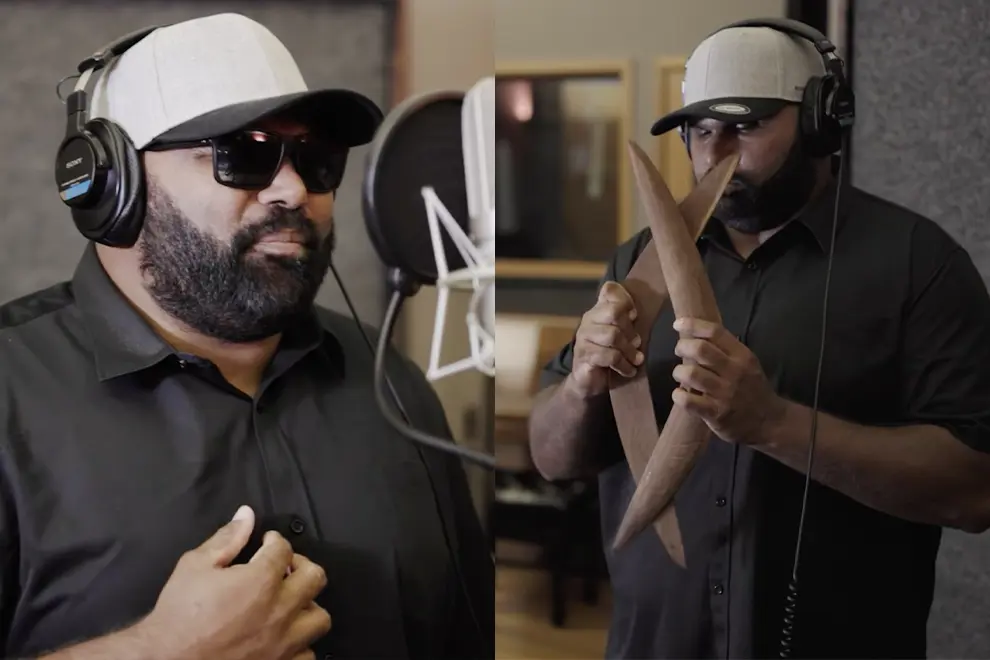
We personally reckon yidaki, which is widely recognised as one of the world’s oldest wind instruments, sounds incredible backed by a symphony orchestra. Shoveller agrees, before pointing out, “About the didgeridoo – in our community, it's not our traditional instrument. So here, it's just a boomerang – we call them gali – and that's the traditional instrument.
“So all our traditional songs we sing here are with a boomerang, no didgeridoo. And no clapsticks, just a plain old boomerang. We have hundreds of songs and we sing with just a boomerang; that's in the surrounding Pilbara [region], with us in the bottom of the Kimberley, up towards Broome.
“Then past Broome, from Derby onwards, right up to Kununurra – that's all didgeridoo,” he adds. “But I was lucky to play the didgeridoo, because my mum's side of the family is from Halls Creek.”
Although Shoveller only took a boomerang along to his audition, he clarifies, “When we did the main [recording] in Perth, we had a lot of instruments: the boomerang plus seed pods and tapping sticks – a few things we could picture that needed to be in the song.”
In The Studio: “This Is Where The Magic Happens”
“I was familiar with the original [Empire Of The Sun’s Walking On A Dream], but then I was wondering, ‘How different is this gonna be from the original?’ And I was like, ‘Okay, this is where the magic happens’ – trying to get away from the original, but keep the original, you know?
“The music was beautiful; it's very touching. When they put all the instruments in it – the orchestra – and make it all balanced, you feel a lot more emotions.”
Upon first hearing the finished version of Walking On A Dream reimagined, Shoveller confesses, “I didn't think it was me singing, actually. I was like, ‘Who's doing this AI stuff here?’” He takes a chuckle break, before elaborating, “So I was a bit shocked and freaked out. I'm like, ‘This sounds pretty good. What's going on?’”
“Wow, You Played In A Big Orchestra!”
On whether his participation in this project has opened up any doors for Family Shoveller Band as yet, Shoveller says, “Our music has been taking off for the last couple of years, but with adding this to our portfolio of playing music… People come up to me and say, ‘Wow, you played in a big orchestra!’
“It’s like, ‘Nah, I haven't played in a big orchestra. I just play in a small band’,” he trails off laughing. “[They say] ‘Oh, but we heard you with an orchestra.’ I say, ‘Yeah, that's totally different to my band’.”
Side note: The West Australian Symphony Orchestra wasn't actually in the studio the day Shoveller recorded his parts.
Family Shoveller Band: “We Put family first”
“In my band [Family Shoveller Band], we create this fusion of music that we play. It's all sorts of genres of music with reggae, rock, pop, country.
“We were lucky to be surrounded by music growing up, to have a listen to all different genres of music and artists and indigenous Aboriginal bands from throughout the Kimberleys or WA, I guess.
“Having our families involved, growing up and performing, and having support from our own family that we have now today – our biggest supporters and fans is our kids [laughs]. When we get pushed from home to go out and perform, and then come back with stories to tell, it's the best feeling that we can get!”
Returning to community after playing shows and sharing videos of audience members singing along with Family Shoveller Band songs is “the best feeling we can have as a band,” Shoveller reiterates, beaming. “As a family band, as well. We're called the Family Shoveller Band, we put family first.”
“Chase Your Dream And Work Hard, You Might Get It In The End”
“As musicians here, we don't get the big opportunities of playing music, and bands and musicians don't tour here anymore. So we got lucky that we had our music teacher, and a music program was happening here, when we were younger.
“At the moment, [Family Shoveller Band] is the only band that's coming out of Bidyadanga. Before us, there was John Bennett and a lot of other bands, Seaside Drifters and Yaringyal [also known as Yatangal].
“We inspire a lotta kids with our performances and our songwriting – that's what we're aiming for. We also catch the broader, bigger audience with our music as well, and just wanna inspire the new generation to show them that if you chase your dream and work hard, you might get it in the end.”
“We’re Taught About No-Go Areas Through Songs”
“There are plenty of sacred sites around Bidyadanga and surrounding areas, and no-go zones and stuff like that… And we’re taught about no-go areas through songs and ceremonies, as well. From [when we are] kids, we know where not to go.
“There's levels of stages you have to go through first to enter some certain areas, through ceremony; it's been like that for years and we're just carrying on what's been handed down.
“Knowing our connection to Country is very important. Knowing the stories of where I'm living – on my Country – is just the best thing. Because it's been handed down from generation to generation, with storytelling of Country – me sharing it with my kids and they'll be sharing it with their kids. It's just knowing where you are: if there's a song for that area, that's a Songline there. What's surrounding there might have a song, as well.”
By The Boab Tree
When asked whether there are any landmarks or sacred sites around Bidyadanga that have inspired a song he’s written, Shoveller reveals, “I do sing a song about a boab tree that got planted ages ago, way before my parents were born.
“I guess one of my great, great grandmothers – coming from Broome to Bidyadanga – just picked up a seed and planted it. She didn't know what that seed was – turned out to be a big boab tree! It's sort of a sacred area that we keep for ourselves and we have our corroborees there.”
The song of which Shoveller speaks is By The Boab Tree, which he co-wrote with Angela Little for the soundtrack to Baz Luhrmann’s film, Australia (2008).
The Call To Country
A core theme in Tourism Western Australia’s global Walking On A Dream campaign is ‘The Call To Country’, which invites travellers to awaken a profound connection to land and sea.
Visually, the majestic beauty of the region is highlighted through footage of Ningaloo Reef’s coral and marine life, Margaret River’s vineyards and the Kimberley's ancient wilderness.
“We Sing About Everything In Our Culture”
Murmuration, birds swooping and twisting in a synchronised flock, acts as a thematic visual thread throughout the Tourism Western Australia ad.
Although Shoveller says murmuration didn’t directly inspire his work on Walking On A Dream reimagined, he acknowledges that observing avian behaviour plays a crucial role within his community: “Some of these birds that fly here, they just fly from Bidyadanga to Indonesia and back. So we know what time it is.
“Birds come in and out – they have a role. Dragonflies come in here, we know that it's time for the salmon that's running – it goes mad! So when they’re hanging around, we know it’s time to chuck a line out. We know all these parts.
“We sing about everything in our culture. We sing about birds: how they flock and when they're migrating. But we sing about other stuff, like the black wasps and how important it is to have it around – like bees and stuff; that’s been around for a long time. And knowing that these small animals – they have a bigger part to play.
“If you don't have these small things around, like a black wasp or a bee, it'd be hard for stuff to grow. You can't take them away, ‘cause – no matter how small they are – they have a bigger purpose. That's how we see stuff, you know?”
This piece of content has been assisted by the Australian Government through Music Australia and Creative Australia, its arts funding and advisory body