 Beck Profile
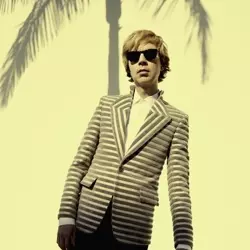
Over the course of 25 years musical chameleon Beck has proved himself to be an artist of massive range, long ago leaving behind the cut-and-paste hip hop aesthetic of his earliest successes to indulge forays into fields as disparate as alternative rock, folk, avant-funk and even country.
Yet after decades spent crafting a career notorious for bouncing from one extreme to another, Beck's last couple of albums — the downbeat psych of 2008's Modern Guilt, followed by the ruminative melancholy of 2014's Morning Phase — have been relatively conventional by his amorphous, outlier standards.
And although this musical stretch no doubt served him well — Morning Phase brought home three Grammys, including controversially nudging out Beyonce for Album Of The Year in 2015 — it was no real surprise when Beck's new collection Colors turned out to be a bright and upbeat barrage of bona fide pop, a return to the more frivolous realms responsible for so much of his past charm.
Yet while Colors may seem for all the world like a directly reactive move away from the sombre tone of Morning Phase, it transpires that Beck and his collaborator Greg Kurstin — the former Beck band member who's more recently made a name for himself producing and writing for artists the calibre of Kelly Clarkson, Adele and Sia — had been working on the new songs for years, and that many of them even predate their relatively reflective siblings.
"Yeah, they were sort of concurrent — I would say that more than half of the record was written before Morning Phase came out," Beck recalls. "With this record, we had a lot of discussion about what we wanted it to be and that's not usual for me, usually I'll just go in and I get a sort of feeling and we just chase it. And I allow a lot of space for things to happen spontaneously, because I realised from a very early age than in music making the cool stuff happens by accident.
"This record was a lot more purposeful though: 'No, I don't want to be sort of just lost in the wilderness and just come up with a bunch of stuff, let's be purposeful and intent on making something really strong.' I wanted songs that were great songs and which would hold up playing live, as well as songs that were just substantial in the songwriting and production and sound, and which could hold their own with whatever music was out there."
While Kurstin slathered everything on Colors with a crisp, shimmering veneer, close inspection betrays the amount of studio time spent on these songs, many proving deceptively complex with plenty happening in the margins.
"There's a lot of ideas," Beck concurs. "There are some songs that we spent as long on as I've spent making entire albums. I'd say the song Dreams, for instance, I easily spent as much time on that as I did the whole Modern Guilt record. And we worked hard on the Modern Guilt record — I'm not saying we just threw that record out, we spent many months — but this album represents like a small body of songs from a much larger pool. Some of which will probably come out later, and some were just part of the process of exploring and experimenting and trying to figure out what this record should be.
"I think where we ended up was that we wanted something that moved and was upbeat and had energy and positivity, but was somewhat sophisticated sonically and musically but incredibly accessible and immediate in the way it sounded. Not from a place of trying to be commercial, but from a place of, 'Well, why would you willfully make it sound like crap? Let's make it as good as we can.'
"And we had the time. Greg and I have been working together for many years, and we're both at a point where we've spent a lot of time making records where we didn't have any good equipment and we didn't have any time, so now we're at that point where we're like, 'Let's just go all the way with this, we have the means now!' We've sort of earned that after so many years in our own paths."
Such essentially limitless creative freedom by nature brings with it the possibility of disappearing down a rabbit hole and not knowing when a song — let alone the album — is finished.
"Exactly!" Beck chuckles. "That's a big danger, it's a big red flag of the records which are so overwrought that they lose everything — they lose their inspiration and their charm and their magic gets cleaned out of it. But that's not the kind of record that we wanted to make: we wanted to make something that was like those records which feel like the fruit of a lot of album making, like the apotheosis. Striving to make that elusive great record.
"I think almost every great artist has at least one record where they did that, where they made that record that just kind of amplified and crystallised what they were doing on another level. Whether it's Thriller or Born In The USA or Full Moon Fever or Sgt Pepper's or Pet Sounds or Nevermind or whatever, those records where you could see that the songwriting and the recording and the group of songs all came together in a really powerful way. That's what we were trying to do, the kind of record that rode that balance of being these incredibly crafted and perfectly realised songs that somehow just arrived.
"Maybe those are albums where the artists got really ambitious, just sat at the table and said, 'Now we're going to pull out the stops.' And of course there are 20 times more casualties than those records — those are the great ones — but there are a lot where people tried and they failed, so we thought, 'Let's pull out the stops, let's do one of those! Let's try as hard as we can and put in every idea, be ruthless about the songwriting and mix it 50 times until we get that just perfect combination.' Not because that's the way that you make a record, it's just a sort of ethos — it's a way to go about it.
"I've made records where you record it all live and mix it the same day and just put it out, and I didn't want to make that kind of record this time, I wanted to make something where we really go deep in the process and see what happens."
Fortunately for Beck and his cohort this elongated display of naked ambition didn't prevent them from having a good time along the way.
"We had a lot of fun," the singer smiles. "It was like music school, we just got to sit there and try to write things that we loved. We were happy to throw stuff away, too. I think when I was starting out — and I think there will be a lot of artists who concur with this — but you're a little more precious with your ideas, you don't want anybody to change them and you really hold on to everything. Now I'm at the point where I can just come up with 50 ideas, so let's come up with a bunch and just pick the best.
"And it's not even necessarily what's the coolest idea or the most original idea, it's just the idea where it has that thing that's just sort of stupidly perfect. Sometimes those things are that point where you're just sort of beyond art and commerce and everything, it's just sort of id. You're sort of just the thing that comes out of nowhere — it could have come out of a three-year-old or it could have come out of someone brilliant — it's just those ideas that stand out. So that's what we were looking for, those things that just sort of instantly stand out and feel memorable."
While some studio approaches reek of contrivance, in this instance it seems they attained a certain purity in that level of expression.
"Yeah, I'm not describing anything that's different from what Kendrick Lamar or Grizzly Bear or Taylor Swift went through in making their records, it's all the same thing," Beck reflects. "It's just part of the process. I've made records where it's very spontaneous and instant, like, 'Put it down, great, that's good, move on,' so I really wanted this record instead to be, 'Can we do better? Can we push more? Let's throw away the whole chorus. Ok, let's get rid of the whole song. Alright, let's take the song title and make a new song. Alright, let's bring back that one bit from the other song and put it in there and write a new beat.' Nothing's precious.
"During the making of this record, I was reading an account of the making of the song Kiss by Prince, and you hear the way that that song was constructed and you just of realise that there's no rules. There's no rules, and nothing is precious.
"That song started out as members of his band producing another band to do a cover of his song, he wasn't even going to put it on his record, and then he came in and heard the track and he could hear something about it. So he threw out all of the band's vocals, sang it an octave higher than he should have, took out a bunch of other stuff like guitars and things — he stripped it way back — and when the other band showed up to finish their song he was, like, 'Sorry, that's mine!'
"So there was sort of this unintended series of events which led to a masterpiece, and it's that sort of recklessness and ruthlessness and complete surrender to wherever it leads that kind of got him into that place where that song could exist. It's not something where you just sit down and it magically happens.
"So I think we went through a bit of that, and we spent a number of years working on this stuff and trying to look at it from ten different angles. It was really a unique experience."
Sadly, in the wake of such stringent artistic endeavour Colors was ready to be released around the time of the 2016 US presidential election but was ultimately held back for a full year, Beck later revealing that he didn't think the album's buoyant tone was a good fit for the political pall that had fallen over his homeland.
"That wasn't the whole reason we didn't put it out, that was just a sidebar," he explains. "That was just in retrospect it felt like that. When I think back to when it was supposed to come out last fall and just the mood of the country, and everyone I knew who was around, was that it was just a weird time. It would be a weird time to say, 'Here's ten bright, happy songs of musical light and unapologetically fun music'.
"I think in retrospect it was probably a good thing that it didn't arrive right at that moment. Maybe it wouldn't have mattered, but I wonder to myself sometimes if it's good for something to come out at certain times. I remember [1996 party starter] Odelay came out at the beginning of summer and that was perfect because it just connected, and Morning Phase came out in the middle of winter and that felt perfect too."
Now that Colors has survived its protracted genesis and been unleashed upon the world, it's time for Beck to present the new music in the flesh, and the singer is unequivocally adamant that the new songs have translated well in the live realm.
"They really have," he gushes. "And you never know until you get out there and actually play them but as we add new songs into the set, I'm kinda amazed. Because we really sat trying to predict these things, like, 'How is this going to work at a festival or at a gig?' but they really do, they get people moving and singing and that's what I wanted. Because ultimately that's what we do! 'Why are we here? Why are we all together? Why did we come here tonight?'
"Like I'm going to go and see LCD Soundsystem play tonight, with their own brand of music and it galvanises people in their own particular way, so I wanted a group of songs that were going to in some way create more of a connection and more of an energy. I don't think that's something that you can willfully do necessarily, but I think it's something to shoot for.
"I'm sure that's what Tom Petty was shooting for, and I'm sure that's what Michael Jackson was shooting for and all of these artists that we love: I don't know that it happened by accident, it's something that you have to aim for. Can you fail? Yeah, of course, you can fail spectacularly, but if it works there's nothing better."
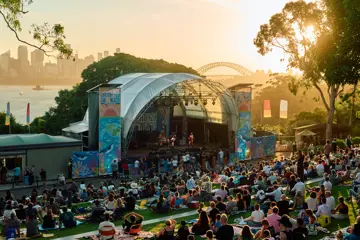
Beck's impending Australian sojourn is anchored around his headlining slot on the inaugural Sydney City Limits festival, and he's certainly no stranger to such communal events in this part of the world. Talk turns to his very first trip Down Under for the ill-fated Summersault touring circus in late '95/early '96, which found him somewhat confounding punters — who knew him mainly by his smash hit stoner rap Loser and the patchwork production styles of the album it came from, Mellow Gold (1994) — by playing sets of predominantly acoustic folk.
"Yeah, it's interesting because the way I started out was playing acoustic and I did that for many, many years," he tells. "So then Loser came out and that record, and at that point — and we weren't living in a world of internet so people weren't watching clips of me on YouTube — I would come out with an acoustic guitar and that was very representative of what I'd been doing for seven or eight years at that point.
"So it was a great way to do that tour, I couldn't really afford to bring a whole band with me down there, and that was an incredible tour to be a part of: Sonic Youth, Beastie Boys, Foo Fighters, Pavement, The Amps and so many more. I remember thinking at the time that it was a special moment with all these bands working together. And you never know, you know?
"I was playing on this little side stage — I wasn't on the main stage — but I remember on New Year's Eve in Sydney, I was the last to play on the side stage and then the Beasties were the last to play on the main stage, and we had this idea that they would come and join me on a freestyle on my stage, and I would finish off the song as they ran back to the main stage and finished it: we were trying to connect the stages!
"So part of that 'let's try something crazy and see if it works!' thing was kind of indicative of that era, where you could really go for it. Somebody would get a wild idea and the response would be, 'Let's try it out! Let's see what happens!'
"But you never know, I remember playing on that tour and Sia — who's an old friend of mine — told me years later, 'You know I was in the audience! I was in high school and I was in the audience when you played that show,' so it's all connected. Sia ended up being a great friend of mine and Greg Kurstin was playing with me at the time, so it's all interesting."
Further Australian festival appearances have highlighted the shapeshifting nature of Beck's live shows, whether the show-stealing choreographed puppet spectacular he brought to the 2006 V Festival in the wake of that year's The Information album, or the relatively straightforward band approach he favoured for his career overview sets at 2012's Harvest Festival.
Although his Harvest set in Brisbane nearly didn't happen at all when the entire Riverstage crowd was evacuated to escape a harrowing sub-tropical storm that ravaged the area just prior to his starting time, a fierce maelstrom that abated quickly enough for him to still dominate proceedings once the crowd returned to the now-sodden fray.
"Woah, that was really crazy," he laughs at the recollection. "That was really touch and go, that was a real storm. But we finished the whole show after the break, and I remember it being a great show. It was very surreal, getting ready to do a show and then the audience having to evacuate and then coming back and then saying, 'Ok, we're going to carry on!' That's the beauty of music, right? That's the beauty if it, it's this thing that kind of fixes everything. When the music's going you can forget all of the dramas and just lose yourself."
And fortunately, Beck has long enjoyed the way Australian crowds have lost themselves to his music, which augurs well for future returns.
"Yeah, it's one of my favourite places," he smiles. "I was lucky to get to Australia on my very first record — from the very beginning — and I grew up in California so there are things about the places that mirror each other.
"But it's a very unusual place in the world — I've been all over the world, and there's nothing quite like it. All bands love going there, it's always a highlight, and it's always some of the best shows. I like to go to Australia and see other bands there, because I like sitting in that audience. That audience has a kind of life that's very different — that's very engaged and appreciative, and it doesn't hold back."