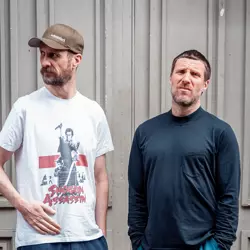
 Sleaford Mods Profile
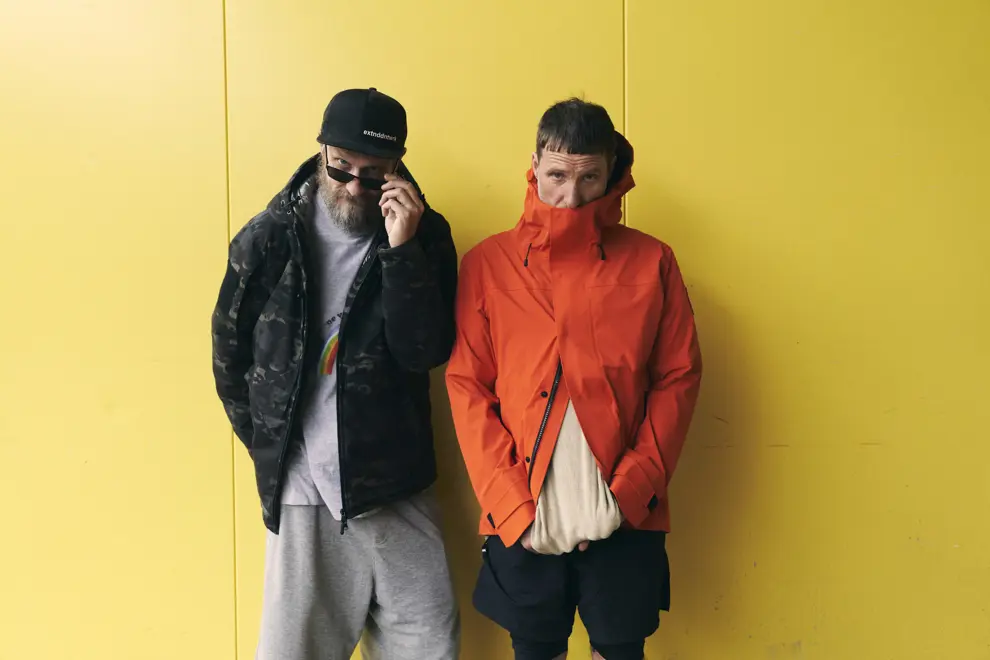
“I find myself, beside myself…” The motif of The Unwrap from Nottingham’s rough and ready gutter sages, Sleaford Mods. Lyricist Jason Williamson’s words cut through with a messy scansion that belies the prescience of their meaning. They hit. They make that other motif - “Yeah, I just buy stuff now” - hurt. Painfully real.
Yet, there is always the wry comedy and instrumentalist Andrew Fearn’s eclectic mixes behind the cut-through lyricism that brings equal levity and grit to the overall performance.
The Good Life, with guest vocals from Gwendoline Christie and BIG SPECIAL, has conviction, heralded by the opening decree: “So, I'm not punching down, lads.” On stage, both Jason and Andrew move with a frenetic and floppy energy, respectively, that persists throughout the hour-and-a-half set.
There is so much fury in the delivery of Megaton, yet so much hope for peace. Here, Williamson speaks truth to power (as always) with the refrain “No war, no death”. There’s also a classic gibe towards the upper classes and the characteristic double entendres. Lights flash hallucinatory pictures of clouds burned on the retina while the bassline thumps into our chests.
From there, the setlist becomes less a sequence and more a slow, coiled tightening. Williamson takes on something like a bardic role, if the bard had been dropped into a Midlands pub and handed a mic instead of a lyre.
He cavorts, half-preacher, half-provocateur, his body loose and erratic, yet always tethered to the pulse. Fearn, as ever, is the counterweight. Still, impassive, pressing play with the air of someone both in on the joke and entirely above it.
“How are ya, Sydney? It’s nice to see you again.” It lands warmly, but never softly.
By the time Flood the Zone rolls in, you can feel the floor beginning to give. A small pocket opens, tentative at first, bodies testing the edges of momentum.
The lights flicker with that frenetic buzzing, almost insect-like, needling at the periphery of vision while the rhythm takes over the centre. It builds without announcing itself. The room is being tuned rather than jolted with that birdsong he makes.
I Don’t Rate You arrives with that familiar sneer, Williamson at one point sucking his thumb, a grotesque infantilisation that somehow sharpens the contempt rather than diffusing it. The humour is there, but it cuts. It always cuts. There is something in the way he leans into the absurd that makes the critique land harder, not softer.
“It’s Friday, Sydney, fuck it.” And with that, the room shifts. Not an explosion, more the turning back of clocks. Something loosens. The fatigue of the week gets shrugged off, or at least momentarily misplaced. Williamson seems intent on rousing us from it, not gently but with a kind of joyful insistence, a refusal to let the crowd stay passive.
Mork n Mindy has a strange staying power live. It lingers. The beat locks in and refuses to let go, a kind of hypnotic insistence that draws everything tighter. It feels less like a song and more like the condition of the room. By now, the crowd has found its rhythm. What started as a shuffle becomes a surge. A small and tentative mosh builds with a sense of its own inevitability.
And then it tips. Not suddenly, but decisively. The movement gathers density, a push-and-pull that feels communal and satirical rather than aggressive. Somewhere in that swell, a buzz-headed woman rises above it all, arms splayed, carried across a shallow pocket of bodies. Not chaotic, not quite triumphant either. Something more open than that. A brief suspension that reads as a brazen trust. The kind of moment that reminds you why live music still matters.
Throughout, Williamson keeps threading between agitation and invitation. He goads, then grins, then doubles back with another line that stings. There is fury but also an odd generosity in the way he holds the room. He does not let it settle. He keeps it alive, keeps it slightly off balance, keeps it listening.
The lights continue their nervous flicker, never quite resolving into anything stable, while Fearn’s beats do the opposite, grounding everything with an almost stubborn consistency. That tension carries the set forward. Even the lulls feel intentional, like the drawing of breath before another push.
The run toward the end gathers a different kind of energy. Less frantic, more assured. You can feel the set consolidating, each track reinforcing the last, as if everything is being funnelled toward a single point. When it arrives, it feels both inevitable and oddly surprising.
Their take on West End Girls by Pet Shop Boys is not played for novelty. It lands with a kind of sideways sincerity. The gloss of the original is stripped back, replaced with something leaner, more pointed. Williamson delivers it with that same clipped intensity, letting the lines sit differently in the mouth. It becomes less about cool detachment and more about observation, about place, about class. The room meets it there.
By the end, there is a sense not of exhaustion but of having been worked through something. The set has built, loosened, tightened, and finally opened out again. Not catharsis exactly, but close enough to recognise. As the last notes settle, the feeling lingers. Something shared, something briefly aligned, before the lights come up and the spell gives way.