If you're not someone well-versed in the world of hip hop, or someone who pays attention to court cases relating to musicians, then there's every chance you may have missed the conclusion to this week's trial which centred around Afroman.
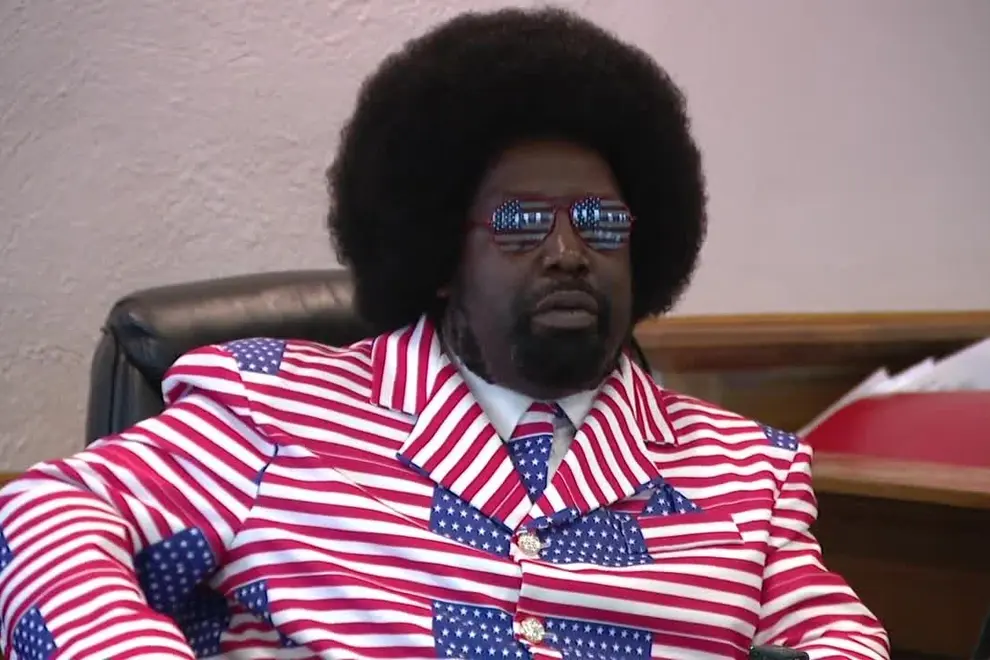
As intriguing as it is wild, it's a story of police raids, diss tracks, and defamation, and one that has briefly occupied the headlines thanks to Afroman's notable court wardrobe.
However, it's also a case whose origins spread back almost four years. So, in case you may have missed it, let's take a look at the facts of the matter.
Who Is Afroman?
The musician known as Afroman is Joseph Foreman, a Los Angeles-born rapper who rose to prominence at the start of the century thanks to his chart-topping single, Because I Got High.
Released in 2000 from his album of the same name, the marijuana-loving track was a surprising hit, and a prominent example of virality in the age of the early internet.
Used as the theme song to Kevin Smith's 2001 film Jay And Silent Bob Strike Back, it topped the Australian charts – a far cry from his follow-up single, Crazy Rap (or Colt 45), which would peak at No. 99 on the local charts.
Where Did The Legal Troubles Begin?
In August 2022, Afroman's home in Adams County, Ohio was raided by police while he was out of state, with officers reportedly conducting the raid on suspicion of kidnapping and drug trafficking.
Security camera footage from the event which was posted by Afroman after the fact shows officers holding guns and wearing bulletproof vests.
He claimed that his external gate, door, and security system were damaged in the raid, necessitating over $20,000 in repairs.
"Good thing my kids weren't home," Afroman later said in a video. "All of this for a vape pen."
During the raid, $5,000 was reportedly seized by officers, who believed it was connected to drug trafficking. However, the rapper later accused officers of tampering with evidence and stealing the money.
In December 2022, the money was returned to him – minus $400. However, deputies were later found to have miscounted the cash.
Afroman Responds
In January 2023, Afroman responded to the incident by releasing a record titled Lemon Pound Cake.
The album was largely a response to the raid, containing tracks like The Police Raid, Why You Disconnecting My Video Camera, Will You Help Repair My Door, and the title track, which focused on footage from the incident in which an officer is seen eyeing off the titular dessert on the rapper's kitchen counter.
However, lyrics such as "White supremacists on my premises" and the accompanying video clips – which utilised the footage of the raid and featured the officers in question – did not sit well with the Adams County Sheriff’s Office.
The Police Sue Afroman
In March 2023, officers sued Afroman, accusing him of invading their privacy by utilising their image in his videos.
This misdemeanour was also paired with a civil lawsuit, claiming the videos and social media posts resulted in "emotional distress, embarrassment, ridicule, loss of reputation and humiliation".
"I asked myself, as a powerless Black man in America, what can I do to the cops that kicked my door in, tried to kill me in front of my kids, stole my money and disconnected my cameras?" the rapper told NPR that same month.
"And the only thing I could come up with was make a funny rap song about them and make some money, use the money to pay for the damages they did and move on."
While Afroman did countersue to recover damages done to his home, the case was swiftly dismissed.
Later that year, a US court dismissed the claims that Afroman had used the officers' likeness for commercial gains, but allowed the case to go to trial in regard to the accusations of defamation.
The Trial Begins
In March 2026, the trial officially began, with Afroman choosing to wear a suit made of American flags during his time in court.
The prosecution's lawyer was seeking a total of US$3.9 million in damages.
On March 16th, Afroman was ordered to take the stand, where he pleaded his case and explained his side of the story.
"All of this is their fault," the rapper said. "If they hadn't wrongly raided my house, there would be no lawsuit, I would not know their names, they wouldn't be on my home surveillance system, and there would be no songs ... my money would still be intact."
"They're suing me for their mistake," he added.
Most notably, he claimed that it was his right to respond to the raid with art in this vein.
“After they left, I had the right to kick the can and to do what I had to do to repair the damage they brought to my house. Yes, I did,” Afroman claimed. “I have freedom of speech. I’m a rapper. I entertain.”
According to WCPO 9 Cincinnati, each of the officers suing Afroman took to the stand to explain their side of the story, including Deputy Lisa Phillips, who broke down in tears while watching a video from the rapper which alleged she had undergone a sex change operation.
Afroman agreed that Phillips was upset by the content of the video, adding "just like I was upset when she was standing in front of my kids with an AR-15 in her hand around the trigger."
Much of the attention to the case was focused on Afroman's lawyer, David Osborne Jr., who approached the claims made by the officers.
In one notable exchange, he grilled Sergeant Randy Walters in regard to the difference between fact and opinion.
“When they call you a son of a bitch, that would be an opinion?” Osborne asked Walters. “I’d say that would be an opinion,” Walters responded.
“Because there’s no way we can prove whether you’re a son of a bitch or not,” Osborne continued.
Another example included Osborne asking Walters about the validity of Afroman's claim that the rapper had sex with the Sergeant's wife.
"I’ve been with that woman since middle school but once someone puts it out there for their fun and entertainment it’s out there," Walters replied.
Much of Osborne's defence work was centred around Afroman's role as an entertainer, and whether or not he should be held to a higher standard as a public figure – much like police officers are typically expected to be.
"Look at that suit," Osborne asked during the trial. "Does this look like a man who thinks that everybody's going to assume that everything he's saying is fact?"
The Verdict
Ultimately, the case came to an end on Wednesday, March 18th, with the jury clearing the rapper of any liability for defamation or invasion of privacy.
"When life gives you lemons, you make lemon pound cake," the rapper told reporters after the verdict.
“I didn’t win. America won. America still has freedom of speech. It’s still for the people by the people.
"This whole thing is their fault," he added. "They broke into my house, put themselves on my video cameras, and into my music career. With my freedom of speech, I had the right to talk about the events going on in my life, with my family, with my friends, and with my fans."