Given the ubiquity of streaming in the current age, it's a little wild to revisit decades gone by and remember just how many disparate and competing methods of music discovery and consumption there were.
That's not to say that streaming is the only method these days. After all, just as many people who champion streaming services will write them off, instead opting for word of mouth, social media, or simply experiencing new music via live shows or new releases at their local music store.
However, there's no denying that the 21st century is an era in which music became increasingly digital and – as a result – the methods of musical discovery became so fractured and questionable, at times.
The Pre-Digital Age
Any discussion of music in the 21st century needs to be preceded by a discussion of where things were at the end of the 20th.
That was the century in which the modern music industry was formed. It was the era in which recorded music became a viable concept, and the time in which music began to be released for home consumption.
This is all pretty much basic information any music-lover would know, but from the '50s onwards, the ubiquitous nature of the radio began to feature real competition by way of a thriving record industry which pressed songs onto vinyl with increasing speed.
In the '70s, vinyl records were king, and while formats such as cassettes offered competition, this analogue method appeared safe from any sort of rival until the launch of CDs in the early '80s.
The CD ultimately became the "fastest-growing home entertainment product in history", and by 1988, its sales had overtaken vinyl, and cassette just three years later.
In 1986, sales in the US had hit 100 million, doubling by 1989. In 1999, sales exceeded 900 million for the first time, and the format hit its peak in 2000 – just in time for the digital age to start taking over.
The Digital Age
The digital age reared its head alongside the launch of the information age, in which internet connectivity began to thrive and ever-increasing internet speeds began to make the idea of sharing media with people around the world an ever-viable concept.
Sure, the bitrates of mp3s were kept small so as to ensure a speedy transfer, but even then, sharing a 96kbs audio recording over a dial-up connection was still a struggle. Even harder was the ability to track down the songs that you wanted.
Did you want to check out Blink-182's What's My Age Again? but didn't have the money to buy the single? Well, you'd better hope that you had a friend who did have the single.
But what if you didn't have that friend? What if, when the band's Enema Of The State album dropped on June 1st, 1999, you found yourself using a formative version of Google to try and find a way to track down the record for free?
Well, then you might have just stumbled upon Napster, which launched that same day.
For what it's worth, Napster was not the first peer-to-peer file sharing service, but it's up there as one of the most prominent.
For those unaware, a peer-to-peer file sharing service is sort of exactly what it sounds like, wherein users share files with other like-minded peers.
A similar concept to the earlier Usenet, one could imagine peer-to-peer file sharing as the equivalent of heading to the grocery store in search of an item. Perhaps you need rice, but your local supermarket is out? Well, instead of heading somewhere else, you could knock on your neighbour's door and get it there instead.
But what if we loosened the legalities and made the item more intangible? What if instead of heading to a music store on June 1st to grab the new Blink-182 album, you simply knocked on your proverbial neighbour's door and got them to send you the songs without paying?
Now, it's worth noting that while peer-to-peer file sharing services aren't inherently designed to facilitate piracy (there's nothing wrong with using these services to share files you've created yourself, for example), it did make piracy easier.
Napster, for example, allowed its users to share files. Many of these users shared music files. And while it might be perfectly legal (in many cases) to share bootleg concert recordings generated without any desire to make income, many of the files that were shared were copyrighted recordings.
That's why in late 1999, they became the target of A&M Records, who launched a copyright claim against the service.
They were far from the only ones to serve a suit against Napster, and famously in 2000, Metallica decided to put the service in their sights after they discovered their song I Disappear – which had been recorded for the Mission: Impossible 2 soundtrack – had leaked early.
From there, it began to spiral. Acts like Madonna and Radiohead had their music leak onto the service, and names like Dr. Dre got in on the lawsuit.
While Napster's traffic would peak in February of 2001, the service would settle its lawsuits and begin to shut down. Though it attempted to become a legal service with a subscription-based model, they filed for bankruptcy in June of 2002.
Utilising Google Trends data, we can actually see something of a real-time look at how interest in Napster declined.
In a graph of search interest over a specific time period, Google Trends shows the data on a relative scale from 0 to 100: zero suggests insufficient data, 50 indicates half the popularity, and 100 signifies the peak interest during a time period.
It's worth noting that Google's data goes back to 2004 – two years after Napster had shuttered – but looking at the term's trajectory on Google Trends, it hit a peak in February 2005 at 100, and it's been a constant decline ever since, indicating that it's slowly fallen out of the public consciousness since.
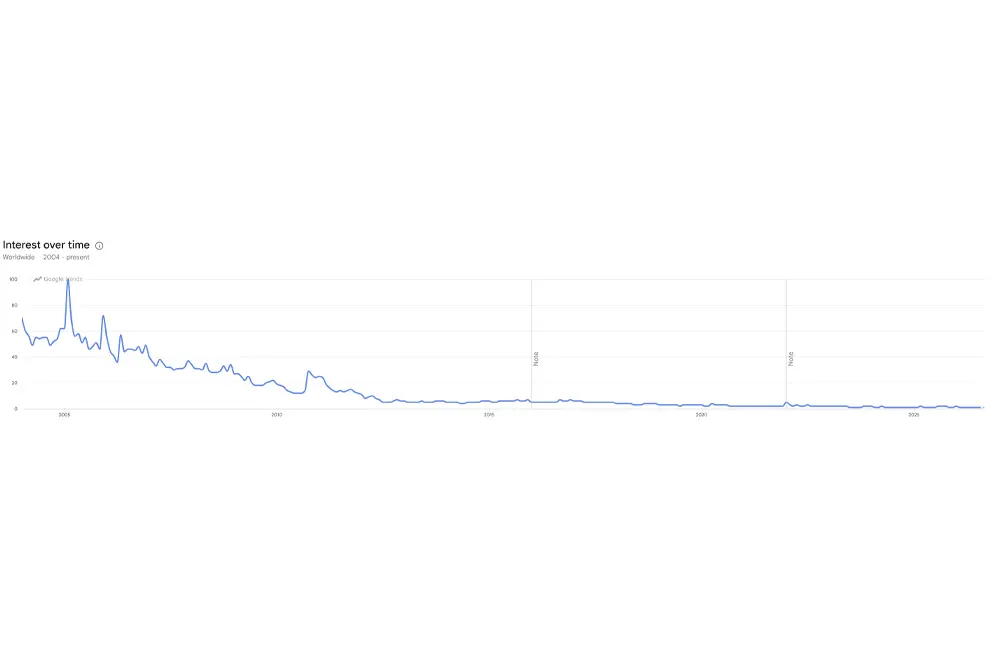
Google Trends searches for "Napster” between 2004 and 2026.
The issue, however, is that one can't put the genie back in the bottle once music-lovers have found a way to get music for free. So other technologies and platforms began to emerge.
This is where we start to see other platforms show up intent on aping the success of Napster, and we see other technologies emerge, including the likes of Bittorrent (effectively a peer-to-peer service which can handle larger file sizes, and a greater number of files).
Much like Napster, we can see interest in the Bittorrent technology – which first emerged around 2001 – reach a peak in December 2004, at which point it slowly fell away, effectively being close to baseline over the past decade.
Searches for 'torrents' in general reached parity with the technology in December 2005, and while it remains higher than its counterpart for most of the time since (including a slight bump around the start of 2015), they've both reached a minimal level of interest.
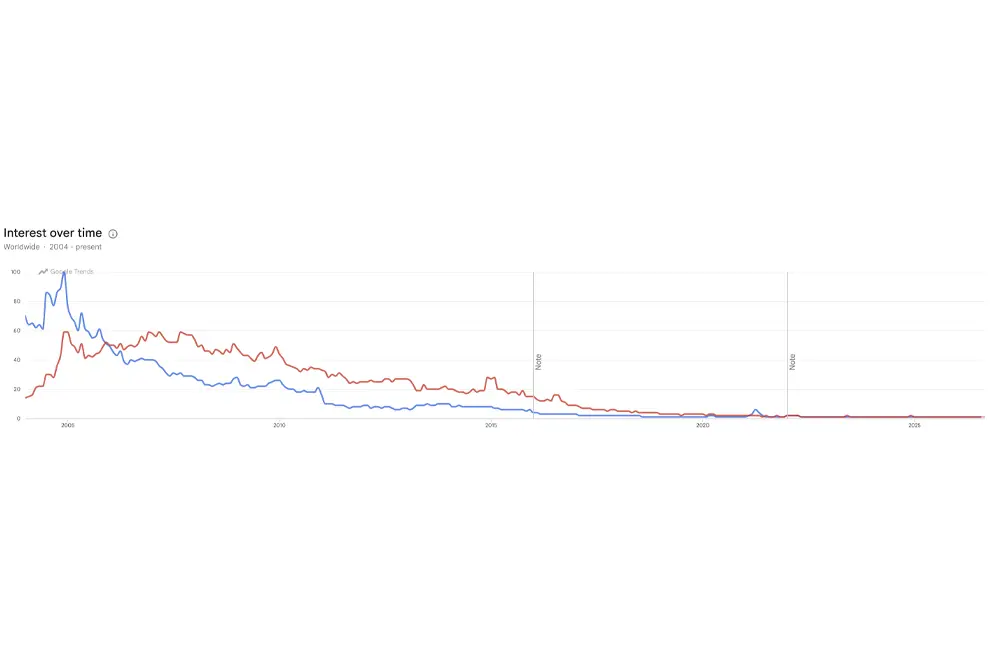
Google Trends searches for "Bittorrent” between 2004 and 2026.
However, the music industry wasn't exactly keen on music fans being able to simply nab their favourite songs for free. After all, if fans get everything for free, the labels make no money, the artists don't get paid, and there's no money to make music.
So, this is where we found a noted shift toward online music stores.
The first online music store emerged after Napster had first debuted, with Bitmusic arriving via Sony Music Entertainment Japan. However, it was a tough slog to compete with selling music when fans could simply find the same material for free.
Various digital outlets emerged, many of them simply run by individual labels, offering only artists they had the rights to, and for various price points.
However, 2001 didn't just bring with it the closure of Napster, it heralded the launch of the iPod – a digital music revolution in which music was suddenly far more portable than it was previously.
It was Apple that really helped to kick off the idea of a successful digital music store, with the iTunes Music Store launching in April 2003. Songs were typically priced at around USD $0.99, making it accessible and relatively cost effective, and in time, the store went international, launching in Australia in 2005.
A major draw here was the ease of using the iTunes store given the ubiquity of the iPod, and with an ever-expanding catalogue, a moderate price point, and a consistent level of quality (in addition to not needing to weed through countless ads and viruses), the iTunes Store seemed like the way of the future.
We can see how fast the iTunes store became popular, too. Though originally called the 'iTunes Music Store', it quickly became called the 'iTunes Store'.
Both phrases were relatively even in terms of their popularity in June 2004, but by August 2005 – when the former hit a peak of 22 – the latter had begun to skyrocket. By December 2008, 'iTunes Store' was at 74 while 'iTunes Music Store' was at 5. When the 'iTunes Store' hit a peak of 100 in December 2012, its counterpart was at 4.
These days, popularity of both has waned, and while 'iTunes Store' has an interest level of 5, its rival sits at 1.
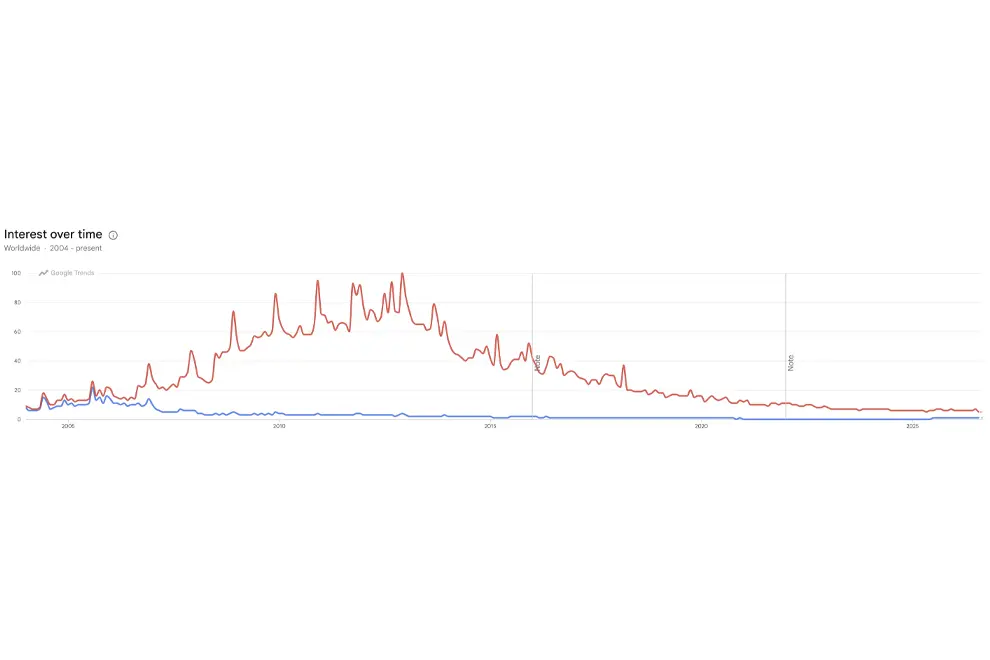
Google Trends searches for "iTunes Music Store” (blue) and "iTunes Store" (red) between 2004 and 2026.
So legal music had become far more popular, effective, affordable, and widespread. However, piracy was still a major problem for the labels.
The issue was, that as moves were made in the right direction, accelerating internet speeds, greater amounts of storage, and exposure to more and more artists left music lovers with greater appetites than ever before.
Previously, it was one thing to have a favourite song for a week, but as music almost began to be seen as a throwaway commodity, tastes changed rapidly, and it was easy to skip your current favourite song in favour of a new one. Music fans again found themselves wondering why they were paying for music when the alternative was greater amounts for far less.
Sure, artists like MC Lars made tracks like Download This Song both championing and deriding the concept while criticising high-profile lawsuits against small-time targets, but it didn't stop platforms like Limewire amassing vast amounts of new users as they searched for their favourite songs (and found either viruses or poor imitations of Bill Clinton).
So how did the likes of Limewire compare to torrents and legal methods of audio?
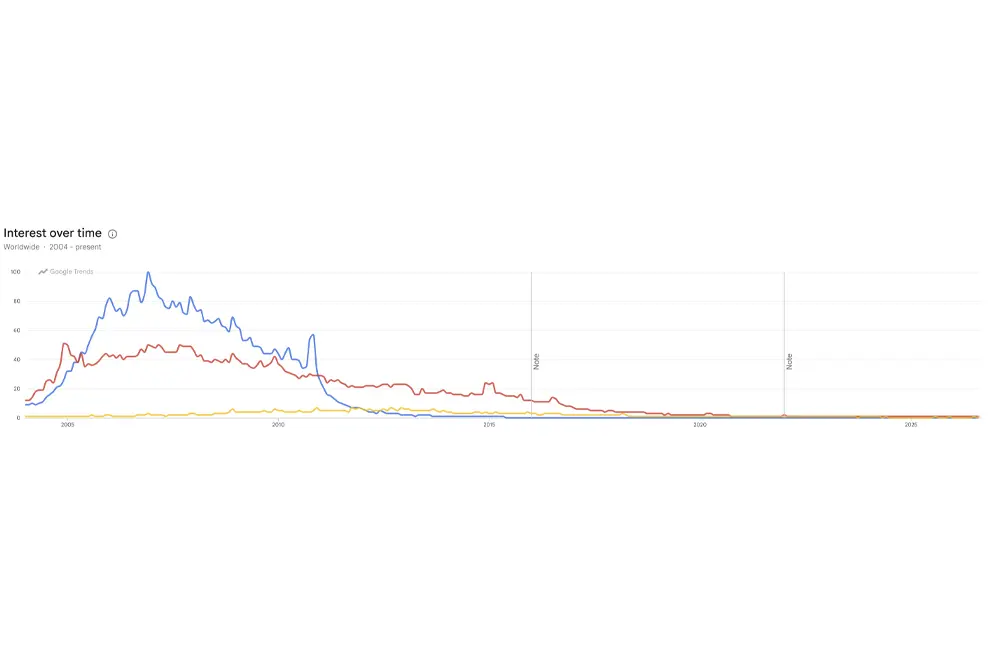
Google Trends searches for "Limewire” (blue), "torrents” (red) and "iTunes Store" (yellow) between 2004 and 2026.
We've seen how popular the iTunes Store was, but while torrents were an early search favourite, Limewire quickly breezed past both. In April 2005, the illegal methods were at a parity of 38, and in December 2006, Limewire hit 100 to torrents' 50, while the iTunes store was at 3.
Interest in Limewire would soon drop, though it remained above torrents until December 2010, when they both reached a rough parity once again. Limewire bottomed out soon afterwards, with the iTunes Store overtaking it, though torrents remained on top. Limewire has been at 0 since 2015, and both torrents and the iTunes Store have largely skidded on the bottom since.
One technology we've not paid much mind to here, however, is that of streaming.
Though it feels like a far more modern technology, streaming was around in the modern sense since the '90s, when burgeoning internet speeds allowed content to be downloaded as quickly as it could be played.
Typically, this was for low-bitrate audio or similarly economic videos, though if one wanted to get really pedantic, you could go back to 1881 for the beginning of this technology, when the Théâtrophone allowed opera-lovers to listen to performances via the phone.
However, in the 20th and 21st century, as internet speeds increased, so too did the capabilities of streaming. While platforms like MP3.com and Rhapsody were early proponents of the technology, so too did Myspace make it a more accessible technology for the younger generation.
In 2006, however, Sweden witnessed the founding of Spotify, a platform which would officially launch two years later as a legal alternative to music piracy.
The idea was that, instead of making listeners pay a fixed rate per song, they could purchase a subscription to the service, allowing them to listen to as much music as their plan allowed per month. Artists would be paid proportionally depending on their streams, and everyone would be happy.
It was a novel idea, and one that swiftly took off, with more and more artists finding themselves on board.
Most notably, it also appeared to be the best move for the music industry in terms of legal music discovery in the face of piracy.
In fact, if we add Spotify onto our recent graph of searches relating to Limewire, torrents, and the iTunes Store, we can see that as early as 2009, the Swedish streamer had overtaken the iTunes store. It would overtake Limewire during its downslide in 2011, and by the end of that same year, it had overtaken torrents for the first time.
It's been a clear winner for the past 15 years, and in December 2024, it reached an all-time peak of 100. For comparison, searches for torrents were at 1, and the others had flatlined.
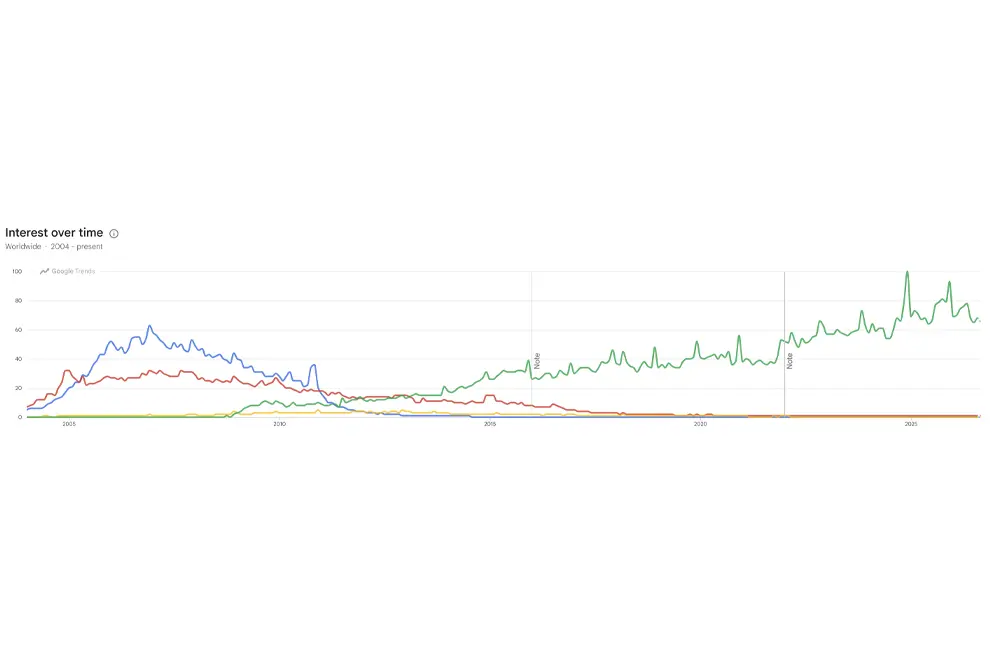
Google Trends searches for "Limewire” (blue), "torrents” (red), "iTunes Store" (yellow), and "Spotify" (green) between 2004 and 2026.
Even now, it appears as though Spotify has become the winner in terms of searches for music consumption. It breezes right past searches for 'music streaming', and even when we throw in the likes of 'vinyl' and CD', we can see that since June 2011, it's been a clear winner. In fact, when the peak of interest in December 2024 saw Spotify at 100, 'vinyl' was at 19' and 'CDs' were at 4.
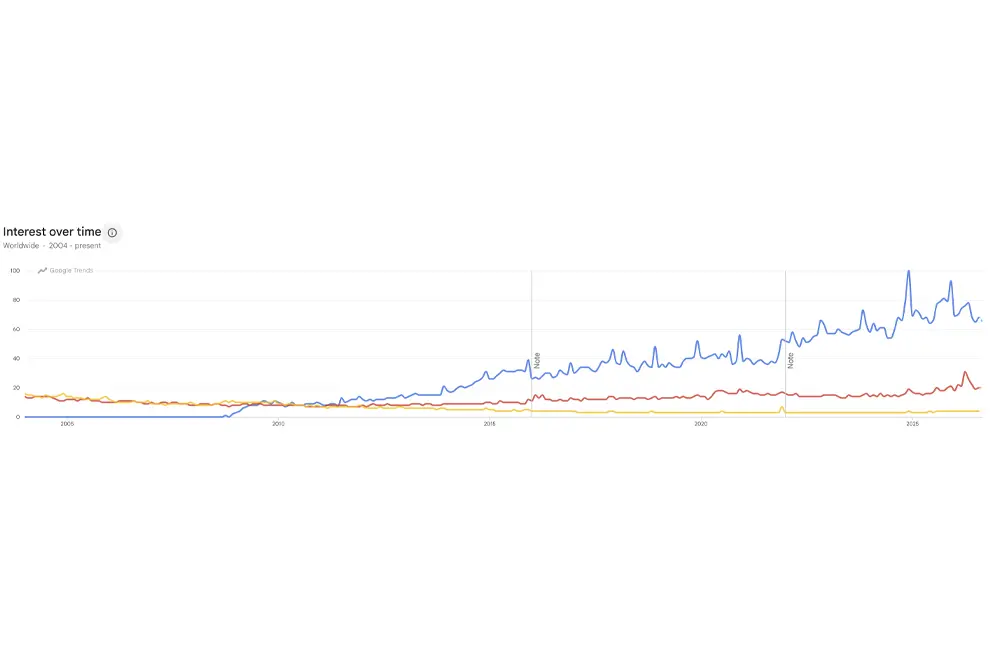
Google Trends searches for "Spotify” (blue), "vinyl” (red), and "CDs" (yellow) between 2004 and 2026.