In the week that the CISAC Board of Directors convenes in Australia for the first time in 25 years, APRA AMCOS and Canada’s Society of Composers, Authors and Music Publishers of Canada (SOCAN) have issued a joint statement about creative industries and artificial intelligence.
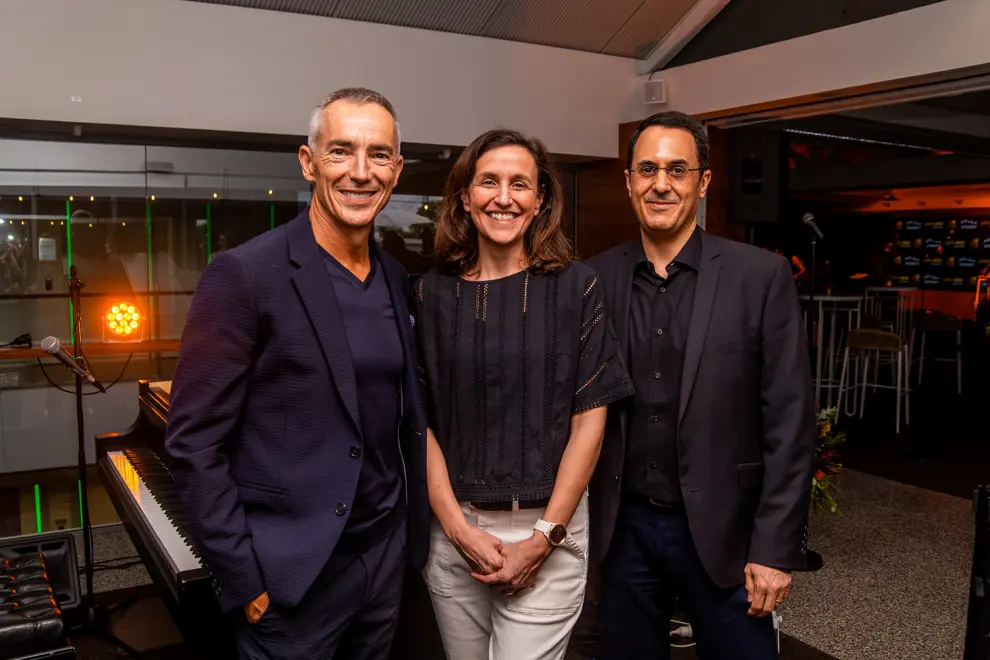
APRA AMCOS and SOCAN have teamed up as Canada’s Prime Minister, Mark Carney, visits the Australian Parliament. SOCAN CEO Jennifer Brown is in Sydney this week, attending the CISAC Board of Directors meeting, hosted by APRA AMCOS.
Collectively, APRA AMCOS and SOCAN represent nearly 400,000 songwriters, composers, and music publishers across Australia, Aotearoa/New Zealand and Canada. Together, the artists’ rights organisations are attempting to determine the impact of AI development, and whether it expands at the cost of artists whose work generative AI platforms pull from.
As recently reported, Australia became the first country in the world to deny a copyright exemption for AI training and data mining, instead looking to secure a practical licensing framework. Canada is facing the same issue.
Together, APRA AMCOS CEO Dean Ormston and SOCAN CEO Jennifer Brown have noted that the sustainable and productive path forward is to make a “genuine” partnership between the technology sector and music industry.
“That means consent before use, transparency about what is used, and fair remuneration that flows back to creators and the communities they belong to,” the pair said. “It means AI development that enhances the quality and diversity of human creativity rather than cannibalising it.”
Ormston and Brown noted that Australia and Canada face a shared unique challenge: the protection of Indigenous Cultural Intellectual Property.
Australia’s Aboriginal and Torres Strait Islander peoples and Canada’s First Nations, Inuit, and Métis peoples all retain cultural knowledge in music, story, language, and ceremony, which Ormston and Brown say AI systems are “harvesting without consent.”
“This is not a niche concern. It is a test of whether the values both governments have affirmed today, respect for First Nations cultures and peoples, are reflected in the practical architecture of AI governance,” they said.
Adding that Australia and New Zealand are already recognised as world leaders in education, innovation, minerals, and strong democratic institutions, Ormston and Brown described the current moment as a “unique opportunity” to introduce a framework for AI development.
In it, they seek to protect cultural stories and a partnership between creators and technology. They concluded that culture must be part of the foundation in re-shaping rules and regulations around AI.
Read the joint statement in its entirety below.
As Prime Minister Albanese welcomed Prime Minister Carney to the Australian Parliament yesterday, he said it plainly: “As two middle powers in an era of strategic competition, Australia and Canada must seek and create new ways to stand with and for each other.” Prime Minister Carney was equally direct about the stakes: that nations like ours must work together on the development of Artificial Intelligence or risk being caught “between the hyperscalers and the hegemons.” We agree on both counts, and we believe the creative economy is where that solidarity must be tested and proved.
We collectively represent almost 400,000 songwriters, composers, and music publishers across Australia, Aotearoa New Zealand and Canada. The shape of that framework matters enormously. It will determine whether AI development generates broad cultural and economic returns, or whether those returns flow overwhelmingly to a small number of global technology platforms at the expense of the artists whose work made AI possible.
Middle-power nations are uniquely placed to answer this question. Australia has already demonstrated that: becoming the first country in the world to rule out a copyright exception for AI training and beginning work on a practical licensing framework instead. Canada is engaged in the same contest. Both countries understand that the choice is not between innovation and creator protection: it is a false choice, and a self-interested one, advanced by those who prefer to avoid the importance of artists and creators in the technological development of AI.
The sustainable path, and ultimately the more productive one, is a genuine partnership between the technology sector and the people who create the content that gives it value. That means consent before use, transparency about what is used, and fair remuneration that flows back to creators and the communities they belong to. It means AI development that enhances the quality and diversity of human creativity rather than cannibalising it.
APRA and SOCAN have each spent a century navigating technological change on behalf of creators, from radio to streaming, and now to AI. The licensing infrastructure exists. The expertise exists. The partnerships between our two governments create the right conditions to build the frameworks that make it work.
There is one dimension of this challenge that is uniquely shared between our two nations: the protection of Indigenous Cultural Intellectual Property. Australia’s Aboriginal and Torres Strait Islander peoples and Canada’s First Nations, Inuit, and Métis peoples each hold living cultural knowledge, in song, story, language and ceremony that AI systems are already harvesting without consent. This is not a niche concern. It is a test of whether the values both governments have affirmed today, respect for First Nations cultures and peoples, are reflected in the practical architecture of AI governance.
Australia and Canada are already recognised as leaders in education, innovation, critical minerals and in the strength of their democratic institutions. We believe this moment presents a unique opportunity to add another pillar: a framework for AI development that treats cultural wealth as a sovereign asset alongside those strengths, that brings creators into genuine partnership with technology, and that the rest of the world can look to as a model.
If middle powers are to shape the rules of the AI era rather than simply inherit them, culture is not a footnote to that mission. It is part of the foundation. We look forward to working with both governments to build it.
Dean Ormston
Chief Executive Officer, APRA AMCOS
Jennifer Brown
Chief Executive Officer, SOCAN