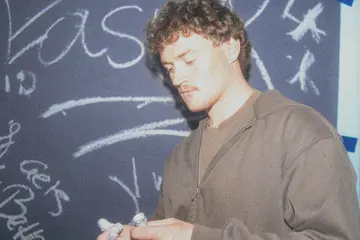
Luke Girgis is a disruptive figure in the music industry, swooping in with his partner Sam Benjamin to take over beloved industry publications including Tone Deaf, The Brag and The Music Network and resurrecting the Australian version of Rolling Stone to create Australia’s most successful music media exit with The Brag Media. Becoming a ubiquitous force at the turn of the decade, his crash or crash through style was a shot in the arm for the profile of Australian music media, building an operation that resulted in the business’ eventual sale to Vinyl Group in 2024.
Girgis went on to become CEO at Providoor after a controversial exit from Vinyl later in 2024, turning the ailing food delivery operation around before exiting in December last year to concentrate on his growing artist management business and investment portfolio. This month, he released his first book, detailing the systems and strategies he has learned across his time in business, creating a short but punchy guide for entrepreneurs looking to take advantage of AI transformation. The book, Death To The Org Chart, is an implementable method to automating and simplifying systems to allow workers more time to concentrate on decision making and action.
“It [the concept] started at Providoor because I didn't know anything about hospitality or e-commerce, so I was breaking down the workflows just so I could learn and understand,” explained Girgis. “Just as I became competent in that, AI technology came out. I realized I had already broken down the business into such incredible micro-workflows that when open-source technology came out, I was able to just bring it in and replace a lot of these micro-level workflows we were doing. That just opened up capacity for so much of the team.”
Girgis’ path to the systems-first model outlined in his book came from his experience running The Brag Media, in an endless struggle against rising costs and squeezed margins.
“Towards the end at The Brag Media, I spent most of my weeks trying to figure out how to become more efficient because we had incredible revenue but a very poor margin—around 4%,” he revealed. “Everywhere I looked in the business, I couldn't figure out how to gain material efficiency. We made small improvements around the edges, but nothing significant. We would get a massive new $300,000 contract in, and suddenly I'd need to hire more contractors to deliver it, swallowing up the revenue. It was a nightmare.”
Don't miss a beat with our FREE daily newsletter
“I decided I never wanted to be in that situation again with any business or revenue stream. I committed to really scrutinizing overheads and cost of goods before taking on any new business. That was the lens I brought to Providoor. Since it was an existing business that I could look at with a fresh pair of eyes.”
Reflecting on his own time building The Brag Media, Girgis said that his initial attraction to the media space was through managing bands and thinking he could do a better job managing media brands using the same principles after watching companies like Vice go through exponential growth. He drummed up funding from his friend and mentor Benjamin and brought in editor and running-mate Poppy Reid, embarking on a journey that he says was problematic from early on in the business.
“Unfortunately, we bought right where the bubble burst. By the time we sold The Brag Media, Vice was worth $300 million, down from $5.7 billion. We really jumped on the wrong wave. The whole ecosystem of what Google and social media did to publications made it impossible to run the business like I was managing bands. Originally the thesis was strong, but it fell apart a few months into the business.”
Girgis credits the eventual success of The Brag to his friend and investor Benjamin, dedicating his book to him.
“There is no chance The Brag Media would have survived or been successful without Sam's unwavering support of Poppy and me, as well as his leadership and mentorship. I remember he said he wanted to put up $1 million in The Brag Media to [get it to] break even. We agreed on a plan and he signed off on it. A few months in, I saw the writing on the wall and didn't believe in the plan anymore. I told him we had to pivot and do X, Y, and Z. He said, 'Mate, if you do that, you're going to burn through all the money and it won't work.'”
Despite his investor's protests, Girgis embarked on the new plan, pivoting to a fast-growth, high-spend strategy and Benjamin reluctantly backed the new plan.
“I think I burnt through all of our cash in about six or seven months when it should have taken us about 18 months to two years. He let me make the mistake, and I lost a lot of his money by spending far more on The Brag Media than we should have. I thought I was done and that we were going to pack up shop. Then he said, ‘Well, I've just spent $800,000 teaching you a lesson, so now go and apply the lesson and let's actually make this business work’. I think publishing is almost impossible to make successful, but somehow we limped over the line.”
The Brag Media sold to Vinyl Group in 2024 for a reported $8 million plus a further $2 million performance payment for Girgis, who was to stay on with the business to steer the media division under CEO and fellow startup founder Josh Simons. The relationship soured quickly, with Girgis exiting in June 2024 after a “business review”. He subsequently sued Vinyl Group for $2 million alongside compensation for lost remuneration, bonuses and share options. Vinyl has since lodged a counterclaim against Girgis for misconduct, which he strongly denies.
Girgis declined to comment on the ongoing situation other than to confirm that the court proceedings were still on foot. Not one to live in the past though, the lessons he learned in the media business were the birth of his new book.
At Providoor, Girgis refined the method outlined in Death To The Org Chart, taking on a business that he reports was losing $400,000 a month with thirty employees to a sustainable break-even position. In what was a massive turnaround, Girgis said his next biggest lesson was one that came with the confidence to back his own judgement.
“If a process or job doesn't make sense to you, it's likely unnecessary or bullshit,” he said. “There are so many jobs out there that look complicated, convoluted, and super important for whatever reason. No matter how many times they're explained to me, I still don't get them. Any time those workflows, tasks, or roles have been eliminated, I haven't regretted it once. If I don't understand it, it can probably go.”
“That's the problem with imposter syndrome: you go into media having never done it, you manage artists having never managed them, or you manage a kitchen and e-commerce site having done neither. When you don't understand something, it takes a long time to get over imposter syndrome because you assume you don't understand it because you're an idiot. I am an idiot, but I also don't regret getting rid of things I don't understand. That's my biggest lesson.”
Girgis explained that the advent of AI coding has enabled the customisation of software and systems like never before, with his own house-made artist management CRM and contract management workflow an example of how, even without technical coding skill, simplistic previously human-driven tasks can be automated to create more time.
“Our artists have never made more money,” he said frankly. “I feel like every hour an artist manager spends doing admin is literally an hour stolen from an artist's career, because they get no benefit from you updating spreadsheets, running your to-do list, or chasing these contracts. All of that does not actually affect the bottom line. Once I alleviated all of that admin from our business, our artist managers were able to focus purely on revenue and strategy. Not one artist on our roster who hasn't made significantly more money this year than in any of the previous three years. There is not one exception.”
Through his method, the book’s confrontational title was born, placing systems and tasks at the centre of business strategy rather than job titles and humans. According to Girgis, the biggest thing holding businesses back is thinking that they are unique and cannot be systemised.
“We don't think micro enough. We look at an artist management business, for example, and think, 'There are so many different nuances about every single one of my artists—what they like, what they don't like, what the brand wants, what the artist is willing to accept, and how every deal gets rolled out. It IS truly unique—even the way I run my artist management firm is so different from any other artist manager because their roster, how their artists work, and their staff are completely different from mine.'”
“If, however, I go micro and ask, ‘What do I actually do?’ A deal comes into my inbox, I respond with questions, I get those answers, I negotiate them further, we get a contract, we send it to the lawyer, and the lawyer gives us a markup. You can even break down what the lawyer is doing and ask if we can automate that. If you break down all the micro-steps of what you do, there is at least some part of your business whose workflows are not unique, and those are the things you can automate. But if you think too macro, you'll always think you're too special to receive help.”
Girgis is quick to point out though, that automation only works when there is truly a task that can’t be better handled by a human. His own audiobook, for example, is narrated by famed reader Scott Brick.
“I just like his voice, and I wanted to work with him. So I hit him up, and since I don't think I'm ever going to write another book in my life, I thought I might as well get the GOAT. The art I could achieve out of the human voice of Scott Brick [Scott Brick], as a fan of his, brought me far more joy than if I had a perfect AI version.”
With the debate on around AI replacing humans and a potentially looming upheaval of the workforce, the ethical debate over the use of AI is raging, but for Girgis, the red line is simple. If the AI can do the work and the sources the AI have been trained on are permissive and compensated, then it’s simply a technological evolution worth jumping on.
He is more skeptical, however, on whether the ethics of compensation is achievable, saying that as an artist manager, while he supports IP protection and manages his artists with that in mind, he doesn’t truly believe that it is viable in the long term.
“I don't think there is anything we can do to stop the IP theft by AI. I think all this championing in Parliament is a bit like the fight against global warming in Australia. We're only 20 million people in the whole world. I drive an electric car and I love it, but if everyone in Australia drives an electric car, we're not going to put a small dent into any global warming metric when you've got countries like India, Africa, Russia, and China ignoring it if they choose to. It wouldn't make a dent. That is the case with AI. If we have a super-strict IP law that protects Australian artists, it's not going to matter when open-source models hit around the world.”
An ominous pointer from someone whose previous media business The Brag relied on its creation of IP, Girgis sees the ailing media industry as retreating into a territory where it is uninvestable, but will not disappear.
“Multinational media operations starting from scratch are going to be very hard to do. The big multinationals are having their equity hammered, and those massive global brands will be sold for pennies on the dollar in the next few years. However, if you have a local media business, you can turn it into a very healthy small business. There is a lot of value in that for both the industry and the owner.”
Phew.
Death To The Org Chart is available from August 20. Pre-order your copy here.