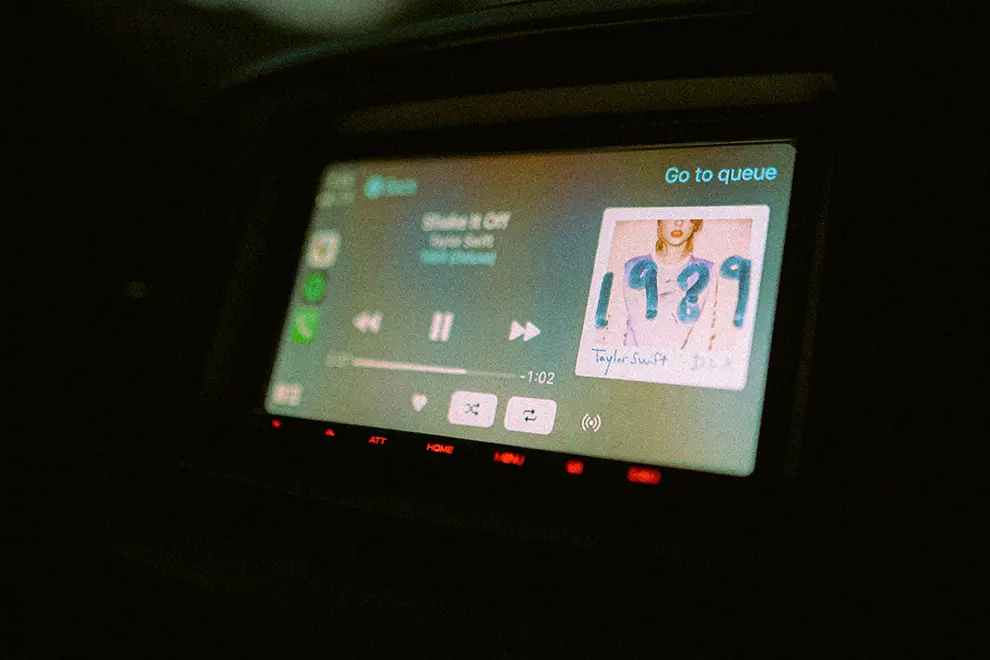
 Taylor Swift Profile
For years, police and road safety organisations have done their best to publicise the risks involved in dangerous driving. From drinking, speeding, and using mobile phones, motorists are well across the dangers.
However, a new study seems to indicate a high-profile New Music Friday also needs to be added to that list.
The study – spearheaded by Harvard Medical School researchers Drs Vishal Patel, Christopher Worsham, Michael Liu, and Anupam Jena – is fittingly titled Smartphones, Online Music Streaming, and Traffic Fatalities and specifically seeks to answer the question of whether the use of smartphones to stream music is associated with increases in traffic fatalities.
To investigate, the team utilised a registry of fatal motor vehicle accidents in the US and specifically focused in on the ten days before and after the ten most-streamed albums released between January 1st, 2017 and December 31st, 2022, as per Spotify’s data.
Looking at records such as Taylor Swift's Midnights, Red (Taylor's Version), and Folklore (the first, ninth, and tenth most-streamed records from this period), and the likes of Drake's Certified Lover Boy and Scorpion, Bad Bunny's Un Verano Sin Ti, Harry Styles’ Harry’s House, and Kendrick Lamar's Mr Morale & The Big Steppers, the researchers determined the lion’s share of these streams occurred on release day – typically a Friday – with streams being lower on the five days either side.
Taking into account other variables such as the time of the year, public holidays, and other similar factors, the findings revealed that on the day of major album releases, US traffic fatalities had a relative increase of 15.1% when compared to similar days, while streams on those same days increased by roughly 43%.
“This is equivalent to approximately 182 fatalities in the US attributable to the release days of the 10 included albums,” the team concludes in their findings.
The study also points out that, “Excess fatalities occurring on album release days were higher among drivers who were younger and male and among crashes where a single occupant was involved, the weather was clear, alcohol was not involved, and vehicles were manufactured with infotainment systems.”
Effectively, the findings revolve around the notion that release days result in higher rates of distracted driving. However, while the team are careful to point out that this correlation does not imply causation, Patel explained to Gizmodo that the “alternative explanations don’t hold up well”.
So, how can these findings be used? As Patel explains, it would be prudent for streaming platforms to offer users warning reminding them to set up their music prior to driving, while other measures – including vehicle design and lawmaking – could also adapt to respond to an increased desire for streaming music while driving.
Simply, Patel tells the publication that asking someone else to handle the music – when possible – is a crucial step. “If someone’s in the passenger seat, hand it to them,” he told Gizmodo. “That was the closest thing we found to a protective factor: the increase showed up almost entirely among drivers who were alone.
“And if a song comes to mind mid-drive, it will still be there when you park,” he added.
Read the full findings of the study here.