With funding from the NSW Government through Sound NSW, the Australian Festival Association (AFA) has published the first industry-led Festival Blueprint in Australia.
It provides a highly detailed simple-to-read cross-reference living resource for NSW events, with practical operational guidance, regulatory information, and insights from industry executives based on real events.
The AFA represents over 85 promoters, suppliers, and industry stakeholders. It was set up in 2018 to advocate for policy reform, industry collaboration, and best-practice standards.
It’s dropped the first five chapters, with others to be drip-fed. The aim is to educate the Australia-wide sector eventually.
“The Festival Blueprint consolidates the festival industry's collective knowledge, guiding organisers of every scale to deliver safe, well-run events that communities love,” points out Adelle Robinson, Chair of the AFA and CEO of Fuzzy Operations.
“We know festivals face real pressure and as an organisation we want to make sure festivals are leading the way with best practice. The AFA was founded to bring industry together and raise the standard collectively, the Festival Blueprint is that vision realised.”
Adds Emily Collins, Head of Sound NSW, “The launch of the Festival Blueprint marks a significant milestone for the NSW festival industry and sets a strong foundation for the sector's future.
“Festivals bring communities together, create opportunities for artists and contribute enormously to the cultural life of our state.
“As the industry navigates ongoing challenges, having a shared best practice framework that is co-designed and industry-led is a confident step forward for festivals.
“Sound NSW is proud to have supported the development of the Festival Blueprint and looks forward to seeing it continue to evolve through ongoing collaboration across the festival sector."
Contributors
More than 70 contributors helped shape the Festival Blueprint, giving practical guidance to navigate planning, risk management, and requirements with up-to-date insight.
Ask veteran festival promoters about the most common mistakes festivals make, and some issues keep recurring.
They include poor budget management, failure to have strong ideals around which to plan, lousy site layouts, failure to understand when and where the biggest risks lie, under-staffing and over reliance on volunteers, sloppy common sense like not enough shade and toilets, poor communication with emergency services and councils, and failure to market and promote properly.
These worsen as festival promoters face the pressure to cut financial corners or rush bureaucratic processes through.
According to past AFA studies, 47% of festivals are impacted by rising operational costs, lack of funding and grants available (39%), insurance (31%), and extreme weather events (22%).
Creative Victoria’s ground breaking Soundcheck report revealed that the average cost to run a music festival is $3.9 million while only 56% of music festivals in 2022/23 were profitable. More than one in three reported a deficit.
Festival Blueprint was developed through input from festivals, government agencies, regulators, emergency services, accessibility specialists, First Nations advisors, crowd safety specialists, and international event experts.
Chapters look at legal responsibilities, crowd management and security, medical & harm management, emergency risk, event management, crowd and movement, First Nations respect, engagement with police, emergency services and councils, food, waste and environment, as well as equality and inclusion.
The section on Regulatory & Compliance starts with the Music Festivals Act (NSW), explaining how it applies in practice and what organisers need to know to run a music festival in NSW.
For new-to-the-game promoters comes the warning, “What counts as a music festival? Many events commonly referred to as concerts may legally fall within the definition of a music festival under NSW legislation.”
Every festival needs to prepare a Health & Medical Plan (HMP) in accordance with NSW Health guidelines. This has to be begun 120 days before gates open.
“Your HMP is more than a compliance document,” it relays. “A strong HMP integrates medical planning, welfare, crowd safety and emergency response into a single operational framework.”
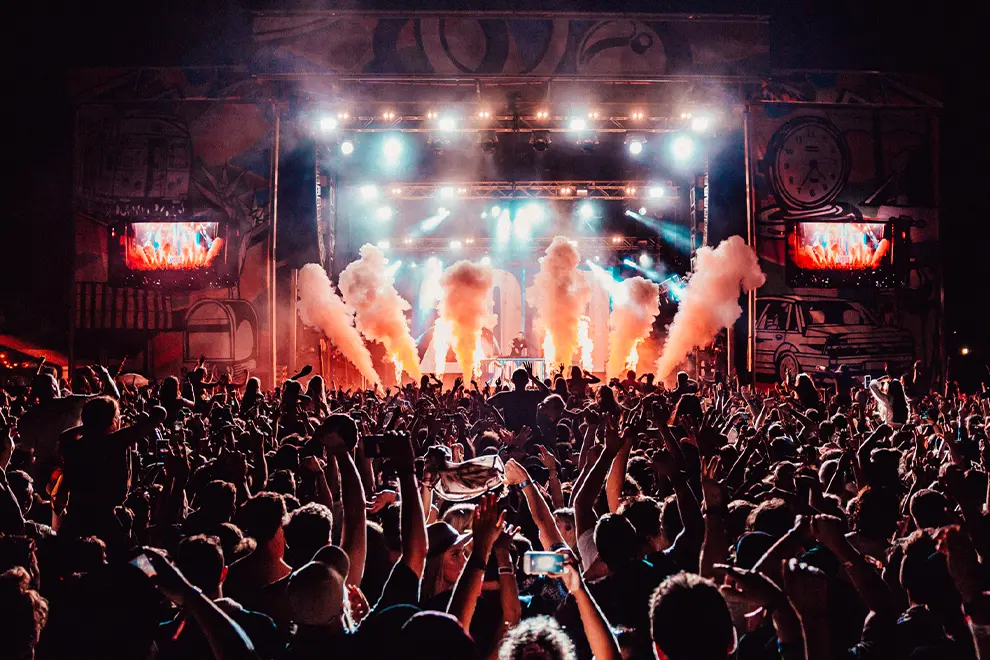
Well-planned crowd management is ensuring patrons have an enjoyable heightened experience with minimal realisation they are being hit with strict security controls.
The insight for this: “Clear signposting, smooth queuing, and efficient spatial layouts reduce attendee stress and directly elevate the overall event atmosphere.
“Involve your crowd manager during the initial site design phase before locking in layouts or launching ticket sales. Resolving layout pinch points on paper prevents permanent physical hazards once site build begins.”
Crowd crushes and inevitable lawsuits are a common occurrence at music tribal gatherings.
According to Festival Blueprint, “Crowd disasters happen when multiple protective measures break down at the same time. Your strategy must combine robust site design, trained staff, clear communications, and tested emergency plans.”
Having a large enough scape is important to guide crowds smoothly, ongoing through access gates, fencing layouts and patron supervision.
The flashpoint to watch out for is at the end of the event. “The mass dispersal period after the final performance carries the highest risk of overcrowding and incidents.
“Staggering performance end times and closing bars early helps disperse crowd movement and reduces peak exit density.”
First Nations
With every festival in Australia staged on First Nations land, Festival Blueprint points out, “First Nations engagement is part of the cultural, ethical, legal, and operational context of running a festival in NSW, not an optional add-on or symbolic opening moment.
“Know where you are, know who should be involved, start early, resource the work properly, listen carefully, document agreements, and carry the relationship beyond the event itself.”
Also: “Budget properly for cultural work. Cultural advice, Welcome to Country, Smoking Ceremony, First Nations programming, ICIP review, community engagement, cultural safety roles, and logistical support should be paid and planned from the beginning.”
Sums up Adam Smith, of Yours & Owls and an AFA board member: “Putting on a music festival means navigating an enormous number of moving parts, from planning approvals and policing through to medical, crowd management and safety.
“Until now, there hasn’t been one place in NSW where organisers can go to understand what good practice actually looks like.
“If we can create clearer expectations, reduce duplication and get organisers and agencies working from the same playbook, we can make festivals safer, easier to deliver and ultimately more sustainable.”
For live music tragic and Minister for Music and the Night-time Economy John Graham, “As music festivals evolve to face the current challenges and opportunities, Festival Blueprint will help ensure NSW continues to lead the way.
“We’re excited to see the impact it can have for organisers, audiences and the communities hosting our festival.”
The full rundown of guidance, tools, and best practice advice can be found via the Festival Blueprint website.
This piece of content has been assisted by the Australian Government through Music Australia and Creative Australia, its arts funding and advisory body