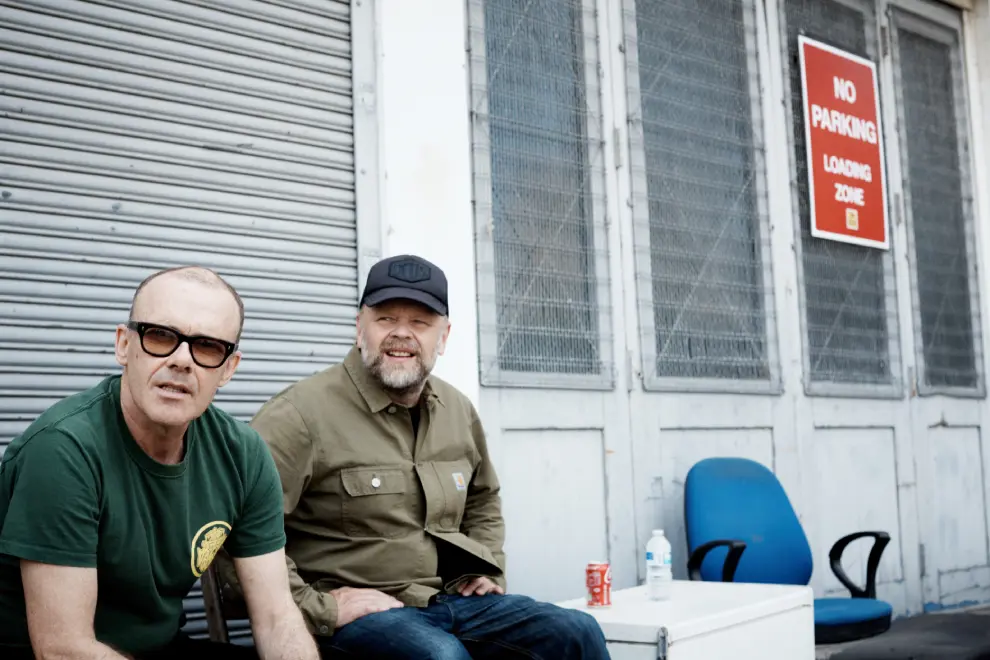
After taking out a loan to buy an Akai S950 sampler in the late-eighties, reading the manual and conducting sonic experiments in his kitchen, Leftfield’s founding member Neil Barnes went on to collaborate with his musical heroes. On the eve of the pioneering electronic outfit’s Australian tour, Barnes reveals a new album is on the cards.
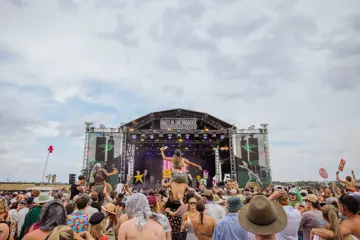
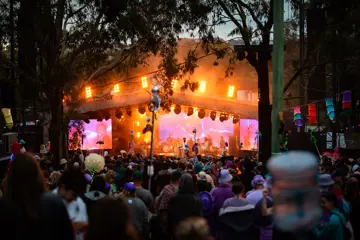
Leftfield last graced our shores in 2018, performing Leftism in its entirety. Three venues across Australia – Sydney’s Metro Theatre, Melbourne’s Forum Theatre and Fremantle’s Metropolis – were filled to bursting with blissed-out punters pulling shapes from their raving heydays.
We were fortunate enough to be in the thick of the sweaty mayhem at Forum Theatre. The opening “blood rave” scene from the film Blade (1988), which depicts vampires partying hard in an underground techno club, sprang to mind.
“I remember the energy in Melbourne being really special, actually,” Neil Barnes, Leftfield's sole remaining OG member, beams over Zoom from his home in West London. “Melbourne was one of the standout moments – playing in that wonderful theatre. It was a wicked time. That was a special experience, playing that album from beginning to end.”
The trailblazing Leftism was released in January 1995 – smack bang in the middle of Britpop. Up until that point, no one had created an entire album’s worth of songs that would work in a club environment.
“Actually Leftism, I hated for years – I couldn't listen to it”
Neil Barnes: “Actually, Leftism, I hated for years – I couldn't listen to it. Yeah, it was too much, you know? I just didn't wanna hear it for years and years and years. And I didn't wanna talk about it. When people said it was their favourite album, I just didn't respect it.
“Now, years later and having performed it [throughout the Leftism In Its Entirety global tour of 2017/2018], I know how much it means to people. It would be really arrogant of me to dismiss it. I do like the record, but the more you play it, the less you like something. In the end, you get a bit like, ‘Ugh, God, I wanna play the new stuff,’ you know?”
“Afrika Bambaataa – Renegades Of Funk was a pivotal track for me”
When asked to single out a particular song that made him fall in love with dance music in the first place, Barnes chuckles before admitting, “Blimey, there's so many! I couldn't really pick one out and say it was my favourite. I mean, I started going to clubs when I was 13. I'd say that probably Afrika Bambaataa – Renegades Of Funk was a pivotal track for me, in terms of my development and interest in electronic music, because it used drum machines and had a really heavy bottom end and a mad vocal.”
“That was a special track, a pretty big one for me. So working with Bambaataa later on [Baambaata feats on Afrika Shox, from 1999’s Rhythm And Stealth album] – you know, having that opportunity – was just an incredible experience.”
“But I had so many tracks that influenced me,” Barnes reflects. “I was influenced by indie music as well. So, you know, Public Image Ltd, Joy Division – they were all massive influences as well.”
Working with John Lydon: “One of the most special moments in my career”
Public Image Ltd’s John Lydon (also of Sex Pistols fame) features on Leftfield’s indisputable banger, Open Up, which dropped in 1993. In the chorus, Lydon sneers, “Burn, Hollywood, burn/ Take down Tinseltown,” expressing his fury over not being offered movie roles when he relocated to California in the early ‘90s.
On recording this track with Lydon, Barnes enthuses, “That was one of the most special moments in my career. It might not have been, but it was – just because John is an amazing vocalist. So get him in the studio in the right mood, and you can get something really special out of him, which is what we did. That was a special one, but it was all down to his songwriting.
“But, I mean, I've had so many great experiences working with different vocalists and managed to pick people I love, and that's how I do it – it's just people I either admire or know they would work in our environment. That's what's exciting about what I do, I think: the opportunity to cross-modulate sound across genres is fun, you know?”
Fun fact: Around the time of Open Up’s initial release, intense forest fires ravaged LA – some fires reportedly even coming close to Lydon's own house – and radio stations ceased playing the song due to the sensitivity of the situation. MTV also dropped the music video from rotation. Despite this lack of airplay, Open Up still reached number 13 on the UK Singles Chart.
Going Full Way Round with Grian Chatten
Leftfield’s latest album, 2022’s This Is What We Do, which made this writer fall in love with dance music all over again, features the British poet, author and broadcaster Lemn Sissay (Making A Difference), Jamaican reggae singer Earl Sixteen (Rapture 16) and Fontaines D.C. frontman Grian Chatten (Full Way Round).
After acknowledging the importance of letting his chosen collaborators “do their own thing”, Barnes cites the brilliant Full Way Round by way of example. “Grian just wrote the song while we were in the studio,” he extols.
“And it was genuinely collaborative, because we were talking endlessly. He’d come and put his head in the door, ‘What do you like about that bit?’ And we [Barnes and the record’s producer, Adam Wren] would both say, ‘Well, that's fantastic, Grian, just keep going. We love it. It sounds great.’ And then he built it up gradually. It was an amazing experience.”
Musically, Full Way Round sounds like zipping through a neon-lit city following a wild night out. The Fontaines D.C. frontman delivers a standout performance as narrator: we’re intrigued, but also a bit terrified – hesitant to tune into his words for fear of what might unfold.
The track seems to document a munted cab ride, with Chatten giving voice to scrambled thoughts. “It's a stream of consciousness – incredible,” Barnes clarifies. “Someone asked me, ‘What's it about?’ And I said, ‘Well, Grian won’t tell me exactly what it's about.’ Bits of it you can see – it's almost like a terrorist thing going on there, you know? With a religious sort of imagery in a crisscross pattern across town, in a cross [Barnes crosses his arms to demonstrate]. It's brilliant. It's poetry.
“And then [the lyrics], ‘I'll do it for you, Julie’ – I mean, it's like, well, what's going on there, you know? Is this helping Julie, or is he killing Julie? Yeah, it's mad – he's having a conversation with himself. It's wonderful fun,” Barnes trails off laughing.
Remembering Andrew Weatherall: “no one will be like him again”
This Is What We Do is dedicated to Andrew Weatherall, who died in 2020. “He was a wonderful man,” Barnes gushes. “An amazing, amazing, lovely man. Such a sad loss. Yeah, it almost makes me cry if I think about Andrew, ‘cause he said some very – I mean, Paul [Daley, the other half of Leftfield up until 2002*] was much more friendly with Andrew in the early days, but I got to know Andrew really well when I brought Leftfield back. He was really encouraging and a lovely man. So, yeah, it's dedicated to Andrew. He was a steward of wonderful music and one of the great DJs, without a doubt, and no one will be like him again.
“He was a philosopher, as well. Very interesting. You’d sit down with Andrew, and he'd start talking to you about other things, you know, not about music. He was a great reader and intelligent, so intelligent.
“It was a massive loss. In my group of friends, people who were intimate with Andrew – far more intimate than me – still haven't gotten over the loss of Andrew, loads of people.
“Little clubs that he did, clubs all over the country – no one else would do them. I think that's why there's so much stuff about Andrew. And seeing Sabres [The Sabres Of Paradise, an electronic group that Weatherall founded] getting back together again and doing stuff is great. I think it's wonderful, you know? Paying homage to the music – that part of Andrew's career.”
The Sabres Of Paradise cheat sheet
The Sabres Of Paradise formed in 1992 as a three-piece studio partnership between Weatherall and engineers Gary Burns and Jagz Kooner.
Since Weatherall was busy DJing and producing, The Sabres launched as a five-piece live act comprising Burns, Kooner, Richard Thair (Red Snapper), Phil Mossman (LCD Soundsystem) and Nick Abnett (The Aloof) to perform a series of legendary live shows across the UK, Europe and Japan.
After releasing three albums and several 12" singles via Warp Records, The Sabres Of Paradise split in 1995.
As part of VIVID Live 2025, the group reconvened in their original five-piece live incarnation for one exclusive show at Sydney Opera House – their first performance in 30 years – before also playing Barcelona’s Primavera Sound festival that same year and continuing to play select shows this year.
To mark this historic comeback, the outfit’s influential first two albums – 1993’s Sabresonic and 1994’s Haunted Dancehall – have been remastered and re-released in partnership with the late Andrew Weatherall’s estate.
Kitchen experimentations: “The start of Leftfield”
Leftfield’s origin story began when Barnes nicked his brother’s keyboard, took out a loan to purchase a sampler and made a track called Not Forgotten [which was released in April 1990]. So, how much did a sampler cost back in the late-eighties? “It wasn't cheap,” Barnes recalls. “I think it was probably about 1,000, 1,200 pounds for an Akai S950 at the time.”
What a great investment that turned out to be! “I had no idea, either,” he admits, wide-eyed. “Believe you me, I had no idea what I was doing and how to do it. I just literally read the manual, got a keyboard and MIDI – allowing me to communicate with it – and made a track, without any effects or a studio or anything. I just did it in my kitchen. I went into a studio to finish it, but I didn't really know what I was doing. It was all experimenting. And that was the start of Leftfield.”
“I mean, Not Forgotten literally was that track. I was strangely confident about it. I’ve still got the original demo, actually – over there [gestures over his right shoulder] – which I've never played. I posted it to a few people. Pete Tong had a copy, which would’ve been sent to a London Records address. Pete Tong never got back to me, and then I got a call from Rhythm King, who said, ‘Oh, come in and have a chat with us about your track, we quite like it. We’ve got this new label [Outer Rhythm].’
“So I wandered in there – quite confident in this record, you know – and sat down with this guy, Michael – I can't remember his surname – and he said, ‘Well, we're not sure we're gonna release it, but we'd like to keep in contact with you. And let us know how you're doing and whether you do anything else.’ And then I went away and thought, ‘Well, that's it.’
“Then they phoned me and said, ‘Oh, we'd like to put it out.’ And it sold 30,000 copies on vinyl, which would make it number one now. So it was mad. In those days, it was nothing, but it did really well, and I was totally surprised.
“I did another single with Rhythm King, and then I got away from them with Paul when we started doing remixes, and we did remixes for quite a long time. Then we were independent, [establishing] Hard Hands [their own label]. And so we recorded most of Leftfield – we paid for most of it ourselves.”
“I have no regrets at all about being on Sony”
“I personally didn't really want to do the Sony deal. I would have stayed independent the whole time, but Paul kinda wanted to, so we did it. And they were great, Sony were really good. The wonderful Mick Clark, our A&R man who sadly passed away, was amazing.
“And, to be honest, Leftism was already virtually finished, so they didn't have to do anything apart from pay for the videos. It was already a finished article; maybe there was a little bit more to add, there probably were a couple of tracks we had to do. And Mick found us Danny Red [who features on Inspection (Check One)] and was very helpful. But I have no regrets at all about being on Sony, they were great.”
Although Leftfield found their sound relatively quickly, Barnes points out, “It took a lot of work. We found the sound, generally, doing remixes. And then when we did the album, we almost wanted to do something different. So we remixed some of the earlier singles, like Space Shanty and Song Of Life, because they'd already come out on Hard Hands. So three of the tracks were already done.
“And we released Open Up independently ourselves, completely, on Hard Hands. There were a couple of labels that wanted to take it, but they only wanted to do it ‘cause John Lydon was on it – they weren't committed to doing it. I mean, we saw everyone. We nearly signed to quite a lot of different people, but they didn't really get it. Until we met Mick Clark, and he really got it. He loved it. He was dancing all around!”
Barnes was 29 at the time of Leftfield’s inception, which probably worked in his favour when it came to negotiating record deals.
“We weren't naive kids just going in there for the money,” he confirms. “We were quite sensible about our approach. Paul had already had record deals that had gone wrong before, with a previous band, so he knew – we both knew – what to look out for. Lisa Horan, who was our wonderful manager at that time, the three of us were really tight in those days, and we understood contracts. It was very difficult to pull the wool over our eyes.
“I think if we had stayed on Hard Hands, we really would have made a lot more money ourselves. But we didn't. It would have taken a lot more work, and Sony did a lot for us. And Mushroom in Australia is wonderful, a great label.”
Belatedly rating Alternative Light Source
When asked whether there are any releases he perhaps didn’t give enough credit to at the time that have since grown on him, Barnes offers, “Yeah, I think there’s some tracks on Alternative Light Source [the first Leftfield album without Daley, released in 2015] that I really was not happy with, but then I listened to them again recently and I thought, ‘Oh, actually, I quite like this. It's better than I thought it was. It's got a sound. It's quite original, actually.’
“And there's some really great moments on it. I discovered it, and I thought, ‘Oh, okay. Because it was a difficult album to do, ‘cause it was kind of a comeback album, I sort of put it down. And Adam did as well, I think; we really put it down together. Both of us sort of thought, ‘Ugh, we could’ve done better there,’ and everything. But then I listened to it again, and I thought, ‘Well, there's some really good tracks on this album!’ So it would be that whole album, really.”
Tips for taking care of your mental health while touring relentlessly
“I've done a lot of work on myself, and I'm very sensible now – I hardly ever drink anymore. I've never been busier. I mean, I'm DJing twice this weekend. My DJing career is going through the roof. It's amazing. I have done one DJ tour of Australia, but I'd love to come back and do another one, because I'm doing big gigs. I'm playing Acid House and all types of stuff. And all of it impacts on your mental health.
“Performing fills your body with adrenaline, and it can take days to come down off it for any human being. Leftfield played to 10,000 people at [North London superclub] Drumsheds at the end of November last year, which was a wicked gig. I didn't think it was gonna come off as a gig; I was nervous about it. It was epic. And, keeping it in balance, you have to accept that as just a night's experience of work – that's what that was. And you can't wallow in it, because that's when it can be tough. And there's no doubt I'm nervous – a bit – about the Australian tour, because it's tough.
“We're doing three nights in a row, and we're in New Zealand first. And it's wonderful, but I think – for someone of my age – it's tough. I'm flying to New Zealand three or four days beforehand so that I can get over it [the jetlag]. So I can have at least two days to chill out and get over it before I start the work. And that's the way to look after your mental health. That's one of the things I've learned.
“It’s still quite mad. We have got a few days off [this time]. But whenever you come to Australia, your wonderful country, the cities are a long way from each other. I mean, I've done gigs where I've started in Sydney, flown to Perth and flown back to Sydney and then flown [again] – literally in three days, I've done that.”
All aboard, Cheshire Cat!
When asked whether any guest vocalists will board the long-haul flight to our shores for Leftfield’s upcoming tour, Barnes enlightens, “We've got Cheshire Cat [UK-based MC Stephen Cheshire, who features on 1999’s Chant Of A Poor Man] is with us for this one. He's the only vocalist because it works perfectly. We performed this version of the show at Glastonbury last year, and it went down really well.”
Leftfield formed in 1989 and have released four albums, so what can fans expect from their latest setlist? “You get a bit of each record delivered as loud – and with as much energy – as we can,” Barnes reveals. “You get tracks from everywhere: a few old favourites that people are gonna love and new stuff as well. So it's a journey.
“When we did the This Is What We Do tour, it was great, because it was nice just doing [mostly new album tracks] and not playing the old ones; that's what I did – played a few old ones, but not many. And that was fun. But now I'm quite happy – for this bit – to be playing more of the old stuff and a couple of new ones. I mean, it’s just swings and roundabouts with things for this, because you have to keep things fresh.”
“I'm not doing any more live things until the next album is done”
“We're doing this – the Australian and New Zealand tour – and then we've got three gigs in Scandinavia, and then that's it. I'm not doing any more live things until the next album is done – I won't do any more. So you're getting us at the height of our ability, to be honest with you.”
Wacko! We’ll eagerly anticipate a brand new Leftfield record, then. “God, I’ve just said that, haven't I?” Barnes smiles. “Yeah, yeah. I’ll start it when I get back [to England].”
*Barnes and Daley went their separate ways in 2002 to focus on solo projects. When Barnes revived Leftfield in 2010, he invited Daley to rejoin, but he declined.
Presented by MG Live, Frontier Touring and 95bFM (NZ only)
LEFTFIELD
SPECIAL GUESTS LATE NITE TUFF GUY (BRIS & SYD)
AUSTRALIA & NEW ZEALAND TOUR - MARCH 2026
Sunday 1 March - Powerstation | Auckland, NZ | 18+
Monday 2 March - Meow Nui | Wellington, NZ | 18+
Thursday 5 March - The Tivoli | Brisbane, QLD | 18+
Saturday 7 March - Enmore Theatre | Sydney, NSW | 18+
Presented by Triple R
Sunday 8 March
Live at the Gardens, Royal Botanic Gardens | Melbourne, VIC* | Lic. All Ages
With special guests Paul Mac (DJ set) and Late Nite Tuff Guy
Also performing at:
Saturday 28 February – Electric Avenue, Hagley Park | Christchurch, NZ*
electricavenuefestival.co.nz/
*Not a Frontier Touring show