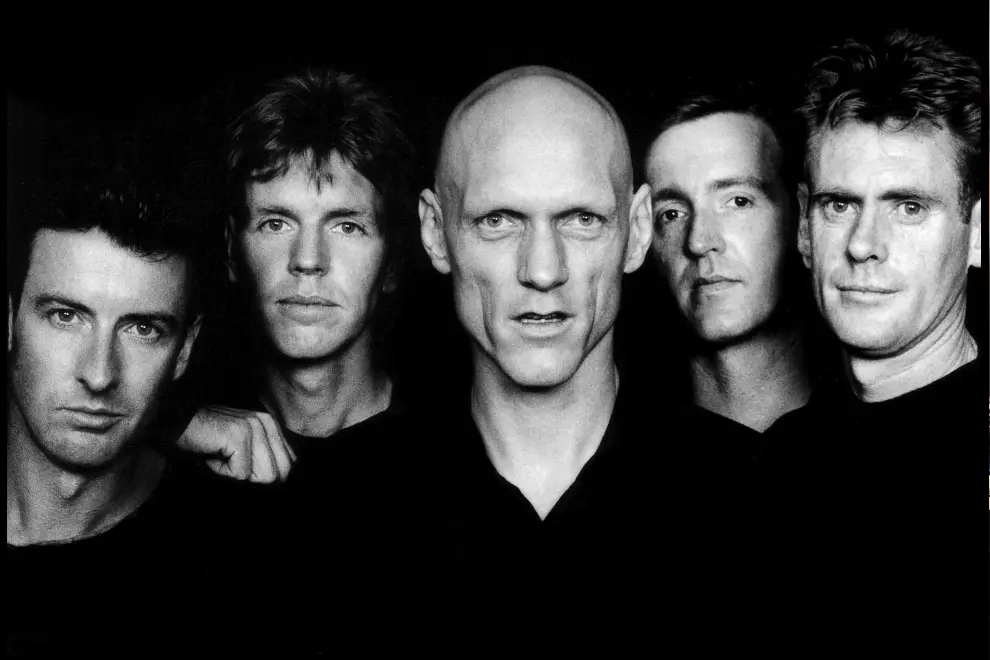
 Midnight Oil Profile
Forty years ago today, Midnight Oil’s Species Deceases EP crashed into the Australian charts at number one.
It was a groundbreaking release, the first Aussie title to enter the singles chart at number one.
And in just 16 minutes, the EP encapsulates everything great about Midnight Oil.
As music historian Ian McFarlane noted, “In terms of sheer sonic firepower, it was one of the band’s hardest-hitting works.”
Species Deceases arrived five years after the band’s first great EP, Bird Noises, which became their first Top 40 entry on the singles chart, rising to number 28.
It might be 40 years old, but Species Deceases still rings true.
The opening cut foreshadowed the rise of AI. “Got robot car, your jobs will disappear,” Peter Garrett raged. “It’s called the politics of a brand-new year.”
Progress might be dated by the reference to Australia’s population (16 million), but aside from that, it remains right on the money. When it was released, it was hard to imagine an Australian city filled with apartments. But it proved to be a grim forecast.
“Manhattanisation is coming,” Garrett predicted. “Open your eyes if you dare. And carry us onto the crossroads, come to your senses and care.”
“Some say that’s progress. I say that’s cruel.”
Rob Hirst remembers Progress as a crowd favourite, “with full houses of young men without shirts, springing up and down in unison to Jim’s killer riff”.
Hirst called track two, Hercules, “a good argument for the supremacy of groups over solo acts.”
Before it took off, Hercules was a Jim Moginie song called “Valuable Thing”. The music rocked, but the lyrics weren’t working.
Just before the band hit play and record, Hirst exclaimed: “Oh, I know – this song is about the Rainbow Warrior.”
French agents had sunk the Greenpeace ship in New Zealand in July 1985.
“Here comes the submarines,” the new lyric ran, “sinking South Pacific dreams.”
“The band amped up Jim’s demo, as was often the way, and I came up with the chorus lyrics literally minutes before Pete committed them to tape – yes, good ol’ two-inch Ampex tape,” Hirst recalls.
“Like Progress, this song lingered in the live set for years, either opening gigs with a concerted, life-threatening sonic assault, or closing them, with Pete dedicating the song to Greenpeace.
“Pete would then charge through the audience with crewmen Messieurs Lippold and Kerr in hot pursuit, his sweat flying freely over the front few rows, pausing only to shout some life advice into the shell-like of a few muscle-bound meatheads.
“Meanwhile, Martin [Rotsey] roamed back and forwards on the stage, like a caged Sumatran tiger, and drumsticks wheeled perilously – and occasionally litigiously – towards the gods.
“Cathartic.”
And just when you think one of the greatest rock songs can’t get any better, up pops Moginie’s backwards guitar solo in the outro.
Hirst would later describe Hercules as the song that defined the band.
“It felt like a miracle,” Moginie reflected in his memoir, The Silver River. “We had a very good team, and that’s what any good band is all about.”
The Species Deceases EP came a year after Peter Garrett had run as a candidate for the Nuclear Disarmament Party, nearly snaring a seat in the Senate.
Hercules and Blossom and Blood were potent reminders of the perils of a nuclear conflict.
“We won’t forget, we can’t forgive,” Garrett declared in Hercules. “Keep us radioactive-free. Strike a bell in Hiroshima Park.”
Blossom and Blood was inspired by the band’s time in Japan, where they made the 1984 album Red Sails In The Sunset.
“This city of blossom and blood,” Garrett sings. “This city suffered more than it should. These sidewalk silhouettes not washed away, not washed away.”
It’s one of the great anti-war songs and a call to world leaders to never forget.
“You talk of times of peace for all,” Garrett notes, adding ominously, “and then prepare for war.”
The EP’s final track, Pictures, provided the disc with its title.
“Don’t want to be a member of a species that’s deceasing,” Garrett declares.
Hirst described the song as “woodchips meet white noise in this cheerful musical adaptation of the Texas Chainsaw Massacre”.
Michael Lawrence, the author of the indispensable Midnight Oil: The Power And The Passion, which documents every gig and release, says: “Pictures uses a US Forces-like call-and-response arrangement in verses which are some of the bluntest environmental statements ever put to music.”
It’s a classic Oils rallying cry. “Don’t sit around in silence,” Garrett urges. “You don’t need a licence.”
When Bernard Fanning won an ARIA in 2006, he appealed to “all Australian musicians that are around now and the ones of the future to use Midnight Oil as an example. They’re such a great example to people like us, ’cause there’s a lot of great things about Australia, but there’s a lot of shit things about this country at the moment as well, and it’s up to people like us to stand up and say something about it.”
Despite being a straight-ahead rock record, Midnight Oil made the EP with dance music producer François Kevorkian at Sydney’s Paradise Studios, owned by Billy “Bad Habits” Field.
Now better known as François K, and credited as the father of house music, the Frenchman fell in love with the band’s remix of Power And The Passion.
Rob Hirst explained the Species Deceases approach: “The band’s zeitgeist at the time was to just get it down loud and live, so we can remind ourselves what we sound like.”
It was a reaction to the “three months-plus we’d spent writing, layering and mixing 48 tracks of Red Sails songs in Japan the previous year”.
In less than a week, the EP was done. “The disc is a scorcher,” was the verdict of the Oils’ official biographer Mark Dodshon.
“It’s a great little rock record,” Peter Garrett believes. “I think the boys were red hot, playing-wise. I know I was really keen for us to do stuff that wasn’t too over-arranged and was more spontaneous and wilder and ‘live-er’. I’m not saying it was only my idea, because I’m sure other people had that idea as well, but I was very pleased that that’s what we were doing.”
Inexplicably, Midnight Oil’s US label refused to release the EP. They couldn’t hear a radio hit.
But the band was undeterred. As Michael Lawrence notes, “Sell out? They never even considered the offers.”
Global success, however, was coming with the band’s next album, Diesel and Dust, featuring the breakthrough smash Beds Are Burning.
Two weeks after the Species Deceases EP was released, I saw Midnight Oil live for the very first time when they played at the Kooyong tennis stadium in Melbourne, supported by Hunters & Collectors and Painters and Dockers.
Then the home of the Australian Open, the organisers had placed matting on the ground to protect the centre court.
Hunters & Collectors trumpet player Jack Howard – who would tour the world with the Oils in 2017 – remembered the Kooyong gig in his memoir, Small Moments of Glory: “We had a great time, we were in fine form, but the thing that I, and many others, remember vividly was the great seagrass matting spectacular.
“The punters, in their natural inebriated wisdom, had pulled up the square pieces of matting and had begun frisbeeing them all over the arena.
“Looking out from the stage, it was quite a sight. The air was literally filled with flying mats. I joined in myself – couldn’t resist, being a discus thrower and all.”
As the matting covered the night sky, the Oils ripped through a cracking set, including all four songs from the EP.
Unbeknownst to me – and the entire crowd – Jim Moginie was playing with three broken ribs after falling through the stage at a show in Geelong the night before.
This was no ordinary rock band.
And this is a very big week in Midnight Oil history.
This week in 2002, Peter Garrett announced he was leaving the band. “The last 25 years have been incredibly fulfilling for me,” he said, “and I leave with the greatest respect for the whole of Midnight Oil.
“The band has brought a lot of pleasure and meaning to people’s lives, including my own. Who could ask for any more? But it is time for me to move on and immerse myself in those things which are of deep concern to me and which I have been unable to fully apply myself to up to now.”
Five years later, almost to the day, Garrett became the Minister for Environment, Heritage and the Arts in the new Rudd Labor Government.
Forty years ago this week, the Species Deceases EP knocked off Jennifer Rush’s The Power of Love to take top spot on the singles chart. It was the Oils’ first – and only – chart-topping single.
The following week, Rush returned to number one, before she was again replaced by the Oils.
The band donated all the Species Deceases royalties to a trust fund for peace and disarmament.
Another Australian EP wouldn’t top the charts until Ratcat’s Tingles – powered by That Ain’t Bad – hit number one in 1991.
Species Deceases ended up spending six weeks on top, staying there until late January, when it was bumped by Starship’s We Built This City.
That song – co-written by Bernie Taupin – was famously rejected by John Farnham and has been called one of the worst songs of all time by Rolling Stone, Blender and GQ.
Blender’s editor Craig Marks said it “reeks of ’80s corporate-rock commercialism. It’s a real reflection of what practically killed rock music in the ’80s.”
There are no such qualms about the Species Deceases EP. Forty years on, it remains as vital and as vibrant as rock ’n’ roll can get.
As Rob Hirst notes in one of his rules of rock:
It’s better to play complaint rock than compliant rock.
With the EP still ringing in my ears, I’m reminded of the words that Bono used when he helped induct Midnight Oil into the ARIA Hall of Fame:
“You can break up a band, but you can’t break up an idea. If Midnight Oil could mean any one idea, it would have to be that Australia could be more for more people and that the only obstacle to that is indifference.
“The Midnight Oil idea is still present, still contagious, still a virus you don’t wanna shake off. It’s like they were born from Whitlam’s phrase – maintain your rage.”
This is something I will remember.
This piece of content has been assisted by the Australian Government through Music Australia and Creative Australia, its arts funding and advisory body