 Kelly-Dawn Hellmrich
“It’s not for you” is what many of us have muttered under our breath many a time. Anyone who’s ever felt like an outsider in the music industry, anyone who’s been told, either to their face or behind their back, that their passion isn’t worth it or that audiences won’t get it.
‘Maybe, it’s not for you’, we’ve wished we could say out aloud. But speaking up can feel impossible, using up energy better spent making great art and building great (albeit alternative) communities. It also starts a bullshit powerplay – why is what you value more important than what I do?
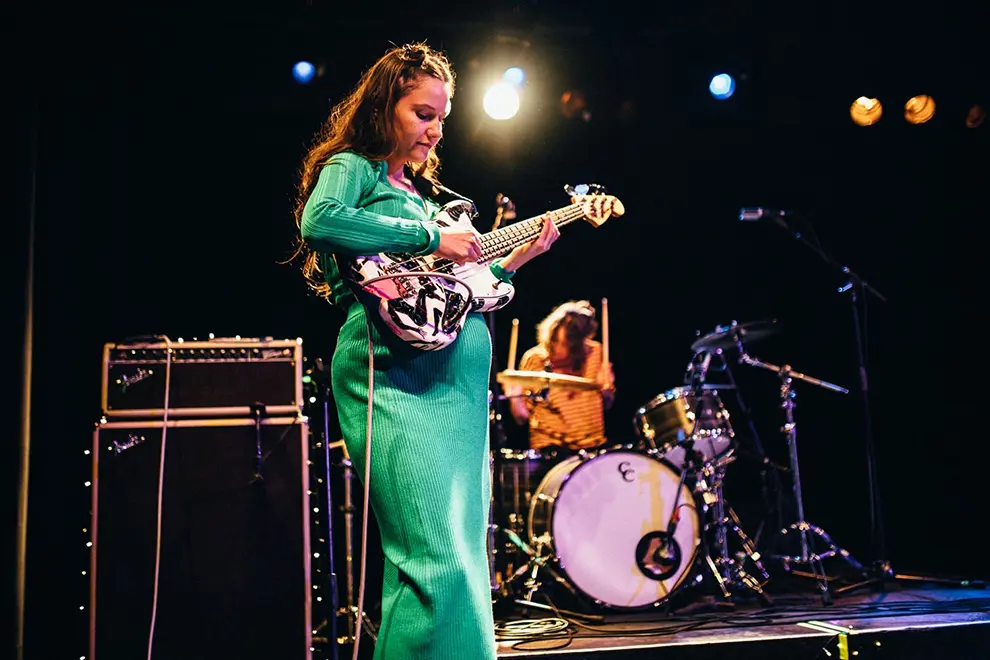
“It’s not for you” is a lyric from her former band, Camp Cope, one of those alternative outlets that somehow, despite not fitting the mould, made it a lot further than so many others. Famous for calling out what was plain to see – shit numbers of women on festival bills – all the time being called ‘fearless feminists’.
It’s lovely alliteration but also a thinly veiled warning. Should we be fearful as we’re feminists? Of what? If you don’t know the answer to that, then that question is for you.
“It’s not for you” is the title of Kelly-Dawn Hellmrich’s book on the Australian music industry, served here as a threat, a provocation, and a promise.
The book features interviews with gender-diverse and female members of the Australian music industry (Vika & Linda, Amy Taylor, BARKAA, Fanny Lumsden, Sampa The Great, and more), alongside a building memoir of Kelly’s own experiences personally and musically.
There’s lots to learn about Kelly and the people she speaks too, put together as a story of fandom, lived experience and mind-blowing expertise. The runs on the board here when you add up the CVs of these people. There will be some you don’t know. And that is for you to follow up.
“To me it’s about having a range available to you,” Kelly says of the process of writing the book and of finding the space to be, well, not a straight white middle class cis man in the music industry.
“I feel like I didn’t have the words before, and that’s what all these interviews have been, finding and being given words to explain experiences.” The range crosses genre, age, gender, class and industry lines, including producers, musicians and industry of various forms.
“I really liked the conversation I had with Julia [Jacklin] because I feel like she helped me understand that I can let the sadness out in my art so I can live a functioning life as a human,” Kelly says of advice about being a writer.
“I think it's very much that like when women create provocative art, and angry art, if you will, it's because we need that catharsis and then so we can function and connect in our daily life. Art is a way to let it out in healthy ways.”
Having been in industry from a young age as an artist, but also in various ways as working at a label, and for government agencies, Kelly has seen many sides of how the Australian industry works (or doesn’t). That range, and feeling of being broken, was a big motivation to getting it out.
“Writing the book, it was really funny like I feel like before I started to write it, I really felt like my relationship with the music industry was broken,” she says. “And I would say ‘I'm retired’ and it broke my heart. But then as I was writing it, I saw that actually I just had this amazing love story with it.
“And like any sort of love, it's up and down. Everything isn't perfect all the time. There's kinks and things that you have to work out. And I found that like any other relationship with my life, it had its challenges, but ultimately, it's all love and that's why it mattered. And that's why it hurt me because I loved it so much.”
Love is an emotion that covers a multitude of sins, and it’s certainly not one that artists who call out discrimination are often assigned. Instead they are considered angry, frustrated, incompetent, bitter – but those are terms not applied equally either.
Why don’t we call early AC/DC or Cold Chisel ‘angry’ or ‘brave’ for calling out industry and society inequities? Maybe Midnight Oil got that label, but it was never seen as a bad thing in the same way it has been for women/gender diverse and non-white folks.
“I had so many rough plans of what shape or like the direction of each interview and it all got blown out the window because I'd find myself just sitting down with these incredibly like inspiring artists and we'd talk some of the interviews went for like three hours,” Kelly explains.
“We'd just yarn and I would then sit there and listen to the recording and be like ‘how am I going to condense this in a way that like it will make sense to a reader?’”
The final choice is a book made up of short pieces, with her memoir as a through line – bits and pieces of being on the road and growing up in Western Sydney without cultural or actual capital, and of slowing building a family of her own.
The interviews are set at times to support, to juxtapose, or even to help guide what might otherwise seem just too overwhelming. These conversations guide Kelly at various ages and stages, but also the reader.
“A big reason why I talked about my personal experience and I was passionate about doing that, even though I didn't want to, is that I need you to understand, I didn't have time or resources to learn music properly or to study it. That wasn't available to me, but I still loved it, and I made it happen,” Kelly says.
“And I think that's what I was trying to explain to those very young girls, ‘don't be disheartened if your brain can't figure out like all the notes on a treble clef, it doesn't matter really at the end of the day. What matters it's what sounds good.’”
“Subconsciously I felt like I really lent on these people I spoke to, and maybe that this is what makes me a bad journalist, this is why I say I'm not a journalist,” Kelly continues. “I'm inserting myself so much and I'm so emotionally involved in what my interviewees are saying, and I really lent heavily on these people to help me shape it.
“I would say ‘I’m nervous’ or ‘I’m scared’ as we were setting things up, I’d say it to people like Courtney [Barnett] and Vika & Linda, and they were like ‘you got this’. And I felt like that's why I wanted to leave it in the book, because we all feel that. I felt like it was for anyone who's young and like making art – I want them to be to feel like that they [the interviewees] were telling them as well. You can have this and you can do it and be vulnerable.”
If being involved in your work makes for a bad journalist, then call me one too. And most music journalists, actually. The book, and Kelly’s approach, is diverse, unusual, and a delight. And if it’s not for you, that’s fine too.
Kelly-Dawn Hellmrich’s It’s Not For You is out now via Penguin Books.
This piece of content has been assisted by the Australian Government through Music Australia and Creative Australia, its arts funding and advisory body