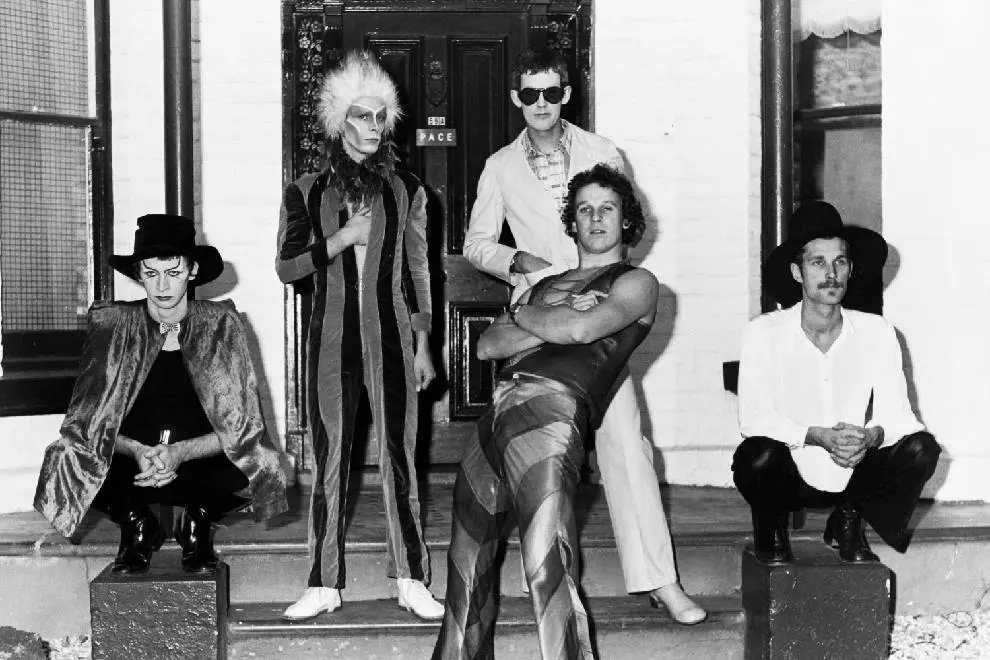
Sometimes things don’t quite turn out as planned.
Think Little River Band making an album in the Caribbean with Beatles producer George Martin. Australian Crawl heading to Hawaii to record Sons Of Beaches with Mike Chapman. Or Men At Work starting work on their third album with Jimmy Iovine.
What should have been the shining moment in a band’s career sadly turned out to be the beginning of the end.
In 1976, after two chart-topping albums that revolutionised the Australian music industry, Skyhooks headed to America. “The Sky’s The Limit” blazed the headlines as the critics tipped they were set to conquer the world.
The Music’s Christie Eliezer was always the band’s chief champion. “Christ, when they go to the US later this year, it’ll turn out as sure as anything that they’ll be the band that everyone’s waiting for,” Christie declared in Juke.
“And when they burst open the scene there, it will be like the Liverpool era after the Beatles bubble burst. It’s the break that the Australian music industry will need.”
But six months later, the Hooks returned more fractured than homecoming heroes.
The US critics saw the band as a poor pastiche of KISS – an act the Hooks had never seen nor heard – and American audiences struggled to understand Shirley Strachan’s Aussie accent.
In a savage critique headed “Skyhooks Can Go Back Home”, the Philadelphia Inquirer concluded, “Skyhooks, to be blunt, is without a single redeeming quality.”
After more than two months of shows in the US and 30,000 miles on the tour bus, the Hooks were in the hole for $90,000.
To help pay the bill, they had an album to make.
This is the story of Skyhooks’ ill-fated third album, Straight In A Gay Gay World, which was released 50 years ago today.
“We just wanted to go home,” guitarist Red Symons recalls.
It should have been the crowning achievement of the band’s career. They had a budget of $60,000 – four times what it cost to make the Ego album. And they were at the state-of-the-art Record Plant in Sausalito, where Fleetwood Mac had just been recording Rumours.
The studio had a jacuzzi, a pinball machine, and industrial-grade nitrous oxide. The conference room had a waterbed floor. There were chefs ready to prepare organic food. And if you wanted to venture out, there was a speedboat or a Rolls-Royce with the numberplates GREED.
This was going to be the album that would break the Hooks worldwide.
But it didn’t quite turn out that way.
“It was hard to capture the sound we wanted,” bass player Greg Macainsh reflects. “The studio in Melbourne [TCS at Channel Nine] had a much more live sound. The studio in Sausalito was a dead-sounding space. We weren’t hearing the sound on tape we wanted.”
“It was unfortunate that we had to do it at the end of the tour, because we were all really tired and really sick of living with each other 24 hours a day, seven days a week,” recalls drummer Freddy Strauks.
“The sessions were very, very tense.”
Freddy remembers the producer, Ross Wilson, demanding take after take, asking if he could hit the drums harder. Freddy snapped. “I can’t fucking hit the drums any harder!”
“There were obvious tensions with Ross Wilson,” Shirl said. “The biggest problem was that the studio was so pure as far as sound and clarity goes. We had so many fucking tuning problems. It ended up stressing everyone out. You’d go to do something and the guitar would be out of tune.”
Guitarist Bob Starkie remembered the sessions: “Wilson was treating us like shit, and everyone was treating everyone else like shit.”
Ross wasn’t vibing on the new material, and he was also trying to negotiate his deal with Michael Gudinski. Shirl didn’t appreciate that Ross was requesting a higher royalty.
When the singer told the producer he didn’t deserve the money he was getting, Ross threw a Coke bottle at Shirl’s head. It whistled past his ear and smashed into the wall next to the pinball machine.
As Shirl asked, “Do you want another Coke?”, Ross stormed out and didn’t return for several hours.
“It just made me think, ‘Well, I’m not appreciated here … I don’t work for nothing; I’m just like you guys.’
“I’d played an important role [discovering the band and producing their first two albums]. For Shirl to say what he did just made me explode. I thought, ‘Fuck it.’”
While making the album, the studio engineer Bill Halverson – who had worked with Crosby, Stills, Nash & Young, Cream, and Eric Clapton – had a simple message for the band:
“You guys have been successful in Australia, but you don’t realise what it would be like to be successful in America.”
Red was having none of it.
“I thought, ‘You’re fucking wrong, you are so wrong.’
“These things are all relative. Australia is no backwater, and we were as successful as it’s possible to be. Girls cried when they saw us. So how was it going to be different in the US? Sure, it’s going to be larger, but what differences?”
Red’s realisation was accompanied by a sinking feeling. “And we all felt the same, but it was never articulated,” he believes, “I honestly think that none of us really wanted to succeed in America. We didn’t care. It was just going to turn into the same job on a bigger scale.”
Skyhooks’ US tour had been brutal.
The Tribune called them “Australia’s greatest disaster since Frank Sinatra made his last tour.” The Niagara Falls Gazette believed they “totally lacked identity – they were no more than refugees from several other bands, plastic copies of the real thing”.
Another reviewer said they were “dressed like a gang of refugees from Marvel comic books. The flashpots that opened their act were the climax of the set.”
Shirl’s larrikin sense of humour also fell flat. In 1976 about the only thing Americans knew about Australia was that it was home to koalas – which they’d seen swinging from the tops of tall buildings in a Qantas ad.
“With koala bears back at home,” Shirl would tell the crowds, “they give pretty good head-jobs – but you gotta watch their claws on the upstroke.”
Before heading to America, the Hooks had a hit song in their pocket, Million Dollar Riff, which would end up opening the new album.
The song’s title seemed appropriate as Michael Gudinski trumpeted the band’s US deal with Phonogram Records as the biggest an Australian act had ever received – $1.5 million.
Two months before the Hooks landed, Phonogram’s Mercury label issued the band’s American debut, Ego Is Not A Dirty Word, which was the Australian version of Ego, with two songs – Every Chase A Steeple and Private Eye – replaced by Horror Movie and You Just Like Me ’Cos I’m Good In Bed from the Living In The 70’s album.
The Phonogram deal was for 10 albums over five years. But the label released just two Hooks albums in the US. And neither Ego Is Not A Dirty Word nor Straight In A Gay Gay World (retitled Living In The 70’s in the US) entered the Billboard charts.
Gudinski claimed that Mercury were very excited about two of the Straight songs – Blue Jeans and Crazy Heart – believing they were potential hits. The US label, however, didn’t release any singles from the album.
But Blue Jeans soared to number three in New Zealand to become Mushroom’s first gold record in NZ.
Years later, Gudinski came clean on the international hype. “I was happy with the deal at the time,” the music mogul told me. “But I think it would have been much better if we’d had one of the real major labels after us. And we didn’t.
“Skyhooks, you either liked or hated, and as much as I hyped it up back here – ‘record companies chasing them, we had to fight them off’ – there really wasn’t that much interest.
“I did the best I could.”
Red will never forget the moment he realised that music was no longer fun.
“You know how you can smell a smell and it has a very powerful association for you? I can remember being in the United States and realising that I didn’t really like playing the guitar anymore. It had become necessary for me to play the guitar; it wasn’t something that I did for fun.
“I’ve got no idea where it was, but I have a complete mental picture of the place where I had that realisation: it was a station wagon with equipment in the back, there’s a bush track and a lot of shrubbery. It’s a distinctive recollection. I realised I was no longer motivated.”
Greg’s girlfriend, the acclaimed writer Jenny Brown, witnessed the drama in the Sausalito studio. Her assessment? “Straight In A Gay Gay World didn’t feel very natural. The band was trying to progress and become more of an international band, which was probably against their nature.
“They never were a power-rock band. Greg really enjoys that style of music, but it wasn’t Skyhooks.”
When he returned home, Red pretty much conceded defeat, revealing to TV Times: “We tailored our patter to appeal to Americans. Shirley even took on an American accent so they could understand what he was saying.
“After a while, we realised it was pointless.”
The Hooks were glad to be home, back in the land of second chances, and rock ’n’ roll shows where nobody dances. Back in the land of chicken and chips, Mars Bars, and roadside tips.
But the US experience had changed the band forever. They would never make another album with Ross Wilson. And Straight In A Gay Gay World was Red’s swansong – he quit the band five months later. Shirl would depart after the following album, Guilty Until Proven Insane.
The Hooks never made it back to America.
“It dawned on us that if we were going to continue, it would be basically ten years of sitting on a bus doing that same sort of thing over and over again,” Greg realised.
“We played with lots of bands there who subsequently became big in America four or five years after we met them, bands like Styx and Journey. That was the career path, how long it would take.
“I don’t think that interested Red. I remember having conversations with him and he’d be asking, ‘Do you really want to do this?’”
“The first two albums were good,” Red believes. “Part of the reason they were good was all that material was conceived before the band was successful. When it came to a third album, we had a whole lot of associated pressures, like being in America.
“It was a struggle because it was post-success material. All the motivation had gone. It had become a job.”
But you know what? Straight In A Gay Gay World might just be my favourite Hooks album. The glorious nervous energy of the band’s debut might have disappeared, but song for song, Straight is strong. To my ears, it’s an album packed with potential singles.
Creem gave the album a rare rave in the US, saying Skyhooks were different to “bland-outs” like LRB, Sherbet, the Bee Gees, Helen Reddy, and Olivia Newton-John.
But the reviewer pondered whether they could crack the American market. “I mean, can a group of self-confessed weirdos inhabiting a nebulous netherworld between Alice Cooper, Steely Dan, the Stones, and the Bonzo Dog Band really make it? Do I care? Yeah, well, a little bit.
“I am glad there are bands like these guys. It just makes living in the ’70s a little more interesting.”
Though their laser-like local focus had shifted as they set their sights on shaping their songs for the world, the Hooks material remained razor-sharp.
And despite the sterile studio, Straight has an energy that can’t be denied. And the band still managed to define the times. Another one of the band’s biggest champions, Anthony O’Grady, wrote about the record in RAM, calling it “methedrine paranoid power rock … the group know that these are brain-damaged times and no way are they taking the MOR [middle of the road] way out”.
Shirl explained that I’m Normal was a reaction to the sexual revolution. “It’s all about a guy who throws away his rubber sheets and dildos and vibrators and sex pills to get back to holding hands.”
And then there’s the closing cut, Crazy Heart, which stands as Greg Macainsh’s sweetest song.
Released on August 21, 1976, Straight In A Gay Gay World landed with a lone black sheep on the cover, and a lambchop dinner on the back. “Everyone has their own interpretations of it,” Red said, “but I think it’s how this band is all lambs to the slaughter.”
Red was right. But 50 years on, this album sits comfortably alongside Living In The 70’s and Ego Is Not A Dirty Word.
A record worth revisiting? Damn Straight.
This piece of content has been assisted by the Australian Government through Music Australia and Creative Australia, its arts funding and advisory body