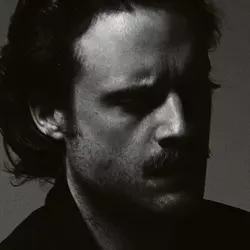
 Father John Misty Profile
Father John Misty isn't an actual person, it's an artificial entity hobbled together to shield an actual person from the world. The person hiding behind the alter-ego is New Orleans-based artist Josh Tillman, a somewhat unique individual who's been plying his trade in the musical realm for over a decade now with varying degrees of success. He began concocting roughshod and mostly downtrodden singer-songwriter fare under the moniker J Tillman, releasing eight album-length collections between 2003-2010, then found himself via a random string of occurrences drumming for burgeoning Seattle indie wunderkinds Fleet Foxes (he counts himself to this day as "the funny one").
Yet upon discovering that touring the world playing someone else's music wasn't scratching his unrelenting creative itch, Tillman decamped and, following a period of purportedly drug-fuelled introspection, returned to releasing his own music, only this time as hedonistic shaman figure Father John Misty. His first album under this new guise was 2012's acclaimed Fear Fun, which dumped the sad sack shtick to embrace his inner smart ass, and suddenly Tillman found himself with masses of fervent new followers embracing this irreverent approach and worldview.
"That's where the hard work is - the rest of it's fucking easy because I'm talented."
But, typically for Tillman's nebulous universe, there was soon another stylistic shift in the offing. He met and quickly fell in love with his now-wife Emma, and the resultant euphoria and contentment was crystallised on the second Father John Misty album, I Love You, Honeybear. It's a laidback emotional rollercoaster, swinging between heartfelt declarations of love and dollops of bitter irony and wry humour. The album paints Tillman (accurately) as a man revelling in his relationship, no longer licking his wounds, nor a brazen lothario, but it's a knack for emotive wordplay that really drives the connection between artist and audience.
"I write a lot of really shitty lyrics too that never really see the light of day," Tillman chuckles. "There's a lot of material that I wrote after I'd written Fear Fun which was a lot of that kinda the same thing, like, (half sings), "I'm going out and I'm getting fucked up and having a crisis about it," and it was just really boring. It wasn't until I met Emma - this person who was like incredibly disruptive to what I had going on at the time - that I started writing material that I thought had vitality.
"Like writing Honeybear and being, like, 'Ok, this is touching on a lot of nerve endings that I think had been numbed both literally and figuratively.' So I think a lot of [the album's lyrical dexterity] has to do with the fact that a lot of it's in my conversational voice, but the hard part and the hard work is in remaining engaged with life, and insisting on peeling away layers and finding the things that have vitality and truth.
"That's really what the artist's thing is - take Taylor Swift, for instance, who I consider to be my foremost contemporary," he laughs, "she's just going back to the same material over and over and over again, she's like, 'Here's this one thing I can do that works.' She's like an alter-ego of herself or something, but I think that anybody who's a real artist - as opposed to a successful commercial entity - has to do the hard work of transformation, instead of just becoming more and more just like a mask of yourself. That's where the hard work is - the rest of it's fucking easy because I'm talented," he chuckles, before adding, "Then you can put in brackets 'laughs bitterly'."
Tillman admits to loving his newfound persona and notoriety precisely because people are connecting with it, and that this manifests more in the live realm than during the creative process itself.
"There are few things that beat the sensation of having a tune ready to go that you know is really good and playing that for people for the first time," he continues. "That's always really thrilling, just to see the spark of consciousness in people's faces as opposed to slack-jawed apathy, which is something I experienced ten years of making this atonal music. That's really exciting. With the creative process, if I could write something every day that I thought was good, I would take that - I would definitely take that - but it just can't be that way."
"Leonard Cohen is one of the funniest fuckers out there, his stuff is rife with black humour."
Father John Misty's material to date has been imbued with a defiant levity that manifests even amidst unabashed sincerity, and Tillman is a firm believer that humour and music can peacefully coexist without becoming pastiche.
"You see a lot of it in hip hop, it's really common there, but I think that the songwriter archetype has become really stale - everyone's just mining this archetype left over from the '70s, this earnest, confessional whatever thing," he reflects. "But then like Leonard Cohen is one of the funniest fuckers out there, his stuff is rife with black humour. I think a great song just includes everything, and that's like the craft of it - it's this magic trick where you've got three-and-a-half minutes, four minutes tops, to communicate something with a few dozen words, and that's it.
"I really enjoy the context that a song affords you, like the melody and the lyric - like the song [from I Love You, Honeybear] The Night Josh Tillman Came To Our Apartment has this really bouncy, dementedly cheerful melody and arrangement, but then it's easily the darkest song on the album. And that's intentional, it's like you're creating another layer of context for understanding what's going on. But [using humour in songs] is treacherous, because you can end up marginalising yourself very quickly, but if it's done correctly then it's definitely something to behold. It's like a tightrope."
Tillman admits taking inspiration from plenty of funny stuff, whether cartoons like Far Side and Calvin And Hobbes or late night talk shows.
"I just did Conan recently and [host Conan O'Brien] was a huge influence on me, and I relate to him - he's this guy who for some reason is compelled to be an entertainer, but you can tell that every step of the way he's confused by it," Tillman explains. "He can't stop this very irrational impulse to entertain, but at the same time it's, like, 'What the fuck is this? I'm like a demented clown or like this monkey!' Seeing someone so willing to acknowledge the duality of the whole thing was like a 'light bulb moment' for me and I completely relate. On paper I'm the last person in the world who should be going out and entertaining people - I'm cranky, I'm cynical and I prefer to be alone - but I have this impulse that I can't articulate where I have to go and do this thing. I don't know what it means, but I know that part of that conflict is what makes what I do compelling or makes it relatable. Because the truth is always located at the crosssection of violent contradiction."