 Taylor Swift Profile
As part of Luminate's most recent annual report, the company revealed that there was an average of 106,000 songs being added to streaming services on a daily basis.
If one were to assume an average length of three minutes per song, that means there is over 220 times more music released each day than one can possibly listen to in just 24 hours.
What that means is, if you're an independent artist without a massive marketing budget, you have to try pretty hard to cut through the noise.
Sometimes, however, artists manage to find themselves cutting through the noise almost by accident.
In early 2025, the podcast Search Engine took a look at an incident in which US band Cake apparently released a new single onto streaming services.
Fans were surprised to see the group make a grand return, given they hadn't released a new album since 2011. Even more surprising was the fact that the song was something of a sonic left turn, given that it was a Russian rap song made in collaboration with PulyaNaVetru.
For those wondering, what had actually happened is that, due to the way streaming platforms work, the song (which was made with a Russian producer called Cake – no relation to the Californian outfit) was uploaded via a distributor without a unique artist ID, and as a result, the usage of the name Cake saw the track linked to the profile of the '90s alt rock icons.
This is the reason behind why – if you're a fan of stoner metal – you might go to check out the US act Sleep only to be confronted by a batch of lullabies uploaded by folks who either accidentally (or knowingly) gamed the system and found their work associated with a more famous name.
What we're looking at here is something of a modern phenomenon whereby rogue operators are utilising the technical opportunities presented by the current musical landscape to exploit some gaps and add their own music to the profile of these larger artists' profiles.
Countless investigations have been made into this happening in recent years. Artists such as Pond, Swans, TV Girl, Poppy, Foxygen, and more have all been caught up in this in recent years, as have deceased artists such as Elliott Smith, with the music in question often being AI-generated content.
In fact, King Gizzard & The Lizard Wizard found themselves at the centre of such an incident just last year. A band dubbed King Lizard Wizard showed up on Spotify with a seemingly AI-generated song dubbed Rattlesnake, confounding fans of the band.
It's hard to say how successful this effort would have been had the Melbourne group not publicly announced their exodus from the platform just months earlier. King Gizzard frontman Stu Mackenzie said in response to the situation that he was “trying to see the irony in this situation,” adding, “But seriously wtf we are truly doomed.”
To their credit, services such as Spotify have been making concerted efforts to crack down on this sort of impersonation that has been taking place on the platform.
In September, Spotify announced a series of new measures to strengthen protections for artists and producers in the AI age, including a new impersonation policy that clarifies how they handle claims about AI voice clones, a new spam filter, and further measures relating to artist verification.
"At its worst, AI can be used by bad actors and content farms to confuse or deceive listeners, push 'slop' into the ecosystem, and interfere with authentic artists working to build their careers," it continued. "That kind of harmful AI content degrades the user experience for listeners and often attempts to divert royalties to bad actors."
Of course, in these cases, so-called 'bad actors' riding the digital coattails of other acts by associating their music with established names is apparently done for nefarious purposes, though it does appear in a small number of cases, it's been done accidentally.
But in the past, it wasn't uncommon for artists to hitch their musical wagons to that of another, whether it be by their song titles or even artist names.
As Search Engine pointed out, there were plenty of examples of artists capitalising on name or brand recognition back in the era in which popular music began to formally establish itself.
In the late '50s, a number of artists reacted to the popularity of Elvis Presley (and his subsequent absence from the music scene due to his drafting into the US Army) with a number of songs.
Lou Monte's Elvis Presley For President was released in 1956, just in time to capitalise on Presley's success and that year's US Presidential election.
It didn't, however, cause much of a stir and isn't as recognisable as Monte's other novelty tracks, including the likes of 1960's Dominick The Donkey, which would later reach the upper echelons of the UK charts in 2011 following a campaign to see it take out the top spot at Christmas time.
In 1964, pop culture collided in a big way thanks to The Carefrees. The year prior, the film Bye Bye Birdie had been released, with its story being inspired by Presley's departure from public life into the armed services.
Coinciding with The Beatles' massive popularity and the ensuing Beatlemania, The Carefrees adopted the lyrics of the Bye Bye Birdie track We Love You Conrad to offer the novelty song We Love You Beatles.
Though it was unlikely anyone was going to walk into a record store and accidentally pick up a copy of The Carefrees' hit thinking it was actually by The Beatles, the use of the group's name undoubtedly helped sell records, with fans of the Fab Four picking up enough records to send it into the US top 40.
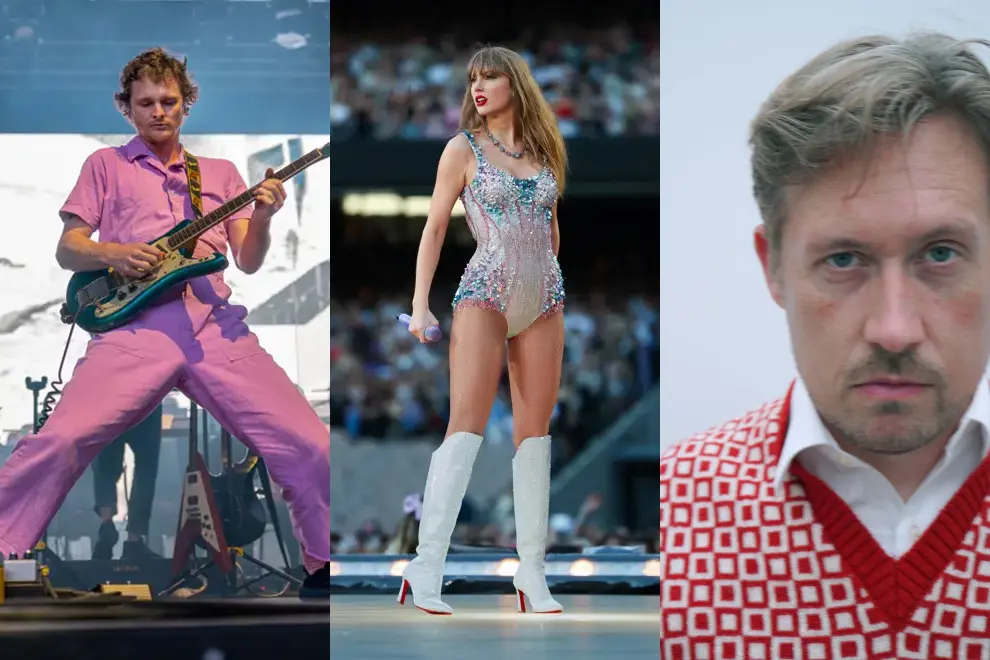
However, it can also be done in a way to help boost an artist's burgeoning career. Case in point: Taylor Swift.
Though arguably one of the biggest musicians in the world these days, it was a different story back in June 2006 when Swift released her debut single, Tim McGraw.
Written about fleeting romances and the emotive power of music from the track's namesake, McGraw had by that point curated a career as one of the world's best-selling musicians, with his name being synonymous with country music.
Of course, one could take a cynical approach and posit this was simply a ploy to get diehard fans of McGraw to stumble upon Swift's music, but there's nothing cynical about the truth.
“We felt it wasn’t likely that country radio would embrace it unless we had a story,” explained Scott Borchetta of Swift's then-label Big Machine. “We put that out deliberately, so people would ask, who’s this new artist with a song called ‘Tim McGraw’?”
Though it's hard to say how much of the track's success was organic and how much of it was due to hijacking searches for McGraw, the tactic worked, and it reached No. 6 on the US Country chart, and No. 40 on the Billboard Hot 100 – one place lower than The Carefrees' 1964 Beatles tribute.
While acts like Maroon 5 and Rick Ross were already well-established artists by the time they released songs like Moves Like Jagger and MC Hammer, respectively, it could be surmised that references to these famous artists didn't help the success of these songs.
Well, let's test that. While the Mick Jagger-referencing Moves Like Jagger topped charts around the world in 2011, Rick Ross' track stagnated in the lower fourth of the US R&B charts. So it doesn't always work.
Likewise, Weezer's 1994 single, Buddy Holly, might have referenced the late '50s rocker thanks to frontman Rivers Cuomo's similar visual likeness, but its success was likely more due to its award-winning video and ubiquitousness on alternative radio instead of its references to Holly.
The strategic move does have some merit, however, especially in the modern age of algorithms on streaming services.
Dutch DJ Sam Feldt managed to bring in more than 600 million streams on Spotify with his 2019 single Post Malone, while Northern Irish rapper Jordan Adetunji broke out in 2024 with Kehlani, experiencing further popularity when the song's namesake lent her vocals for the remix.
There's also instances where this sort of mimicry has caused a little bit of legal trouble, though this largely extends to band names, specifically, and is rarely done intentionally.
Most notably, US grunge icons Nirvana found themselves sued by an English band of the same name in 1992, with the British outfit having been around since the '60s. This lawsuit ended with an out-of-court settlement.
Other examples included UK group Bush being forced to adopt the name BushX for the Canadian market due to another band with the same name, and Blink-182 adding the '182' suffix after an Irish group called Blink took issue with their initial moniker.
We've no clue, however, how US producer Jason Forrest managed to get away with going by the name Donna Summer for a few years.
Other times, this sort of name recognition can be used in more humorous ways. While Buckcherry took their name from a spoonerism of Chuck Berry, Ugly Kid Joe adopted their moniker as a play on glam metal outfit Pretty Boy Floyd.
The Eagles Of Death Metal named themselves as a jovial descriptor of their sound which referenced '70s outfit the Eagles, while the likes of REO Speedealer, John Cougar Concentration Camp, and Guns N' Wankers were all riffs on acts like REO Speedwagon, John Cougar Mellencamp, and Guns N' Roses, respectively.
Meanwhile, Lou Barlow of Dinosaur Jr. and Sebadoh paid tribute to The Jon Spencer Blues Explosion with his act The Folk Implosion, and it's not hard to work out where US producer Duran Duran Duran took his name from.
Special mention also needs to be given to Melbourne act Elvis II for the boldness of their name, and while The Tony Danza Tapdance Extravaganza didn't take their name from another musician, it's fascinating to wonder how many folks have turned up in hopes of seeing US actor Tony Danza tapping away on stage.
However, one of the most notable examples of this comes by way of iconic Californian punk/emo outfit Jawbreaker.
Famously splitting in 1996 following the release of their major label debut, Dear You, the year prior, such was vocalist Blake Schwarzenbach's reticence to reunite that a New York trio comically-dubbed Jawbreaker Reunion emerged during their absence.
While diehard fans would undoubtedly have found themselves enticed by the notion of seeing a Jawbreaker reunion on the marquee of their favourite venue, things got incredibly confusing in 2015 when – two years before the actual Jawbreaker reunion took place – Schwarzenbach shared a bill with the band Jawbreaker Reunion.
Ultimately though, is there any benefit to this sort of musical mimicry?
For the most part, when it comes to the names of artists, there doesn't appear to be any particular edge that it gives fans – at least historically.
After all, if you happened to hear the likes of Dread Zeppelin or Mac Sabbath mentioned in conversations about upcoming gigs, the average punter probably isn't going to think Led Zeppelin or Black Sabbath are actually touring.
However, it does provide something of an opportunity for artists to evoke a sense of familiarity.
Sure, tribute acts will already have that in-built fanbase to a degree, but if you're using a name like Joy Orbison, there's a chance at least some folks who have heard of Roy Orbison might decide to check your music out on the off-chance there's stylistic shared ground with the crooner (though they might not stick around once the beats begin to drop).
A rarer (though not unheard of) example comes about by way of acts who have experienced legal battles and find themselves touring under the same name as others.
For various reasons, different variations of bands such as Queensrÿche, Gene Loves Jezebel, Great White, Black Flag and others have toured simultaneously, often with slightly different (legally-required) names.
We can only assume there’s been a few folks who unwittingly turned up to see a far different version of the band they had hoped to see.
However, the big place where an edge might be gained is on streaming services in the age of the algorithm.
Considering that we live in an era in which new musical discovery is simply a click away, it's become incredibly easy to game the system to ensure that your new single has a higher rate of discoverability depending on the search terms that are used.
That's not to say you should name your upcoming release Taylor Swift's New Single, but given that it's a pretty prominent search term, who's to say it won't help when it comes to sharing it with the world?
So while this sort of musical moniker mimicry has long been a source of entertainment for fans, or a good way to help increase engagement, it can easily be a divisive topic.
While some members of the general public may consider it an example of an artist trying to mislead consumers, others take it in their stride with good humour. But these days, maybe it's just good marketing in the streaming age?