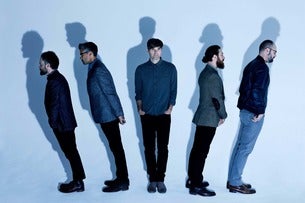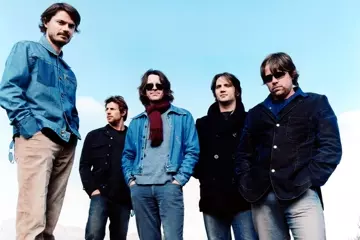
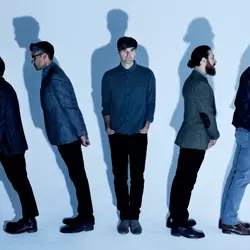
 Death Cab For Cutie Profile
“I built you a tower, a tower in my mind, a place that no one else, no one else would ever find/Because I needed you, I needed you contained, you’d run circles round, circles round my brain; until I couldn’t think, until I couldn’t think of anyone else.”
Does that sound like a vintage Death Cab For Cutie lyric? Does it sound like the signature lovelorn obsessions of this century’s greatest star-crossed indie rock lyricist Ben Gibbard?
Yes, ladies and gentlemen, Ben Gibbard is sad again. We are so back.
Misogynists used to say that Taylor Swift dated people and broke up with them just for new songwriting material, and whilst that is obviously a baseless smear, designed to lessen the strength of her songwriting prowess; no one can deny the power of raw emotion in the hands of a talented songwriter.
None more so perhaps than a songwriter like Gibbard, who built a fanbase at the turn of the century on extrapolating the 3am thoughts of the heartbroken male.
Death Cab For Cutie were indie back in the early-internet heyday when that word meant something.
They were signed to Barsuk Records, a label out of Seattle that was founded in 1998 by Josh Rosenfeld and Christopher Possanza to release music for their band, This Busy Monster.
Death Cab toured relentlessly, steadily built a devoted fanbase, and Rolling Stone still didn’t review their first four albums. Pitchfork were early adopters in their golden age, and a 7.5 in the year 2000 only underlined the fact that Death Cab were the epitome of the Pacific Northwest underground cool.
People talked about We Have The Facts And We Are Voting Yes in the same breath they mentioned Modest Mouse’s The Moon & Antarctica. The same breath as The Shins’ Oh, Inverted World.
Listening to these albums became a call sign. That you were part of a scene, part of a sub-culture; one that wore a short-sleeve t-shirt over a long-sleeve t-shirt, and your heart was firmly placed on those sleeves.
Then Hollywood caught up and put a face to it. Seth Cohen’s charming, witty, cute-but-not-too-cute face. And things were forever changed. The first episode of The O.C. aired on August 5th, 2003. Transatlanticism was released on October 7th, and by the Chrismukkah episode in December of that year, the album poster was already on Seth’s wall.
A Lack Of Color soon made its official TV soundtrack debut, and suddenly the floppy-haired emo guys from Bellingham, Washington, no longer had to tour in the back of a minivan.
But for the sad kid sitting in your maths class, Transatlanticism was their Sgt Pepper’s. And I mean this in more ways than one, Plans was their White Album.
The lyrics from these two albums were scrawled onto the backs of countless school diaries. Songs were placed onto the mix CDs for crushes as strategic, coded messages. Death Cab For Cutie gave a vocabulary to the awkward generation that were doing more teenage flirting via the messenger boards of AOL and MSN than they were in person for the first time in human history. These albums mattered.
But a lot can happen in 20 years for a band. One of their albums went #1. They went Platinum. They were nominated for Grammy Awards. Some of them left for new projects. Some of them got married to movie stars. You know, standard 20-year high school reunion stuff.
Lead singer and songwriter Gibbard spent the pandemic doing his part to help the citizenry by keeping morale high, live-streaming constantly and performing covers, B-sides, and fan requests; whilst also telling the kind of behind-the-scenes stories of the band that were good enough to make you forget that you’d been in lockdown for five weeks.
And once the world went back to work, so did they, releasing the post-punk-inspired Asphalt Meadows in 2022, an album that only underlined the fact that this band was not yet done evolving.
And now they’re back with I Built You A Tower. Their first album since Transatlanticism on an indie label, ANTI-, and we find them at a crossroads. Yeah, they’re technically indie again. But almost 30 years into the game, they are now indie-Dad-rock. And is that a bad thing? Not necessarily.
Not with the self-awareness their lead singer and songwriter possesses, and this introspection is on full display as he sits down to talk with The Music about rediscovering what makes a great Death Cab For Cutie record.
Undeniably, one of the hallmarks of the nascent I Built You A Tower is its vulnerable nature, asserting itself as one of the group’s rawest albums of the past decade.
As Gibbard explains, it’s hard to say whether or not this undertaking was one rooted in difficulty. “It's really not a question of easy or difficult, it's just a question of whether or not I feel like I've had a series of experiences that are worth writing about,” he says.
“I mean, this isn't a flex, it's just a function of reality that we had about 90 songs that got cut down to make this record. And a lot of them were not worth releasing, but with the ones we are releasing, the hope is that what I'm saying about the human experience is relatable.”
Almost universally, Death Cab fans would agree that the human relational experience is a key component of the band’s appeal. However, there’s always going to be a tension between the songwriter’s intentions and that which the audience experiences.
However, while Gibbard may perform the song and have it bring up visceral memories for himself, the audience has had just as much time to attach their own memories to each line. It’s something which can occasionally be difficult to contend with, but ultimately, a notion that Gibbard has grown past.
“I do harken back to those moments,” he admits. “But the reality is that when you're playing a song that you wrote 20 years ago about someone, the hope is you don't still feel that way about that person. Unless it's a love song that you wrote for your wife.
“So, oftentimes I find myself playing some of these older songs and feeling grateful. For example, The District Sleeps Alone Tonight and some of the songs on Transatlanticism were about my first adult partner, and she exists rather prominently in those records. She lives in Brooklyn now, and when we go out to play two shows at Madison Square Garden, I'm not playing these songs about this person being like, ‘Oh, I still feel the same way.’
“She's lived a life, I've lived a life, we're friends now, I’ve watched her kids grow up,” he adds. “Honestly, I think it's rather lovely to have these snapshots in time that you play, and that mean something to the people who are listening to them, and they're contextualising their own life in them.”
If one were to look back at the storied Gibbard discography, it doesn’t take long for fans to zero in on 2003.
Opening the year with the release of The Postal Service’s sole album, Give Up, in February, one could have forgiven him for taking a figurative half-day, especially given the fact that Give Up has cultivated a status as not only one of the biggest indie albums of the era, but the second-best selling album on the Sub Pop label – behind only Nirvana’s 1989 debut, Bleach.
In October, however, Death Cab returned with Transatlanticism, their fourth record and first since a brief break designed to alleviate growing internal tensions. Needless to say, 2003 was the very definition of an indie rock hot streak for Gibbard.
“I definitely knew I was on a heater, but in no way would I have expected those records to hit the way they did,” he explains. “It was the first time in my life that I had the privilege of time and freedom to write and experiment in my songwriting.
“I mean, I was writing the first couple records in between shifts at jobs I hated. And I was finishing the songs for The Photo Album a month before we went into the studio to make it, because we had to get it done. We had to have a record out in the Fall, because if we didn't have a record out, we wouldn’t be able to afford to go on tour. All that stuff.
“So writing Transatlanticism and Give Up was the first time I got a sense of what my capabilities were as a songwriter,” he adds. “And I remember towards the end of the Give Up record, Jimmy [Tamborello, The Postal Service bandmate] would send me a song, and like, boom, I'd turn it around in like a day.
“It just felt like things were flowing really well. I honestly think that will go down as the most fruitful creative period of my life.”
Any musician going through such a hot streak would undoubtedly find themselves somewhat paralysed by the paradox of choice, and the inability to determine whether or not the stellar showing of songwriting at play would be better served for one project or another.
For Gibbard, however, this wasn’t a particular issue. While tracks like Brand New Colony or the enduring Such Great Heights feature that iconic songwriting style, they feel so connected to The Postal Service that it’s hard to imagine them having been utilised on Transatlanticism instead – something Gibbard agrees with.
“I was just reacting to what Jimmy was sending, so it felt pretty cut and dry in that sense,” he explains. “I didn't feel that there was any creative conflict there, because they both existed in their own space.”
In recent years, both Transatlanticism and Plans have received a retrospective focus thanks to anniversary tours in which Death Cab For Cutie have played the records in full.
This revisitation has allowed Gibbard to re-experience much of this music in a new light, including an ability to reignite the pride he feels for certain songs.
But which songs come to mind? “Passenger Seat,” he offers immediately. “I'm just so proud of that song, it's just the perfect little moment, you know?
“And then there's songs that, you know, they're fine, and they're part of the record. I'm not gonna tell you which ones those are. But they remind me that I’ve become a much better lyricist in the last 20 years…”
The selection of Passenger Seat is an understandable one. Many fans of Death Cab For Cutie would likely select it as their own favourite, potentially due to its ability to operate efficiently within the vast amount of space present within.
“Chris Walla is just a brilliant guy in so many ways, and I think there's so much more space in that record than there has been in the later era records by this band,” Gibbard reflects.
“Transatlanticism was made on a 24-track tape machine. We didn't have unlimited tracks to double-track the keyboard part and then triple the bass. ‘Let’s try that, let’s add this.’ You couldn’t do that. You had to commit, you know?
“And I think that we really carried that ethos into making this new record. We had been working on some demos, and we were starting to have a vision for what would become I Built You A Tower. And I fired off a text on the band’s group chat that said ‘we're not gonna get lost in the overdub weeds on this next record.’
“Not that we were never trying to…we couldn't remake Transatlanticism if we tried, but we can learn lessons from the old records and what makes them work,” he explains. “And I think one of the things that makes Transatlanticism work so well is there's a lot of space in it.
“And I think for some of our last records, all the frequencies in the spectrum were over-represented, and I think it’s a period that we're glad to have moved on from.”
Another prominent use of space can be found on Plans, the 2005 follow-up to Transatlanticism, and the seldom-played Brothers On A Hotel Bed. “That was a composition that Chris and I did together,” Gibbard remembers.
“And I remember at some point, when we were starting working on Transatlanticism, we were just so impressed by some of the production calls he'd made, you know, and he was like, ‘Yeah, I got good at recording in the last nine months,’ and I have always thought that Brothers On A Hotel Bed is one of the songs that showcases that the most.”
Gibbard’s mentions of Chris Walla are in reference to his former bandmate, who spent 17 years as a multi-instrumentalist within Death Cab For Cutie from 1997 until his departure before the release of 2015’s Kintsugi.
While their relationship is still positive, Gibbard admits that the pair haven’t spoken about the recent retrospective approach to the acclaimed records they made together.
“He lives in Norway, and I would say we're on very good terms,” Gibbard explains. “We all have relationships that were of paramount importance for an extended period in our lives, and Chris was in the band for 17 years. We made a lot of music together, what will assuredly be some of our most well-known and best music together…
“It's one of those things; we have no beef whatsoever. We see each other from time to time, albeit not as much as I would like, but we shared 17 years where we made a lot of great music, we butted heads a lot, but I don't think either of us would change a thing.
“Chris left at the right time for himself, and he's been doing great work ever since.”
The topic of great work brings to mind Death Cab For Cutie’s most recent release, I Built You A Tower, which arrived on June 5th as their eleventh record.
An accomplished collection of work, it brings to mind Gibbard’s mention of learning lessons from previous records. In particular, bassist Nick Harmer is featured high in the album’s mix, somewhat reminiscent of 2008’s resonant I Will Possess Your Heart – a performance Gibbard will happily champion.
“I was making a lot of demos that were kind of like power trio demos where the bass is a huge driver of the harmonic information,” he explains. “So Nick’s not just holding down the roots, you know? He's doing a lot of riffs that complement what I'm doing on guitar, so it made sense to have him that high…
“Put it this way, Nick’s favourite bass players are Eric Avery from Jane's Addiction, Simon Gallup from The Cure, and Peter Hook from New Order and Joy Division. They all played hooks, you know?
“And you mention I Will Possess Your Heart, and when he came in with that bass line, it was like a wink to Jane's Addiction… it kind of feels like Mountain Song,” he adds. “I would argue it's one of the most iconic basslines of the last 20 years. And that’s all Nick.”
Another notable aspect of I Built You A Tower’s release is its release on Epitaph sub-label ANTI-. The group’s first time on an indie label since Transatlanticism ended their four-record run with Barsuk in 2003, it’s an interesting experience for a veteran indie band to head back to their roots once more.
“We had a wonderful run on Atlantic Records and the people there really championed the band and let us do what we wanted to do,” Gibbard recalls. “But we shared our successes and our failures were our fault, for making not as good records. If the record didn't turn out, it wasn't their fault; it was our fault, you know?
“So I have to say, one of the differences about being on ANTI-, that was not the case with Atlantic, is that we genuinely love all of the artists on the label. We're on this label with our friends The Beths and Slow Pulp. Fleet Foxes are old friends of ours, and we've known Neko Case forever.
“And I wish I knew Tom Waits, maybe I'll get a chance to meet him at some point, but there’s also Waxahatchee and MJ Lenderman. It just feels good to be on a label run by people who were in bands, or are currently in bands, and a label that has a no-skip roster.
“Because no disrespect to the big pop artists on Atlantic, but I just don't give a fuck about that music, you know?” he offers. “So when you have to pretend that you care, like when you're talking to somebody at the label, and they're talking about artists that you can't stand, you gotta be like: ‘Oh, yeah, that's really cool…’ It's nice to not have to do that anymore.”
Death Cab For Cutie – The Music’s Music Bracket
With Ben Gibbard on board, we’re going to pit 32 Death Cab For Cutie songs against each other to determine a champion. The rules are that he cannot think too long about it, and that we are going to need an answer within three seconds.
Round 1
Bend To Squares vs. Tiny Vessels
Tiny Vessels.
Company Calls Epilogue vs. Fake Frowns
Ooh, that's a tough one. Uh, Company Calls Epilogue. When I wrote that song, I thought it was one of the best songs I’d ever written.
No Joy In Mudville vs. 405
No Joy In Mudville.
Scientist Studies vs. The Sound Of Settling
Scientist Studies. I've always loved it. It's so personal to me. It’s about us in Bellingham and the lean years, and that’s so important for me.
Why You’d Want To Live Here vs. Black Sun
I think Black Sun is a better song. Why You’d Want To Live Here feels like the histrionics of a 24-year-old, which is how old I was at the time. I hadn't spent a lot of time in Los Angeles at that point, but by the time I lived there, I really knew it, and I felt like I could write about it from a much more scathing place, if that's the right way of putting it.
Blacking Out The Friction vs. I Will Possess Your Heart
I Will Possess Your Heart all the way, yeah.
The New Year vs. I Will Follow You Into The Dark
I mean, I guess I have to say I Will Follow You Into The Dark, right? It's our biggest song… I love it, it's great. Why would it be hard playing a song with however many thousands of people singing along?
I was at a hockey game recently, and Brandi Carlile turned up, and we had both just played with Dua Lipa in Seattle the month before, with her on one night and me on the other, and she said something along the lines of, “It's kind of cool when you write a folk song.”
And it hit me that she’s right. At this point, I Will Follow You Into The Dark is a folk song. It is so much larger than the band, you know, it has taken on its own life.
Title & Registration vs. Transatlanticism
Transatlanticism. Yeah, I have to. It’s one of the best songs I've ever written.
We Looked Like Giants vs. Marching Bands Of Manhattan
I'm gonna say We Looked Like Giants, just because it is a song of my teenage years, which I look back on fondly.
Soul Meets Body vs. What Sarah Said
What Sarah Said.
Crooked Teeth vs. Brothers On A Hotel Bed
Brothers On A Hotel Bed, definitely.
Bixby Canyon Bridge vs. Cath…
Bixby Canyon Bridge.
Grapevine Fires vs. Codes And Keys
Grapevine Fires.
You Are A Tourist vs. Gold Rush
I'm gonna say Gold Rush, if only because it's more fleshed out lyrically, and it’s more personal because it’s about the gentrification of Seattle.
(One could argue, however, that You Are A Tourist has the best guitar riffs in the Death Cab For Cutie catalogue.)
It's a cool guitar line, but I think it's pretty light lyrically. I still enjoy playing it, and people seem to like hearing it, but it's definitely our Shiny Happy People; let's put it that way.
I Dreamt We Spoke Again vs. Photobooth
Photobooth! It's a song of great personal significance to me. It's about an era of my life, during a summer in Bellingham, and it’s like a song of innocence. I really enjoy playing it even to this day.
Foxglove Through The Clearing vs. Punching The Flowers
I really love Foxglove, because it's such a unique song in our catalogue, and I'm really proud of the lyrics. It comes from a recording I made in the ‘90s that resurfaced when I was uploading a bunch of 4-track demos from that period into Pro Tools and digitising them. And I found it, and looped it and then wrote over it. So to me, it's a bridge, you know? It’s a bridge from us as a band from the very earliest recordings to now.
I love it because it’s the earliest stuff I ever wrote, paired with my aesthetic at this point in my life.
Round 2
Tiny Vessels vs. Company Calls Epilogue
Company Calls Epilogue.
No Joy In Mudville vs. Scientist Studies
Uh, Mudville.
Black Sun vs. I Will Possess Your Heart
I'm gonna go with Black Sun.
I Will Follow You Into The Dark vs. Transatlanticism
Transatlanticism.
We Looked Like Giants vs. What Sarah Said
What Sarah Said.
Brothers On A Hotel Bed vs. Bixby Canyon Bridge
Bixby Canyon Bridge.
Grapevine Fires vs. Gold Rush
Grapevine Fires.
Photobooth vs. Foxglove Through The Clearing
Foxglove Through The Clearing.
The Semi-Finals
Company Calls Epilogue vs. No Joy In Mudville
Ooh, I'm gonna go Epilogue.
Black Sun vs. Transatlanticism
Transatlanticism.
What Sarah Said vs. Bixby Canyon Bridge
What Sarah Said.
Grapevine Fires vs. Foxglove Through The Clearing
Foxglove Through The Clearing.
The Preliminary Finals
Company Calls Epilogue vs. Transatlanticism
It's got to be Transatlanticism.
What Sarah Said vs. Foxglove Through The Clearing
Uh, both? I’m kidding. What Sarah Said.
The Grand Final
Transatlanticism vs. What Sarah Said
Okay, well, it's got to be Transatlanticism.
It’s clear that we’ve found the champion that most fans would be happy with. “Well, that's good!” an excited Gibbard echoes. “I’m glad we are all in agreement.”
Death Cab For Cutie’s I Built You A Tower is out now. Tickets to their forthcoming Australian tour are on sale now.
Death Cab For Cutie
I Built You A Tower Tour – Australia 2026
Thursday, November 12th – Hordern Pavilion, Sydney, NSW
Friday, November 13th – Margaret Court Arena, Melbourne, VIC
Sunday, November 15th – Fortitude Music Hall, Brisbane, QLD