 Basement Jaxx Profile
In the '90s, Brit eccentrics Basement Jaxx revived classic house by adding an urban flavour. They opened the way for Disclosure, Rudimental and Gorgon City. Now the duo are again in vogue.
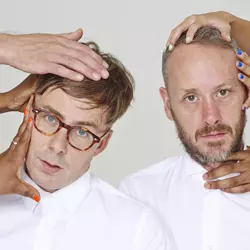
This month Felix Buxton and Simon Ratcliffe will be headlining DJs at Electric Gardens Festival on their first Australian tour in four years. "We just play house music, generally — maybe some bits of orchestral music or maybe some didgeridoo... it doesn't matter," Buxton says.
"I want to write a musical."
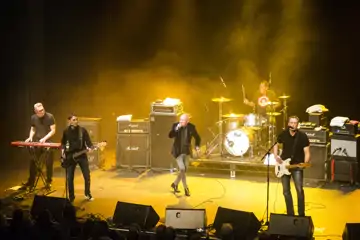
Basement Jaxx clicked as underground house DJs in Brixton, London. "It wasn't fashionable when we started," Buxton maintains. They impressed the music's US originators with early productions on their own Atlantic Jaxx Recordings. The Jaxx began to write 'songs' — cue Fly Life (featuring Corrina Joseph). They signed to XL, debuting with 1999's Remedy — home to Red Alert. On subsequent albums, Basement Jaxx experimented with hybridisation — like Diplo, championing subcultural musics — and solicited big-name vocalists. Indeed, they cut the punk-grime Cish Cash with Siouxsie Sioux for 2003's Kish Kash — the album winning them a Grammy. Basement Jaxx brought a feted live show to Big Day Out. During a hiatus, they recorded a live orchestral project — thrilling Buxton, a classical music buff.
In 2014 Basement Jaxx made a comeback with the independently released Junto (Spanish for 'together'), signalling a return to the house of Remedy. Though Never Say Never was a US club hit, Junto was slept on. "It is what it is," Buxton philosophises. "You can't force anybody to like anything or to let them know that you think something is really good. It's up to people to decide and, again, it's to do with fashion and what they're surrounded by. People get swept up in whatever people are talking about at that moment. As you get older, it's very hard — unless you have a rebirth." If once Basement Jaxx were pop stars, Buxton today speaks of them as outliers.
While Buxton appreciates that music is cyclical, he pays no heed to (media) trends. "I've never followed new bands — it's always bored me," he says. "What the dance music culture is doing, I really don't care." Still, Buxton makes jabs at EDM as "marketed music" — with its "Instagram-based DJ". "There seems to be a corporate mindset," he laments. "Music seems to have been taken over by advertising people." Instead, Buxton lauds those upholding "the original ethos" of house, and fostering its diversity, positivity and unity. He looks for "authenticity" and "depth" in music. The irony? Such sentiments are on-trend.
Recently, Toolroom Records, run by fellow Electric Gardens DJ Mark Knight, issued Frenchman Erik Hagleton's driving remix of the Remedy banger Jump N' Shout. But, says Buxton, Basement Jaxx won't present an eighth album "probably 'til 2019". His desire is to "explore other avenues" — some beyond dance. "I want to write a musical." Wait — a musical? Buxton laughs, "It's something that I shouldn't be talking about, really — because I believe that we do too much talking, rather than actually doing."