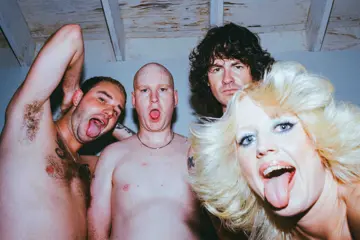
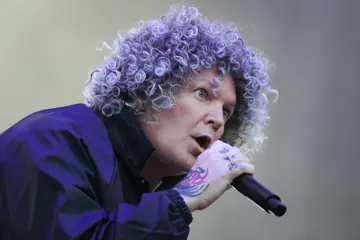
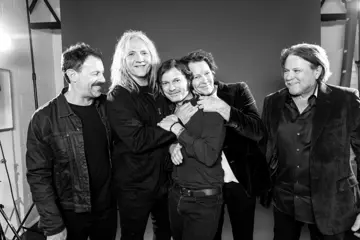
There was a period, a few years ago and a few years in length, where Lo! existed solely as Carl Whitbread, the former Omerata guitarist honing demo after demo, composing the music on his own with Breach's collapse as a benchmark. From this lonely operation the songs that formed the band's 2011 debut Look And Behold, which was for the most part recorded in a manner not dissimilar. In as far as intelligently heavy music can be in Australia (and in a manner akin to the band's vocalist Jamie Leigh-Smith), it was a roaring success.
When it came time for album number two an initially shaky line-up had been solidified over years of gigs, and Whitbread could write better to fully utilise the band's entire arsenal – not even having a drummer, Adrian Griffin, living overseas would stop them. “I still sort of wrote the basis for most of the stuff but there was definitely a lot more collaboration this time around,” explains Whitbread, “and even though it was hard to get together with Adrian throughout the process, I'd just email ideas and stuff like that, or songs, and he'd record electronic drums at home and come up with some drum ideas. Also, Jamie had a lot of input this time; he can play guitar and he's a pretty all round musician as well so there was a lot of the stuff that he'd written on there that we worked together on.
“One of the main differences I've noticed on this album is in the drum department,” Whitbread elaborates. “The first one Adrian sort of just roughly stuck to what I had done but this time he sort of opened up a lot more and I also wrote more to his strengths this time; he likes his blast beats and he's really good at that sort of stuff so it was good to actually write for that this time around and know that we have a drummer who can do that stuff quite easily.”
As the sphere of input broadened an already broad heavy musical palette, Whitbread looked further afield to capture the new sounds for what became Monstrorum Historia, opting out of the largely DIY approach that produced the first album. “Last time it was sort of done all over the place and it was really segregated in the way we tracked everything; it was a bit of a nightmare for mixing and stuff,” explains Whitbread, who helmed the desk for much of it. “But this time it was a lot more natural, you know, we all got in the studio at the same time and just did it over a few weeks all at once so I think it's a lot more cohesive this time as well as far as sound goes.”
This time around Dylan Adams was enlisted to assist Whitbread with the recording and handle the mixing. “We've worked with him before so he's sort of familiar with our sound even though he doesn't generally do heavy stuff,” Whitbread explains the selection, “but he's already familiar with us and he's a good friend and we get along really well. And it was also good to have someone who didn't just focus on heavy music, I thought that would be a nice element, to have someone from a different background approach what we do and not really be super familiar with that style – especially when it came to mixing, there are lots of techniques that Dylan used that, you know, I guess you normally wouldn't use with a metal band. I think it really opened the sound up a lot more as well, it wasn't just typical drum replaced stuff.”