Ding dong! The Mormons are back. Following a season in Sydney last year, The Book Of Mormon is once again taking over Melbourne’s Princess Theatre. This hysterically audacious yet remarkably heartfelt musical first landed in Australia in 2015, where it smashed ticket sales records at the Princess Theatre.
The gleefully irreverent musical follows two mismatched Mormon missionaries dispatched to a remote Ugandan village, where their convictions clash with harsh reality. The Mormons are portrayed as blissfully naïve, their cartoonish optimism beaming against a backdrop of cynically realistic Ugandans.
Faced with poverty, disease, and a ruthless warlord, their mission unravels into an outrageous lesson in faith and friendship.
Possibly preordained, the creative alliance between South Park creators Trey Parker and Matt Stone, and songwriter Robert Lopez, the double EGOT-winner and brain behind Avenue Q reads, in retrospect, as inevitable.
The Book Of Mormon emerges from that partnership with Parker, Stone, and Lopez writing the book, music, and lyrics, and Parker co-directing alongside choreographer Casey Nicholaw.
Raised in Colorado, just over the border from Mormonism’s Utah epicentre, Parker and Stone developed a long-running fascination with The Church of Jesus Christ of Latter-day Saints, respectfully satirising it in South Park and earlier projects, including their 1997 film Orgazmo, before channelling that same edge into a musical that would become a global phenomenon.
Premiering on Broadway in 2011 to enormous critical acclaim, The Book Of Mormon shattered box office records, won nine Tony Awards, four Olivier Awards, and a Grammy Award and has grossed over $800 million, making it one of the most successful musicals of all time.
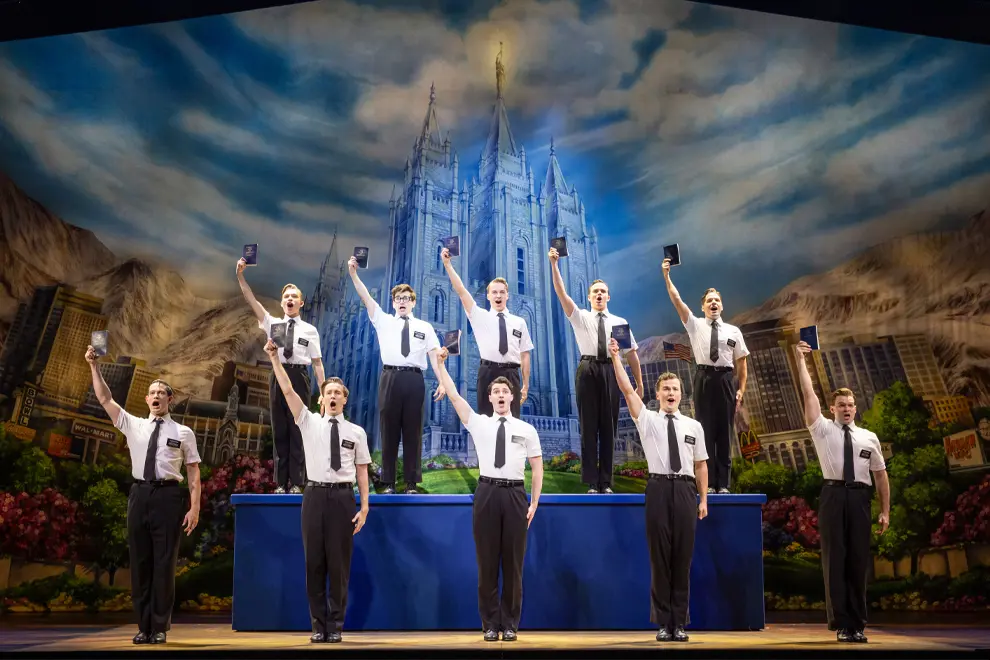
Last night, the gold carpet was rolled out on Spring Street, the congregation largely dressed for the mission in white shirts and ties. Inside, a false proscenium, inspired by Salt Lake Temple, framed the action with ceremonial grandeur, while glowing stained-glass panels and celestial scrims suggested an idealised Mormon heaven.
The story opens at the Mormon Missionary Training Centre in Salt Lake City, where Elder Price, a clean-cut overachiever, leads a demonstration in door-to-door conversion during the infectious opening number Hello!.
From the first doorbell chime, the audience was all in, buzzing as though reunited with a gloriously inappropriate old friend. Played by Sean Johnston, Elder Price is relentlessly optimistic, with Johnston perfectly capturing the character's poster-child enthusiasm.
Dreaming of a mission in Orlando, Price's hopes are dashed when he is instead paired with the goofy, compulsive liar Elder Cunningham and sent to a remote Ugandan village. Nick Cox’s portrayal of the babbling Cunningham is immediately lovable. The contrast between Johnston’s golden-boy Price and Cox’s socially awkward Cunningham neatly sets up an odd-couple dynamic that drives much of the show’s chaos and comedy.
For audiences unfamiliar with LDS history and theology, the song All-American Prophet delivers a razzle-dazzle crash course. We’re introduced to Joseph Smith, an “All-American prophet” with “Donny Osmond flair,” who, in 1823, was visited by the angel Moroni and told to dig up his backyard.
Why? Because apparently the Bible is actually a trilogy, with the third instalment engraved in reformed Egyptian hieroglyphics on golden plates just waiting to be unearthed in upstate New York.
Elder Cunningham, patron saint of enthusiastic misunderstanding, sums it up with hysterical simplicity: “So the Bible is actually a trilogy? And the Book of Mormon is ‘Return Of The Jedi’?”
Upon arriving in Uganda, the pair are robbed by a militant group led by the warlord General Butt Fucking Naked, fearsomely portrayed by Augie Tchantcho, who reprises the role from the original Australian run. They are then welcomed to the village by Mafala Hatimbi, played with commanding warmth by Simbarashe Matshe, and his daughter Nabulungi (Paris Leveque). In her professional debut, Leveque brings a luminous sincerity to the role.
The missionaries also meet the local LDS team, led by the closeted Elder McKinley. Tom Struik proves a comic standout with tightly-wound merriment and a commitment to emotional suppression, hilariously highlighted in the upbeat number Turn It Off, complete with pink sequin vests and a tap-dance routine. Traumatised by a deadly confrontation, Price requests a transfer to Orlando, abandoning Cunningham, who instead discovers his moxie in the macho, Rock Of Ages-style Man Up.
In Act II, Cunningham’s wildly improvised scripture in Making Things Up Again resonates with the villagers, leading to the sultry duet Baptise Me. Meanwhile, Price grapples with doubt during the absurd showstopper Spooky Mormon Hell Dream, featuring dancing devils, Jeffrey Dahmer, and a host of hellish inhabitants.
Ultimately, Price weighs strict doctrine against empathy, underscoring the musical's witty commentary on faith and scepticism. The show also knowingly leans into the white saviour complex in the earnest I Am Africa, before building to the exuberant ensemble number Joseph Smith American Moses; a joyfully blasphemous pageant that reframes gospel with a smorgasbord of sci-fi references.
Tony Award-winning designer Scott Pask vividly contrasts the opposing landscapes of Mormon Utah and gleaming Orlando with the sunbaked tin roofs and mud huts of a remote Ugandan village.
Anne Roth's costumes sharpen that divide. The missionaries’ crisp shirts, black ties, and pressed trousers emphasise uniformity, while the Ugandans’ distressed, mismatched clothing pieced together from Western donations and local textiles reflects individuality shaped by circumstance. The African Pageant reinforces this idea, with pioneer costumes crafted from soft drink bottles, license plates and feed bags. Elsewhere, the red devil onesies and neon-robed Jesus magnify the show’s divinely irreverent language.
For Australian audiences, the quirks of Mormonism seem almost otherworldly, heightening the show’s absurdist humour. But make no mistake: the show's playful jabs at the LDS Church are never mean-spirited.
The loud, unrestrained laughter that ricochets around the theatre carries a note of admiration for just how far the punchlines dare to go. Sure, the show is wickedly camp and packs more profanity than a Tarantino film, but it also maintains a surprising thread of genuine tenderness.
Rather than tearing faith down, The Book Of Mormon nudges us to look past the fine print of organised religion and focus on the core teachings of love and compassion, because at the end of the day, it doesn’t matter whether it's a blonde Jesus, Joseph Smith or even Boba Fett showing you the way; what matters is that the message sticks.