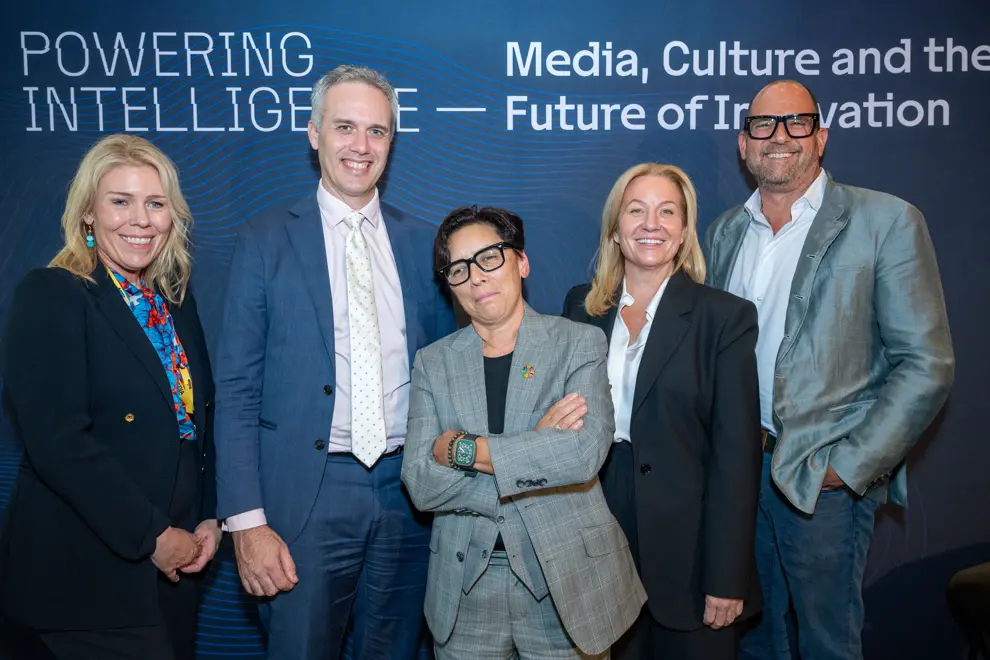
On Thursday afternoon (26 March), leading figures in Australia’s creative and media sectors joined forces to present their case about licensing in the age of AI at Parliament House. They delivered their case with a presentation called Powering Intelligence: Media, Culture and the Future of Innovation at Parliament House in Canberra.
Together, they presented a panel discussion on AI and copyright, detailing how the issues are affecting Australian creatives, to parliamentarians, senior public servants, policy advisors, and industry leaders.
Late last year, the Australian government decided not to introduce a text and data mining exception, ruling out the ability for AI developers to mine copyrighted material for training without permission.
The presentation came at a precarious time for the music industry, as Universal Music Group, Warner Music Group, and Sony Music have signed agreements with AI platforms. Meanwhile, Australian acts such as Polaris, Alpha Wolf and others have had fake AI songs appear on their artist profiles on streaming services.
Claire Harvey, Editorial Director at The Australian, moderated the panel. Harvey was accompanied by Universal Music Group’s EVP Jonathan Dworkin, The Guardian Australia and New Zealand’s Managing Director Rebecca Costello, award-winning musician Charlie Chan, and UTS Professor Edward Santow. Additionally, Attorney General Michelle Rowland and Senator Sarah Henderson delivered opening remarks.
ARIA, PPCA, APRA AMCOS, the Australian Publishers Association, the Australia New Zealand Screen Association, the AWG Collecting Society, the Copyright Agency, Free TV Australia, The Guardian Australia, and News Corp Australia supported the media and creative figures.
In a statement, Attorney General Michelle Rowland said the federal government has “no plans to weaken copyright protections” against AI companies.
“The Government has been clear for some time that there are no plans to weaken copyright protections when it comes to AI. This includes explicitly ruling out a Text and Data Mining exception, which I was extremely proud to announce last year,” she shared.
Rebecca Costello said that when journalists’ work is taken without permission or compensation, “the impact is fewer journalists, fewer newsrooms and less public interest journalism.”
“We invest everything in journalism,” Costello shared. “When that work is taken and used without compensation, the impact is fewer journalists, fewer newsrooms and less public interest journalism. No market operates when you can take something for free and then charge for it. Licensing is happening, and it has to, because the alternative is the erosion of the journalism that feeds these models in the first place.”
Jonathan Dworkin concurred with Costello’s point, noting partnerships with AI in the music industry, such as UMG and Udio, as ways for the industry to take back control, as it did in the days of Napster and rampant piracy.
“We didn’t defeat piracy by turning off the internet,” Dworkin said. “Ultimately, we prevailed because streamers built a better product than piracy. That’s what we hope to do with AI.”
Charlie Chan added that the creative sector already has the technology to “licence things properly” and protect the work of artists.
“We actually have the technology we need to license things properly, to protect content and find where everything is,” Chan said. “We cannot fall into a homogenised experience of all of our creativity. Australia has something truly unique – a thousand generations of First Nations culture – and we have a responsibility to protect it.”
Professor Edward Santow urged the government to protect the creative and media sectors in the AI landscape.
“We need government to play the role of government: to ensure there is a fair market so that organisations can participate fairly, and to protect the population,” Santow said. “Australians have among the lowest levels of trust in the world when it comes to AI, not because we are scared of technology – the opposite, we tend to be among the earliest adopters – but because people can see when technology goes wrong.”
Creative Australia has noted that Australia’s creative sector contributes $67 billion to the national economy, and that licensing arrangements in the age of AI are emerging across journalism, music, publishing, and visual media.