Tina Arena Profile
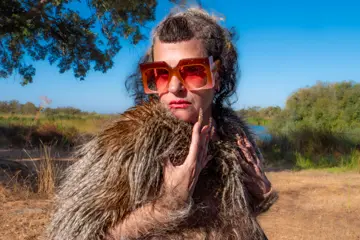
Tina Arena has long been many people. She is the former child star, a pop diva and Australian music's great survivor. And, lately, she's emerged as a feminist icon.
In April, Arena presented the lavish collection Greatest Hits & Interpretations to mark her storied 40-year career, even dueting with Dannii Minogue on a new glitchtro version of Sorrento Moon. Now the pop queen is embarking on the accompanying Innocence To Understanding tour. "I don't know when I'll be touring next, it might be a while," Arena declares, amid preparations. "So I just say, 'Let's have a good time and have a party.' And that's what it will be, it's a celebration." However, in her BIGSOUND Festival 2017 keynote, the 49-year-old will likely share some behind-the-scenes tales.
Arena was raised in an Italian-Australian family, nestled in Melbourne's humdrum outer suburbs. At nine, she found instant fame on joining the TV show Young Talent Time. "Tiny Tina" cut records as early as 1977. All grown up, Arena majorly reinvented herself with the hi-NRG hit I Need Your Body. But she arrived as a singer-songwriter with 1994's mega-platinum second solo album Don't Ask.
Routinely miscast as an adult-contemporary act, Arena's discography reveals a chameleonic musical identity - spanning house, soul, rock, pop and power balladry. "I have been musically a little adventurous," she notes, pleased. Still, Arena never consciously adapted to pop's shifts. "I think it's a bit dangerous to follow musical trends," she starts. "So I've always tried to just do what I think is right musically... I've avoided [following trends] 'cause it just doesn't suit my personality." In fact, Arena has often been ahead of her time. She worked with Chic's Nile Rodgers on 2001's Just Me - comparable to the confessional electronica of Madonna's Ray Of Light - well before Daft Punk came calling. "He's a hugely intelligent man," Arena remembers. "I had a really great connection with Nile. It was a great experience. I knew even back then that his time would come again." For 2013's Reset, she solicited Alex Hope - the 'It' songwriter currently associated with Troye Sivan. "I guess I have, in some ways, an uncanny ability to be able to smell or know what is going on." Recently, Arena collaborated with kitsch electro-popsters Client Liaison on their song A Foreign Affair - performing alongside them at Splendour In The Grass in an OMG move. "They're the new hipsters," Arena extols. "I think the boys are very clever."
Her late '90s LP In Deep phenomenally successful in France, Arena relocated to Paris. European fans didn't have preconceptions about her, which was liberating. Making French-language albums, Arena would rival Celine Dion. But, a few years ago, she brought her family back to Australia. "I kind of miss the anarchism of France, really, 'cause they're a bunch of anarchists - and I like that!" Arena laughs. "I've actually learnt a lot through that culture about myself and about things I love... They're incredible thinkers. They're really progressive thinkers and they'll think outside the box."
When, in 2015, this progressive thinker was inducted into the ARIA Hall Of Fame by another Minogue, Kylie, she called out the music industry's misogynistic ageism in a widely reported acceptance speech. Arena is unsure of its impact. "I think change is slow."
At her "peak", Arena was "confronted" with the image-driven marketing of female artists - "a brutal realisation". "It's not an easy thing being a woman in the music industry, because you can be treated like an object - and there's a human being behind that object." Today, Arena - who's published her autobiography Now I Can Dance - has a receptive millennial audience for such insights into popdom. "I feel that it's a responsibility that I have as a human being to be able to talk very honestly and openly about that, and to demystify the fantasy that is created, and to get back to the art and the craft and why are we doing what it is that we're doing?"
Arena has a potential ally in Madonna - who's subversively campaigned against ageism, even as her manoeuvres are mocked. Yet, while lauding Madonna generally, Arena is uneasy about her strategy of defiance ("a protection"). "I am not Madonna. I am Tina. I'm a girl that's lived a different life to her - but I've worked really hard as well - and I don't believe in ramming that down anybody's throat." She wants dialogue; "I think the way moving forwards is creating an open forum for discussion and for discussion to come from a good place and a place of good intentions - where you wanna do it, and [do it] in love, and to always spread the word of respecting one another and to just hold back and think about this philosophically."