The Mission
On one otherwise unassuming day in 1985, Hunters & Collectors frontman Mark Seymour sat with some members of the band’s inner-sanctum in the beergarden of an inner-city Melbourne pub and set out a blueprint for the band’s future.
At this stage they’d been around for less than five years, having cut their teeth on the then-thriving early-‘80s St Kilda post-punk scene where they’d made an immediate impact with their industrial leanings and cacophonous live shows.
The fact that they’d taken their band name from a track by German experimental outfit CAN pointed towards their motorik inclinations, the group’s primal music in the early days often featuring members pounding on empty gas cylinders and other metallic detritus for percussion.
Despite such raucous, avant-garde displays Mushroom Records head honcho Michael Gudinski had seen potential in the band from the outset, quickly getting their signatures on contracts and placing them at the vanguard of Mushroom's new alternative imprint White Label.
They remained on that roster for the duration of their career, but – predominantly due to the band’s uncompromising nature – by ‘85 the hits had not been forthcoming, even as their albums sold respectably due to their sizeable inner-city following.
The band’s sometimes amorphous and unwieldy line-up had been whittled down to a committed core of six following an ill-fated six-month sojourn to the UK in 1983 – during which they signed an international deal with Virgin Records, only to promptly lose it for insulting a label executive – but something needed to change for them to continue moving forward.
As Seymour recounted to author Tracee Hutchison in her 1992 book Your Name’s On The Door:
“I think it came down to making a decision about whether we wanted to take it seriously as a profession or not, because we still had this kind of hobby attitude to it. I remember having a discussion with Robert Miles and Doug Falconer in a beer garden at the Standard Hotel in Fitzroy, and I said, ‘Look, you know, we should try and make a commercial record if we want to take this seriously in the long-term’.
“I think that was almost a year before we even started thinking about recording this record, but our experiences have always been ongoing ones, and the touring and the playing sort of affect the decisions that get made a long time later. So that’s really why Human Frailty came about: I mean, we wanted to have some sort of commercial success.”
The Music
This purported push towards widespread commercial acceptance landed on April 7th, 1986 in the form of the aforementioned fourth Hunters & Collectors’ studio album, Human Frailty.
The album had been recorded on a shoestring budget over four weeks at St Kilda’s Allen Eaton Sound studio – a small space more commonly used to record TV jingles and pre-recorded songs for the TV show Young Talent Time – with the band handling production alongside Scottish engineer Gavin MacKillop.
The songs themselves also had their genesis in the then-seedy underbelly of St Kilda, specifically a small bedsit atop long-standing institution Leo’s Spaghetti Bar in Fitzroy Street. This is where Seymour was living at the time – when he wasn’t on the road plying his trade – and this is where the doomed relationship transpired which would inform virtually all of Human Frailty.
When Human Frailty was featured on the 2007 SBS documentary series Great Australian Albums, Seymour was open in admitting:
“The whole album is about a girl that I was in love with – May was her name…
“The thing about Human Frailty is that I was in an emotionally switched-on period in my life – there were a lot of things going on and happening to me – and I was just bringing in these events and writing every night. I just had a lot of raw material.”
Human Frailty’s propulsive opening track Say Goodbye was also the album’s lead single, marrying a real life fight that Seymour had with his partner to an overheard snatch of conversation which would become one of the most memorable choruses in Oz rock history: “You don’t make me feel like I’m a woman anymore”.
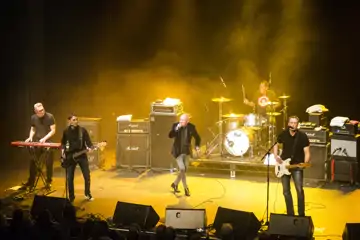
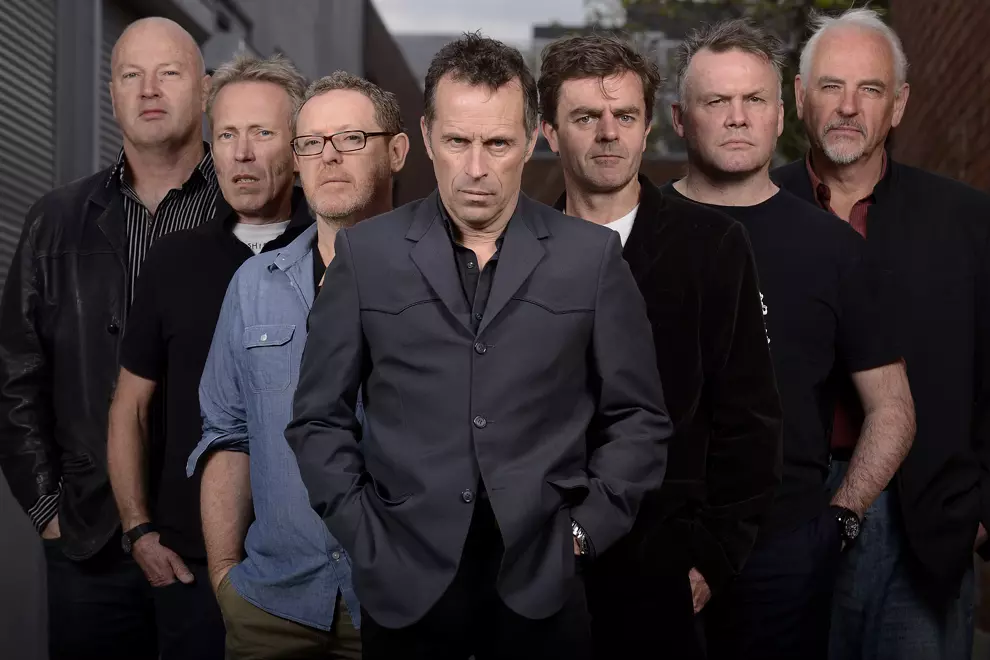
Say Goodbye also showcased the band’s new six-piece incarnation perfectly. They were now essentially a power-trio – with Seymour (vocals/guitar) out front of a powerful, dextrous rhythm section in the form of his pub mate Falconer (drums) and John Archer (bass) – themselves augmented by a classically-trained brass section comprised of John ‘Jack’ Howard (trumpet), Jeremy Smith (French horn), and Michael Waters (trombone/keys).
The horn section not only proved a point of differentiation in terms of Hunters & Collectors’ line-up configuration but provided emotional counterpoints and coloured the band’s sonic palette in a way that gave them a definite edge over their peers, especially on the highly-competitive ‘80s pub circuit.
The album’s second single, the timeless love ode Throw Your Arms Around Me, had been the song which first opened Seymour’s eyes to the potential of more personal songwriting, and its appearance on Human Frailty marked its third time in the Hunters & Collectors canon (having already been released as a standalone single in 1984 and then appearing on 1985 live album The Way To Go Out).
These days it’s a certified Australian classic – in 2001 named one of the Top 30 Australian songs of all time by APRA and covered by everyone from Crowded House to Pearl Jam – but back then it signified a new, more accessible side to Hunters & Collectors, its overtly intimate lyrics, more melodic arrangement and singalong chorus immediately opening the band to the possibility of pleasing larger audiences.
Seymour’s new penchant for lyrically opening his heart is pervasive all through Human Frailty, with songs throughout the album mirroring the arc of a bond between two lovers first flourishing then falling apart.
The early throes of passion appear in Dog and Everything’s On Fire, drilling deep into the dark side of lust and obsession, before things begin to unravel with the confusion and isolation of The Finger, the way 99th Home Position chronicles a couple’s despairing battle for identity and the mournful This Morning, a howl of regret and acceptance signifying both the end of the relationship and the end of the album.
Only a song contrasting the mundanity of everyday life against the bigger picture (Relief) and one snapshot of political upheaval amid the volatile Reagan-era (Is There Anybody In There?) sit outside of the singer’s relationship dilemmas, though both numbers still suit the record’s anguished tone.
Even the album’s solitary cover – a melancholy rendition of the slinky Stuck On You by Sydney outfit Sardine V – fronted by Oz rock veteran Ian Rilen, whose subsequent trio X had inspired Hunters & Collectors’ new stripped-back incarnation – slotted seamlessly into the back end of Human Frailty and fit the disintegration of a relationship narrative perfectly.
The Branding
This new more accessible music wasn’t the only concession that Hunters & Collectors made in their quest for wider acceptance. Film clips were specifically scripted and shot to appeal to a more suburban demographic, and even the artwork of Human Frailty and its attendant promotional material reflected this new desire to expand the band’s marketing potential.
The band’s art director Robert Miles – the other guy listening to Seymour scheming at the Standard – played such a big role in this regard (alongside his work on the band’s live sound) that he’s listed as an actual band member on Human Frailty.
Seymour told the SBS, “Rob Miles had a huge influence – in a way he kind of art-directed the band, and had a huge influence on the way that the band reinvented its image.”
Miles himself told the same program, “We talked about where we saw the band being in the pantheon of Australian culture and all of that sort of stuff – we were interested in that – and the idea of going out there and reinventing [the band’s image] and changing it around was talked about”.
Even the band’s fashion sense and stage demeanour adapted to reflect this desire to reach new more mainstream audiences, with Falconer telling SBS;
“Around that time we started playing more suburban shows, we relaxed a bit in the dress department. Flannel shirts became all the rage, and Mark started developing this sort of bloke-y persona that he probably avoided a bit in the early days.”
The Landing
All of these subtle shifts – at least from an outside perspective – seem to have had an immediate and consequential impact.
The band (as always) toured hard, and – despite getting little love from commercial radio – Human Frailty shot up the charts, going Gold within the first couple of months and giving the band their first Top 10 album (sneaking in at #10) on its way to eventual double-Platinum accreditation.
They would go have higher chart placements down the track – the band’s eighth album Demon Flower (1994) proving their highest peak at #2 – but Human Frailty remains by far the best-selling and critically-revered Hunters & Collectors album.
At the 1986 Countdown Awards – the precursor to the ARIAs – Human Frailty was nominated for Best Album, eventually losing out to John Farnham’s Whispering Jack behemoth (alongside worthy fellow nominees in Crowded House’s self-titled debut and Paul Kelly & The Coloured Girls’ Gossip).
Legendary Countdown head honcho Molly Meldrum seemed pleased by Hunters & Collectors’ rise from the margins, writing in the 1986 Countdown Annual:
“One of my favourite albums of the year was Hunters & Collectors’ Human Frailty. What a great surprise they were! I first saw them six or so years ago [sic] but then, I think, they had strong peer group pressure put on them by people they hung out with and they went off on a tangent. To come back with some of the best Australian songs of ’86 was great to see.”
Elsewhere in the 1986 Countdown Annual Seymour admitted to his commercial aspirations – quoted as saying in an August interview with Countdown Magazine, “I wanted the band to become a household name in Australia” – while a piece by journalist Rosa Sense titled ‘Hunting & Collecting’ showcased another less predictable aspect of the band’s newfound success:
“As singer, guitarist, writer and frontman, Mark Seymour became an unlikely sort of sex symbol in his own right. The ‘thinking woman’s pin-up’ as he was tagged, he stood out as a new, sensitive male, forthright about the hitherto ideologically unsound nature of male heterosexuality. ‘I set out to throw off the disguises of masculinity’ he explained. ‘That was something that I recognised as being a big no-no in rock and roll’.
“The lyrics he sang on Human Frailty were a brutally honest account of personal recollections, relationship blues and sexual politics from a male point of view. If that freedom of emotional expression looked at odds with the muscular, singlet-clad appearance, then it was a quiet subversion of a common Australian stereotype.”
Critics had fallen for Human Frailty’s abundant charms from the get-go, pretty much across the board. Upon the album’s release journalist Phil Stafford wrote in RAM magazine:
“Human Frailty is hard rock for soft hearts, hot coals for the jaded soul… It’s life and it’s here in all its hues: angry purple, jealous green, cringing yellow, the reds and blues of joyous days and haunted nights. Hunters spin the colour wheel of human existence, and know just where to stop it. That’s timing.”
Fellow scribe Christie Eliezer offered in Juke Magazine:
“Very few rock and roll writers these days allow you into his/her world to feel their music and become part of their spirit. Mark Seymour in Human Frailty is one of those writers.”
Even the broadsheets got in on the action, with Robert Guilliatt positing in The Age:
“On Human Frailty, Seymour shifts to a more personal style of songwriting, opening up entirely new melodic and lyrical possibilities without losing sight of the fact that Hunters & Collectors are fundamentally a rock band… it never seemed possible that a Hunters & Collectors album would have so many memorable tunes.”
The Aftermath
Human Frailty had seen Hunters & Collectors undeniably become what Ed St John in Rolling Stone called, “a truly accessible, street-credible rock’n’roll band”, but had they fulfilled Seymour’s mission statement of crafting a commercial album? He certainly doesn’t seem to think so.
His band may have broached the suburbs and won over the massive new audience they’d craved, but speaking on the SBS Great Australian Albums program he offered candidly;
“There was a real sense that we were alone out on this spiral arm, this little group of blokes doing this stuff. We didn’t really feel connected with the broader industry, and what we were trying to achieve isn’t what we got.
“Especially in the context of that conversation with the guys at the Standard Hotel beforehand, saying ‘we’ve got to make a commercial album’ – we didn’t make one.”
What constitutes a ‘commercial album' is probably a subjective argument anyway, but there’s no questioning that with Human Frailty Hunters & Collectors created a timeless and classic Australian album, surely a more aspirational result than any purely commercial considerations.
In the 2010 book The 100 Best Australian Albums (by respected journalists John O’Donnell, Toby Creswell, and Craig Mathieson) Human Frailty came in at #18, while in 2021 it was ranked #69 in Rolling Stone’s list of the 200 Greatest Australian Albums Of All Time.
Even respected overseas publications acknowledge the album’s global impact, with UK magazine Uncut placing Human Frailty at #258 on their list of the 500 Greatest Albums Of The ‘80s.
And far more importantly than critical impact, it paved the way forward for Hunters & Collectors as they faced the future as an entity.
Today, four decades after the fact in a time where Holy Grail blasts out around countless sporting arenas and Throw Your Arms Around Me is our country’s most mangled karaoke song, Hunters & Collectors are a cherished Aussie rock institution.
They were inducted into the ARIA Hall Of Fame in 2005, and remain one of the most beloved acts to ever emanate from these shores.
And it all traces back to Human Frailty. Even Seymour admits as much.
“The thing that I learned with that record was that I realised that anything that was happening to me – anything that affected the way I feel – was what I write about,” he told SBS. “From that album on pretty much.
“Whereas before that album I was kind of in denial pretty much, I thought that the artistic process was something that had to be at a remove and outside of yourself – that was my academic upbringing. It was arthouse.
“Whereas Human Frailty was really a point of arrival and a point of departure, in terms of what the band did after that as well.”
Fittingly, we’ll leave the final word with Seymour, who pondered the impact that Human Frailty had made on both himself and Hunters & Collectors in his illuminating 2008 autobiography Thirteen Tonne Theory, where he wrote:
“It had a compelling message but it was conveyed subversively. To reach a pub audience, masculine power was what worked, but the sting was in urging blokes to sing lines like ‘You don’t make me feel like I’m a woman anymore’. To bellow this line as if it were the only thing left that mattered. Australian men crossing the gender barrier in song while they sank their favourite piss and their girlfriends got out of the way. It wasn’t pretty, but it was funny in a vaguely tragic way.
“Human Frailty was the record that delivered this message. It was recorded badly. The drums were like a ticking clock. Everything was small. But the songs were clear and strong. There was a story. A St Kilda story, her and me; a story that fixed the band to a time slot and a real predicament.
“Human Frailty changed everything,” he added. “The exotic wildness was a thing of the past. It was about love now.”
This piece of content has been assisted by the Australian Government through Music Australia and Creative Australia, its arts funding and advisory body