 The Preatures Profile
Two ARIA nominations for your debut album is more than a decent achievement, and if ever there's a reason to a feel a justified second album slump, that's a fair one.
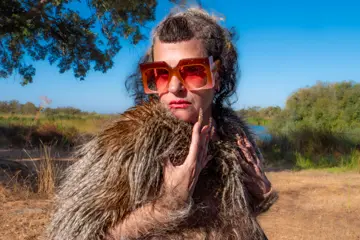
"I wanted to smash binaries with this album," says frontwoman Isabella Manfredi of the group's newest output, Girlhood. "We're living in an age where we talk about things in terms of binaries all the time; feminine, masculine, you know… And in writing this record, I just wanted it to be about the messy, contradictory experience of being a woman… It's not one or the other."
We're sitting at a busy cafe in Sydney's Surry Hills along with The Preatures' guitarist and producer Jack Moffitt. It's not all that far from their studio and rehearsal space, Doldrums, The Preatures' home for all things when they're back in Australia.

"To a certain degree, I put up a lot of walls to get through all of that touring and I just needed to come home and unravel," explains Manfredi.
For Manfredi, Girlhood was her most intimate foray into songwriting yet.
"I didn't know it was the right shift for the album, I just knew it was the right thing for me as a songwriter. I guess naturally, it was putting a mirror up to myself and seeing what came out," she explains. "Vulnerability and fragility, they're great strengths.
"I think having perspective is a big part of that. Looking back on my adolescence and childhood and my parents divorcing and what that did to my… It sort have split me in half and I felt, really, like I had just been torn the middle, never really been put back together again. So, when I hit 27 I just said, 'Well, I've got to start writing about this otherwise I'm just going to be in two pieces for the rest of my life.' That's the reason why I write songs, to reconcile things."
What was meant to be a month-long recording process ended up blowing out to a year, something that while unplanned and unexpected was a process that both Moffitt and Manfredi are thankful for.
"I think it's taken the time that it needed to take. And honestly, it was down to a couple of things," explains Moffitt. "One of them was we've been working on a song that required a lot of consultation with the Indigenous community and the other two things happened early on in the process were that we had Gideon [Bensen] leave, Luke [Davison, drummer] suffered an injury that put him out of action for a while, and what that kind of forced us to do, I guess, was get back together the way that it used to be before the band really took off.
"The album that we thought we were going to make very quickly became a new thing that we were learning about on the fly. I'm glad that we had the time, I really am, because I think we've ended up with a record that says a lot more about who we are for the moment."
Moffitt was co-producer for the band's debut and chose to again take to the chair for what would become their most advantageous record yet.
"I really set myself a bunch of personal goals, and it had a lot more to do with my growth, I guess, than the growth of the band. It sounds strange, but I'm lucky that they coincided," he laughs.
"I think in acknowledging myself; I was actually a lot more capable of being there for you, especially in allowing the songs you were writing to become clear and to live on record," he says, turning to Manfredi.
"And just [focusing on] being a creative partner and being a lot more reciprocal to Izzi's intention and her focus, and not shying away from what my responsibility was and [realising] if I didn't feel self-confident, that that was okay. It's not about me, it's not about anything else, it's about getting this record right. I would say that was something I was a lot more conscious of than I have been in the past, where I was trying to hide behind things. This time I want to put everything just there. Let's put it all up there and see what happen."
When it came time to do the final mix, there was an obvious choice for the band when it came to pick their mixing engineer. Bob Clearmountain is an LA-based engineer and producer, best known for his work with the likes of Bruce Springsteen, David Bowie and The Rolling Stones, and locally for his time with Divinyls and The Church in the '80s.
"The mixing of the record, it's its own thing and whatever I built into the production through my engineering and production at that level, it's like 95% of the identity and Bob's 5% is actually the thing that lifted that up a lot more," explains Moffitt.
"And what we were looking for when we were looking for mixers, was for somebody to take the perspective of that era and that sensibility through to now. And I don't think those things change though we live in the world where we're surrounded every day by a completely eclectic array of different sounds and whatever, and I love that about being a musician in 2017."
"We took all of the songs to Bob in LA and they were all done. And then he just… It was amazing watching him bring them out," continues Manfredi. "His mastery is that he really didn't do that much to them."
"It appeared that he was," laughs Moffitt.
"Maybe that's a better way of putting it," Manfredi agrees. "But he was just all about the song, what does the song want? He wasn't like, 'I'm going to mix the shit out of this record, it's going to be the best record'.
"You get a lot of those mixing engineers with big egos and, you know, [they] come in with their own angle on a record. He just lifted it. He just brought every song up on board, listened to it and then — it was amazing! It was like everything that was inherent in the production, he just brought it out.
"It was a lot about confidence for us, this record. I love [The Preatures' debut album] Blue Planet Eyes, it's a great record, but it's quite self-conscious in a lot of ways."
"There's things being hidden there and they're very consciously being hidden," continues Moffitt. "Whereas in this record, we're very consciously trying to present everything as it is. That journey, to actually make that choice, that's probably the result of all of the experience that we've had."