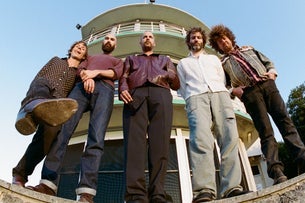
 Pond Profile
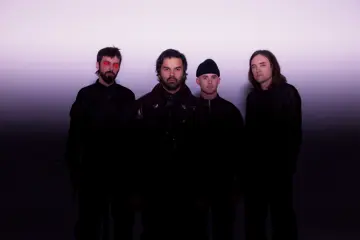
When listening to Pond’s forthcoming studio album Terrestrials, it is hard to discern what exact era of music you might be listening to.
Is this an album from the heyday of Aussie pub rock? Is this a relic from Britain’s spangled New Wave generation? Is it hyper-modern psych-rock? Is it music beamed down to us from the future?
The Perth-bred psych rock band has long been known for their heady approach to music: a mix of ridiculousness and sincerity, a sound that relies on heedless experimentation and genre fusion.
Terrestrials, their eleventh studio album – merging a pub rock strain with the post punk of Sisters Of Mercy, Magazine, and more – encapsulates Pond’s deep commitment as a band to Trying Shit Out (and having a giggle while they’re at it).
Over a Zoom call, the band’s frontman Nick Allbrook explains that the image of “Goths at the pub” became Terrestrials’ so-called stylistic north star.
At the mention of the phrase, he chuckles. “It’s fucking ridiculous. ‘Goths at the pub’ is something we laughed at every time someone said it – but it kind of does sum us up in a way. We’re a bunch of bogans, but we’re also sensitive art school types, you know?”
Pond was formed in Perth in 2008 as an attempt to create a collaborative project without ego: the original idea was to be able to get anyone they wanted to play whatever they wanted. At around the same time, Kevin Parker conceived of Tame Impala, a project in pursuit of unrestrained creativity.
There is much overlap between Pond and Tame Impala. Kevin Parker is a former member of Pond. Nick Allbrook is a former member of Tame Impala. Jay Watson is currently a member of both.
The aim to create unabashedly, to treat the studio as somewhat of glorious playground, has remained – but for the first time in Pond history, this particular recording process was subject to a simple set of rules.
“We’ve never done that before,” Allbrook admits. “It was pretty funny. At the beginning the only rule was no fuzz.” He play-acts getting stuck into his bandmates, and goes full Ocker. “No fuzz this time guys. If you want distortion you’ve got to turn your amp up or have a cheeky overdrive pedal…
“It’s just us fucking being dickheads and rinsing each other. Going, ‘Oi, no Pink Floyd Shit this time alright? We’re doing Goths At The Pub right now.’”
Consciously toying with Aussie pub rock - taking cues from the likes of Rose Tattoo, Midnight Oil, and Coloured Balls – has imbued the upcoming Pond record with a striking feeling of Australiana. It is an identity that not every artist has the desire to lean into. For Allbrook, the choice feels natural.
“Maybe this isn’t universal, but I feel like, every year you’re alive, it gets harder to put on artifice. To pretend to be something other than what you are. I think over the time I’ve just really gotten to appreciate art that shows its own faults and its own inadequacies.”
Artists and creative people, when they start out, he says, are gripped with the temptation to “recreate yourself, reshape and remodel yourself in the image of your ideal person, morally and stylistically.”
“And so you’re presenting this beautiful, cool, morally impenetrable person,” he explains. “And for a lot of Australians that involves becoming American. Being a New Yorker, or being from London, or whatever.”
He has realised that engaging in that kind of pretence is not conducive to meaningful self-expression. This realisation, however, does not mean that he doesn’t view that Australian identity as a "fraught and difficult” one.
Crucially, however, “it’s not a fraught and difficult existence, it’s very very privileged.” Being a White Australian “benefitting from colonialism and genocide and mineral extraction,” sitting in and being aware of violence of that identity, is an uncomfortable feeling.
“The only way that I have managed to find any kind of peace with it is through making art,” he notes. “Because I think it’s so deeply deeply fucked that you can’t really find any finality.” Justification of the White Australian existence, he says, cannot exist.
“So the only way to go about it is the bottomless grappling and exploration that is making art about something. It’s just kind of a mirror. You’re not actually seeking any final answers or anything, you’re just kind of toying with it and throwing words and ideas into the void.”
He sighs. “Talking about Australian identity, it’s tough not to get existential.”
Pond has the specific experience of, not only being an Australian band, but being a band from Perth – often considered one of the most isolated cities in the world. (Contrary to popular belief, it is not actually the most isolated city in the world. Factually, that title actually belongs to Auckland.)
“I think in the early days, being so far away from everything, and without any hope or concept that what we were doing would make any ripple in global music, you just feel like the stakes aren’t very high, so you can just piss around and make any awful noise you want,” he says of the band’s Perth roots.
“And it’s all faintly ridiculous. It definitely gave us a sense of humour, taught us not to take ourselves too seriously. The ridiculousness of what WA is. A place ruled by Jabba the Hutt figures, mining billionaires. It’s a very silly place. But at the same time it’s magical and ancient.”
That duality, he ponders, might have “added to the Pond thing of walking a thin line between irony and earnestness.” It certainly seems to have cultivated in Allbrook his own unique, endearing, cheeky, but intelligent outlook on the world.
Pond has long been known for their, frankly, insane level of output. While Terrestrials is the band’s eleventh studio album, Allbrook continues to release solo albums, as well as albums with buddy-and-Tame-Impala-band-member Cam Avery. How, then, does he make sure that he is not spread too creatively thin, that he still has more music to give?
“I don’t know, hey,” he admits. “I always worry about that. I think you just have to trust that the well won’t run dry.”
He hypothesises that “the feeling that the well is running dry” is actually fake. “That’s a trick. That’s the anxiety blocking the well. Everywhere you look there’s creative inspiration if you open your eyes, and if you’re open to it.
“It just comes flooding in from every direction no matter what you’re doing: if you’re on the train, if you’re taking a shit, if you’re at work, whatever.”
It is easy to become bogged down by anxiety over the possibility that that stream of ideas will one day end. “Or you get really protective of certain ideas, thinking you need to make sure this is realised in the best way it possibly can be.”
This kind of perfectionism, he says, is also an artistic trap. “The wheels get locked and you’re not really doing anything. I think I’ve found that the best way to do it is just to use your ideas when you have them and just hope and pray and trust that more will come for the next project.”
Terrestrials feels at once futuristic and retro. On the album, time and circumstance isn’t linear – it’s all over the place. And it is funny and ridiculous, as he says, but marred by a dark undercurrent, a gnawing sense of existentialist dread.
The dread is inescapable, but “a vein of hope” persists through the music, just as it does in life.
“I’ve started seeing heaps of young lads, on the train and on the waterfront, going fishing. Like, it’s a thing, it’s a fucking hip thing. It’s crazy. I don’t know what happened. But that filled me with hope.”
Terrestrials is, ultimately, “about being dissatisfied with your own reality and your own place in the world, and your own boring state, country, town. And I guess there’s a hope that if you accept it and learn to love where you are and what you are then we’ll maybe be less likely to kill each other and our planet,” he says, laughing slightly maniacally.
The album centres on dissatisfaction, but that is not a feeling he, on a personal level, is particularly bogged down by. “I’m pretty satisfied with how I’m going and my place even though I’m deeply flawed and imperfect in many many many ways.”
He sighs, his tone taking a lonesome walk downwards. “I’m dissatisfied with what we’re doing to the planet, and what the rich are doing to the rest of humanity. I’m dissatisfied with that.”
On the opening line of the album, Allbrook warbles, over unearthly synth patterns, “Now, the future’s in the water.” As the textures swell around his words, it is hard not to think of those young lads, heading out to the water, going fishing, filling Allbrook with a – not uncomplicated – kind of hope.
Pond’s Terrestrials releases on June 19th.
This piece of content has been assisted by the Australian Government through Music Australia and Creative Australia, its arts funding and advisory body