In September, it will be 30 years since Pauline Hanson made her infamous maiden speech to the Australian House of Representatives.
Widely reported by the media, it has historically been seen as a turning point in local politics, often viewed as the moment in which far-right rhetoric received a mainstream platform, and when Hanson became a household name.
Three decades on, Hanson remains a prominent – if incredibly divisive – figure in Australian politics, and while that maiden speech is seen as a metaphorical opening of the floodgates, it also served as the start of one of the most unexpected and controversial moments in Australian music history as well.
Indeed, it was the rise of Hanson, and the widespread protests against her that gave way to the birth of Pauline Pantsdown, but before we reflect on that watershed moment in which politics and music met the justice system, it’s time to go back to where things first began.
Pauline Hanson’s Rise To Infamy
Born in Brisbane in 1954, the first four decades of Hanson's life were largely free from politics, having only made her foray into such matters in April 1994, being elected as a Councillor of the Ipswich City Council. That role lasted for just under a year, at which point Hanson set her sights higher.
Joining the Liberal Party in 1995, her chances of election in the House of Representatives were viewed as minimal. However, after advocating for Indigenous Australians to lose government assistance, she gained wider media attention and traction in the eyes of the public.
Ultimately, Hanson emerged victorious in the 1996 federal election, being elected into the seat of Oxley as an independent after dis-endorsement from Liberal leader John Howard.
She made her maiden speech in September 1996, with her anti-immigration stance (“I believe we are in danger of being swamped by Asians,” she stated), and disdain for Indigenous Australians receiving governmental assistance (“I am fed up to the back teeth with the inequalities that are being promoted by the government and paid for by the taxpayer under the assumption that Aboriginals are the most disadvantaged people in Australia”) being given the lion’s share of the attention.
The Public Response
As one would expect, Hanson’s controversial viewpoints were widely covered by the media. Most notably, 60 Minutes ran a segment exploring her political rise and viewpoints in a piece titled The Hanson Phenomenon, which saw the political figure being asked blunt questions such as “Are you xenophobic?” by reporter Tracey Curro, and resulting in the now-ridiculed response of “Please explain?”.
In a sense, the latter phrase became a meme before it was called as such, and while comedians and broadcasters such as Tony Martin and Mick Molloy dined on those two words for close to two full years in their own radio program, the comical overtones hid an undercurrent of ignorant racism that the Australian public now felt free to begin expressing.
However, while her fanbase grew gradually, musicians also found themselves responding to Hanson’s rising popularity.
While the likes of The Single Mothers’ Turning Into Pauline and PH Balance's All For Nothing were more underground musical responses to Hanson, so too was Midnight Oil’s White Skin Black Heart a more mainstream critique.
Additionally, Brisbane punk band Escape From Toytown drew upon Hanson’s much-cited history of operating a fish and chip shop by releasing the song Fish And Chip Bitch From Ipswich, with the track even topping 4ZZZ’s Hot 100 countdown that year.
However, the biggest musical takedown was still to come.
The Birth Of Pauline Pantsdown
In April 1997, Hanson’s One Nation party was founded, at which point it became clear that her viability as a political contender was gaining traction.
Soon, Simon Hunt – an life-long musician, artist, sound designer, gay rights activist, and lecturer – decided to take action. The result was a composition which was – as Hunt later explained – “essentially made for a party”.
Based around a recording of Patrice Rushen’s Forget Me Nots, and utilising samples from tracks by Cheryl Lenn, Michael Jackson, Maxwell, and the Brothers Johnson, it was the lyrics of this song – dubbed I’m A Back Door Man – which drew the most attention.
Editing snippets of Hanson’s own speeches, interviews, and comments, phrases such as “I'm a backdoor man/I'm very proud of it/I'm a backdoor man/I'm homosexual,” “I'm very proud that I'm not straight/I'm very proud that I'm not natural,” and “I'm a backdoor man for the Ku Klux Klan/with very horrendous plans,” were strewn together, designed to be utilised as a track for which Hunt would lip-sync to.
"I took a lot of her speeches [and] rearranged her voice so that she was like a proud gay activist intolerant of anybody who wasn't gay," Hunt later told Double J. The method wasn’t unique for Hunt, who had utilised a similar approach in 1988 in protest of anti-gay campaigner Fred Nile, with his work being broadcast around Sydney and even on triple j.
There’s every chance the song would have gone largely unnoticed had the national broadcaster not gotten involved.
The party the track had been made for was called Melting Pot, an event held at Sydney’s Metro Theatre on August 23rd and hosted by Vanessa Wagner, the drag queen persona of Tobin Saunders, who had roles as both a behind-the-scenes employee and on-air presenter at triple j.
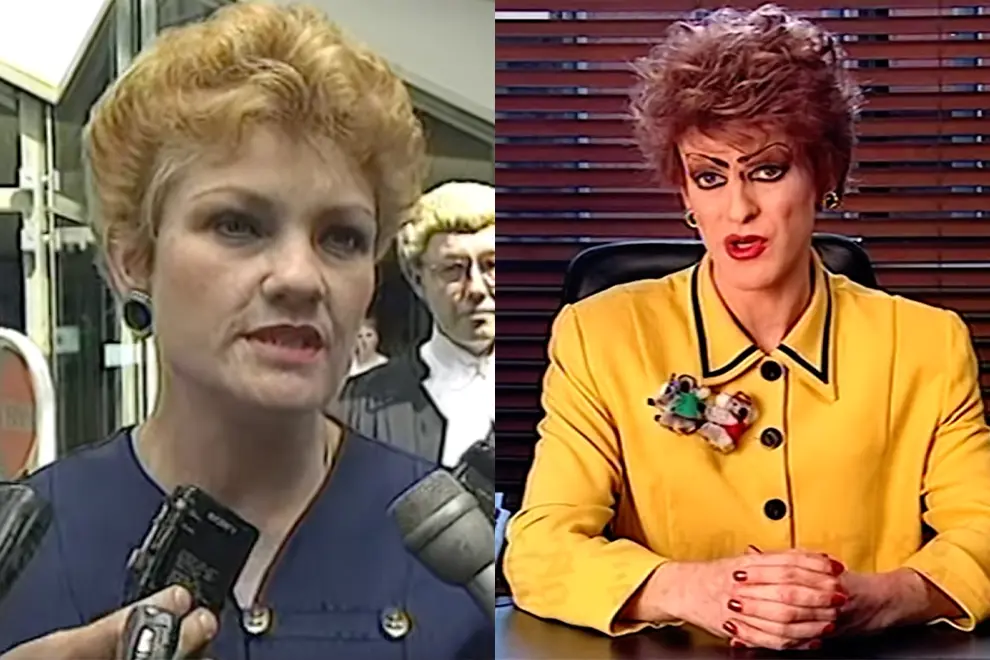
The plan was for Wagner to talk about the song on air, give it some airtime, and promote the Melting Pot event, at which Hunt would debut his Pauline Pantsdown persona, which drew upon elements of drag and Weimar-era cabaret to mock Hanson and her beliefs.
“Pauline Pantsdown is a homosexual character whose sexuality is defined by Hanson's own definition of a homosexual,” the man behind the persona would later explain. “She's ‘not natural’; ‘not straight’; ‘not human’ and of course is ‘very proud’ of all these attributes.”
The debut of the track on the airwaves caught everyone by surprise. "We brought the track into triple j and by that night it was the number one request on air and it stayed that way for nine days,” Hunt recalled.
Indeed, the track was massively popular on the station until Hanson herself got wind of it. As per the Sydney Morning Herald, Hanson contended that the song had “a number of defamatory meanings, such as that she engages in unnatural sexual practices including anal sex, that she is of subhuman intelligence, that she is a pedophile, a homosexual, a gay activist and a prostitute.”
Hanson further claimed “the broadcast material gave rise to imputations that she is a homosexual, a prostitute, involved in unnatural sexual practices, associated with the Ku Klux Klan, a man and/or a transvestite and involved in or party to sexual activities with children.”
The track had begun broadcasting on triple j on August 21st, 1997, but within “four or five” days, Hanson had issued a write of defamation against the station. triple j felt it wasn’t defamatory and responded by adding a note beforehand that the track was satire, but the popularity of the song led it to be added into high rotation.
By August 28th, Hanson had taken the matter before Queensland Supreme Court Chief Justice Paul de Jersey, seeking a temporary injunction for its airplay by claiming defamation.
Sure enough, her attempts were successful, and by September 1st – after just eleven days of airplay and no official release for the track (despite attention from “five or six different major record companies”) – I’m A Back Door Man had been taken off the airwaves.
Specifically, the track was taken off the air so that Hanson could deliver her Statement of Claim regarding the song and the reasons it was considered defamatory. While an appellant usually only has 28 days to deliver their Statement of Claim, it ultimately took 13 months for Hanson to do so.
Hunt appealed the decision, claiming “the material amounted merely to vulgar abuse and was not defamatory” and noting that triple j announcers has made preceding statements claiming “the song was satirical and was not to be taken seriously,” but the track was disallowed from further broadcast.
Somewhat interestingly, Hanson’s lawyers latched onto the lyric of the song in which the words “I’m a very caring potato” are used, claiming it “is understood to be a word associated with a male engaged in sexual acts.” For those playing at home, it isn’t.
By the time the station’s annual Hottest 100 countdown rolled around in January of 1998, the track’s lingering popularity and the controversy of the previous year still loomed large, and the track was ultimately voted into the No. 5 position – directly between The Verve's Bitter Sweet Symphony and Blink-182's Dammit.
“We can’t play number five,” Helen Razer said upon the song’s placing in the poll. “Pauline, you’re a gem – uh, not you, Pauline, but Ms. Pantsdown – and thank you very much for providing one of the most amusing little ditties of the entire year.”
“Some may say ‘amusing’,” added Adam Spencer, jovially. “Others would say a vile, disgusting attempt to rend asunder the fabric that holds together our comfortable and relaxed Australia.”
“As you know, triple j can't play the song today because Pauline Hanson heard it and said, ‘I don't like it,’” Pantsdown told the station’s listeners in a message broadcast in place of the song. “Instead, I'd like to read you some unedited words that she said in the Parliament on December 2nd, 1996.
“‘As a citizen, the right of free speech under the law is fundamental to our nation and way of life. Stopping free speech will lead, in the end, to a totalitarian society ruled by dictators where no one will have the right to disagree.’
“I think this means free speech is all right, unless someone says something you don't like,” Pantsdown added. “Fellow Australians, crush racism, support the RSPCA, and continue to be very caring potatoes.”
Months later, in June of 1998. it was also voted into the station’s Hottest 100 of All-Time countdown, where it reached No. 92, slotting between Metallica’s The Unforgiven and U2’s I Still Haven’t What I’m Looking For.
“We would’ve liked to have played your track,” presenter Robbie Buck told Pantsdown during that broadcast. “Unfortunately though it seems like we have a bit of a legal problem about playing it.”
To date, it remains the only song voted into triple j’s annual poll but ultimately omitted from broadcast.
The Return Of Pauline Pantsdown
Prepare for a terrible pun, because despite the legal setback, Hunt was (pants)down but not (pants)out following the song’s ban.
After winning 11 seats at the Queensland state election in June 1998, Hanson and her One Nation party were preparing for the upcoming 1998 federal election. But Hunt wasn’t ready to give up.
“I’d been stopped by Pauline Hanson,” Hunt later told The Huffington Post." “People have tried to stop me before and I’m not going to be stopped by Pauline Hanson. So after a month or so of licking my wounds, I really thought, ‘Well, I’m just going to have to do another song.’”
The approach was similar, with Pantsdown listening to roughly countless hours of Hanson’s speeches to craft a new track, but being careful to avoid the legal issues (“at least eight lawyers went over the lyrics,” Hunt would claim).
“I spent about 500 hours editing the song from syllables, so I could get her to say anything that I wanted her to,” Pantsdown later said. “It was aimed at both kids and adults – singalongs for the kids, politics for the adults.”
Titled I Don’t Like It, the new song was officially distributed via TWA Records on August 28th, and featured lyrics referencing the previous controversies, including “I don't like it, when you turn my voice about/I don't like it, when you vote One Nation out,” “Please explain, why can't my blood be coloured white/I should talk to some medical doctors, coloured blood is just not right,” and the bafflingly delightful “I don't like anything/except I like Neil Diamond.”
“I released it on a small independent label on a Friday evening,” Hunt later recalled. “It was trucked around the country to get all the radio stations to start playing it at once. The strategy was that Hanson couldn’t get a court hearing over the weekend, and by Monday there would be too many people to sue for playing it.
“Also, she’d been able to stop the previous song because it had called her gay. I Don’t Like It had more direct allusions to her racism, and lawyers had advised me that she would be unlikely to try and argue against that in a courtroom.”
The CD also featured an additional remix dubbed the Xenophobia Mix, and an instrumental track titled Pauline's Nightmare, which was a dreamy composition featuring a number of Asian instruments.
Paired with a music video which parodied Hanson’s infamous “I have been murdered” video from 1997, made reference to the unauthorised use of Hanson’s voice, and featured a number of shirtless Asian dancers, the commercial result of the new track was a very respectable placing of No. 10 on the ARIA Singles chart, two nominations at the 1999 ARIA Awards, and being voted into No. 52 on triple j’s Hottest 100 countdown.
Most notably, Hunt would reflect that the impact of the song would also follow Hanson herself wherever she went. “When she did meet-and-greets in Perth shopping centres, CD shops would play the song full blast,” he recalled. “When she sat in a Wagga Wagga cafe, a local radio station dedicated the song to her.”
On September 10th, days after the release of the track, Hunt legally changed his name to Pauline Pantsdown via deed poll in preparation for a Senate run.
During this time, triple j actually refrained from putting the song onto their playlists, with Hunt later explaining there were fears from the station it would be considered “electoral material” given Pantsdown was a Senate candidate. Reportedly, the success of the track was due to it having been aired on commercial radio.
After an on-air interview with DJ ‘Ugly Phil’ O'Neil, the track managed to cross over to the mainstream, but even more typically liberally-minded programs such as Recovery were reticent to give it airtime.
“Although we put out several press releases to the entertainment media about these apprehensions, there was a lot of self-censorship on the basis of Back Door Man,” Hunt would later explain. “People thinking/perceiving that the Back Door Man court decision suggested that it was illegal to edit someone’s voice or something like that.”
Ultimately, the Senate election would take place on October 3rd of 1998. Just days earlier, on September 28th, the Queensland Supreme Court held their hearing on the APC’s appeal of the temporary injunction on I’m A Back Door Man. If successful, the ABC could have broadcast the track for the remaining five days before the election.
Hanson had previously delayed the hearings in hopes of it taking place after the election, which she had assumed would occur in August. But while she wasn’t successful, her legal tactics were, and the track was still not allowed to be broadcast.
The results of the hearing almost resulted in a televised meeting between the two Paulines, but while Hanson issued a statement on the verge of tears for the cameras, Pantsdown arrived 90 seconds later, missing the politician, but issuing her own statement to the camera.
“If people are hurt by satire they should get out of the political game, and leave it to people who can actually justify their actions, and their words, and their policies,” she said.
The pair had actually crossed paths days earlier, on September 24th, at the Mortdale Bowling Club in NSW, with photographs of the meeting making the national press.
According to Hunt, the legal issues actually went on for years, and as recently as 2016 “still [weren’t] actually resolved.” However, he also noted that the ”current legal status is that the ABC are not allowed to play it on air, but the song is not ‘banned’.”
The 1998 Senate run ended being something of a disappointment, with One Nation receiving 1,007,439 votes nationally, gaining one seat, and seeing Hanson lose hers; and Pantsdown receiving 2,295 votes and not winning a seat. Meanwhile, another group – comprising satirists David Mouldfield (named for Hanson’s One Nation co-founder David Oldfield) and Paul-Ian Handsome Handpuppet – received a total of 2,786.
Regardless, the man behind it all was pleased with how the media circus and the Senate run had unfolded.
“It was actually really enjoyable,” he explained in 2016. “I never really wondered about what I was doing, because I that actually wanted to have an effect on the political process. And using comedy, using performance to do that, it's like being the world's biggest 12-year-old.
“The whole experience of Pantsdown was like a fascinating way of manipulating media as it was in 1998.”
Post-Pantsdown
While the new millennium brought with it something of a lull in terms of the level of controversy Hanson generated, so too did Pantsdown effectively find herself retired. Hunt reverted to his former name, and no more music was released with Hanson in the crosshairs.
In August 2000, in the wake of Prime Minister John Howard’s refusal to apologise to Indigenous Australians and the Stolen Generations, Hunt returned with another track titled I’m Sorry under the name Little Johnny.
Much like the Pauline Pantsdown compositions, this was a sonic collage which utilised Howard’s past speeches to once more satirise the political figure in question. Sadly, this one avoided mainstream attention and largely went unnoticed by the wider public.
“Apparently one of the DJs took a particular dislike to the way I’d made fun of John Howard physically, and stood up in two consecutive meetings and said ‘We shouldn’t play this song,’” Hunt later explained.
“And so 2JJJ didn’t play it, it didn’t do the crossover into mainstream media, and never really got heard.”
For the most part, the ensuing years were quiet on the Pantsdown front until 2011, when Hunt returned to perform I Don’t Like It at the Sydney Mardi Gras alongside Hanson’s announcement of her candidacy in the NSW state election.
Another performance took place on Channel Seven the following year, and in 2016 – just after Hanson won a seat in the 2016 federal election, SBS aired the documentary Pauline Hanson: Please Explain!, in which she described Pantsdown as “an absolute idiot ratbag”.
In 2024, Hanson found herself in a rather familiar position when Robert Irwin threatened to sue producers of Hanson's political cartoon series, focusing on an episode satirising his involvement in a tourism campaign for Queensland. Hanson refused to remove the video, telling Irwin to "lighten up".
“It’s satirical, have we become so precious that we are actually looking at ourselves all the time without having a joke?” Hanson told Perth’s 6PR. “Where’s the Australia that I grew up in where you could have a laugh and a joke at yourself?”
More recently, however, the question has turned to whether or not Pauline Pantsdown may make a grand return in the wake of Pauline Hanson’s popular resurgence in Australian politics. Hunt, however, told the Star Observer this month that “there’s no immediate plans” for a comeback.
“Everyone except for me thinks that now is the time,” Hunt explains. “It’s not the time, we’re just gonna let One Nation show themselves a bit more. It’s the third time I’ve seen this this cycle of Pauline Hanson’s supposed return to popularity. I mean it’s really extreme this time in terms of numbers, but she can’t govern, you know?”
Almost 30 years on, it remains to be seen whether I’m A Back Door Man might ever receive the wider airplay it deserves, but at least it gave rise to one of the most intriguing cases of free speech in music we’ve ever seen.