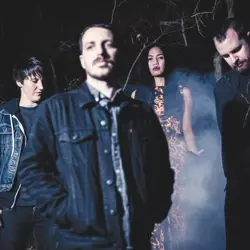
 High Tension Profile
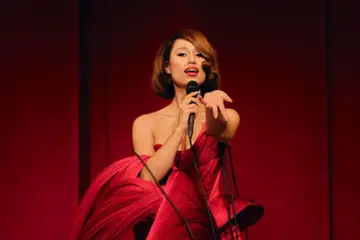
Before her beer has even arrived, High Tension’s Karina Utomo is already explaining the concept of the clip for Bully, the title track of their second album.
“The underlying theme of the song and the video is about conquering the fear relating to the feminine struggle. It’s about social aggression. Not physical aggression or violence, but about all the negative connotations that come with being female.
“Bully is the most powerful track out of anything on the album, so the intention was to execute a powerful video with only women [in it] to create a sense of empowerment without referencing the typical, lame girl power shit.”
Before she’s accused of hitching onto the feminism bandwagon, Utomo is quick to clarify: “We are about empowering women or whoever, but we’re not about excluding others who aren’t being empowered in the process.
"It’s not a criticism, but more an observation of a real lack of female protagonists on the scene."
“Traditionally the hardcore and metal scene has been very male-dominated and a bit of a boy’s club. But it’s not that the guys want to exclude women; on the contrary, I’ve always felt that even as a young girl going to these hardcore or metal shows I’ve always felt safe and really welcome. So it’s not a criticism, but more an observation of a real lack of female protagonists on the scene.
“I’m sure that it’s not just in music; it’s in a lot of big industries. Women don’t consistently have that leading role of having control and power. It’s very, very rare. And when they are in a position of power it’s so much tougher [to hold onto it].”
Utomo, in person, looks nothing like the screaming banshee she appears to be on Bully and High Tension’s first record, 2013’s Death Beat. Slight of frame, it’s her physical stature that proved the biggest hurdle of her career, she admits. “One of the main issues, for me personally, was a sense of fear in terms of my size and physical capabilities as a female.
“Obviously I needed the strength and ability to be able to learn how to sing the way I do. Only once I learnt how to use my voice this way could I overcome the other fear I had: being a woman and not being taken seriously. I’m sure that this type of fear is what’s stopping a lot of girls and women coming into the scene and giving it a go.”
Her hard work is the music industry’s gain. “When we toured with King Parrot earlier in the year we noticed a lot more girls coming to these shows and a lot of younger girls in particular. They made the effort to talk to me and to ask questions like ‘How long did it take you to be able to sing like that?’ which was both humbling and exciting.
“There’s a shift happening and there’s this realisation that [performing on stage] is not as scary as they thought it would be.
"If you don’t highlight being a woman as a handicap, it’s not going to be a handicap."
“I get asked the question so many times [Utomo puts on a stuffy, conservative journalist voice] ‘How does it feel to be a girl in a male-dominated industry?’ all the time. To begin with, if you don’t highlight being a woman as a handicap, it’s not going to be a handicap. At the end of the day, it’s all about the music. If you think the music is cool, sweet. Buy the album, come to the show. If you think the music is shit, then it doesn’t make you sexist or racist or whatever.”
It’s a heavy topic, but as the conversation about Bully’s themes continues, it seems High Tension is a band engaged with current affairs and politics. Other tracks across the album cover deep issues like the 1965 Communist purge in Indonesia, ethical and environmental disasters and a group called the Lavender Panthers.
The song What’s Left refers to the Lavender Panthers, a homosexual vigilante troupe who targeted gay-bashers in 1970s San Francisco. Led by the openly gay Reverend Ray Broshears, they were skilled in various combat forms from karate to alleyway brawling.
“Ash [Pegram], our guitarist, wanted to base this song about the Lavender Panthers, but in order for me to be able to sing it I had to change some of his lyrics and tie it into stories of my own friends. One of the lines [in What’s Left] references a friend who got mugged and gay-bashed. One of the most tragic parts of the story was that he’d met someone that night and he begged the perpetrator to give him his sim card back because he’d just gotten this guy’s number.
“[Gay] relationships are so much harder, life is so much harder; you can’t even get married here for fuck’s sake! It’s fucking brutal.” Utomo has a unique perspective on the area, having been requested to DJ at a number of lesbian parties, “despite the fact that I’m neither a lesbian nor a DJ”.
So what makes the playlist? “The hits. When I was younger I used to go and dance at clubs and places like that but there were always creeps or guys trying to buy you drinks. Everybody’s welcome at a lesbian party so there are absolutely no creeps and everyone’s having a great time.”
“It’s good that everyone in the band is up for fucked-up shit.”
High Tension have made a deliberate decision not to tour as hard and as often as many of their peers. Utomo laughs as she lists the three shows in Brisbane, Sydney and Melbourne that encompass their entire Bully album tour. With experience on their side from their respective time in other bands such as Young & Restless and The Nation Blue, it’s a conscious choice.
“When [bass player] Matt [Weston] and I first talked about starting a band, we basically agreed that there was no point in going through the struggles of being in your first band, playing to no one and having nobody really giving a shit. So we have been wiser. When we do play shows hopefully they’re good ones. We haven’t included a lot of the smaller towns [on this tour] because I think we’ve still got a long way to go to build that interest and justify those extra days on the road.
“I really respect and look up to bands like King Parrot who are so relentless in touring. I don’t know how they do it mentally and physically, being in a van with the same people for so long. We’ll never be that band that just tours constantly. We all have lives.”
Of course, playing shows sparingly offers more chance to enjoy the camaraderie that comes with being in a band, like fooling around in roller skates before a camera. “I feel like band photos can be so annoying, so you might as well have a LOL while you’re at it. The shoot with Kane [Hibberd] took a long time, which isn’t necessarily a bad thing because we got some great shots out of it. But [drummer] Damian [Coward] bought the rollerblades and the ones he bought for me were about five sizes too small so my feet were all curled up in there. The guys are doing sick jumps and stuff and I’m just standing there clenching my face.
“It’s good that everyone in the band is up for fucked-up shit.”