I’m always astounded by how popular The Beatles remain. Despite breaking up in 1970, they are currently the 150th most popular artist on Spotify. That longevity is mind-boggling, especially when you put it in context like this person did on Twitter a few weeks ago:
Listening to The Beatles and The Beach Boys in the 2020s would’ve been the equivalent of listening to Scott Joplin or stuff like “Take Me Out to the Ball Game” or “You’re a Grand Old Flag” in the 1960s.
listening to the beatles and beach boys in the 2020's would've been the equivalent of listening to scott joplin or stuff like "take me out to the ball game" or "you're a grand old flag" in the 1960's (60 years)
— gracie 🏳️⚧️ 🌸 (@APanther369) March 10, 2026
Though this tweet is ostensibly about the long-term popularity of The Beatles, it is making an indirect comment on the current state of culture. The fact that we are still listening to The Beatles today highlights (a) how revolutionary they were and (b) how little our culture has moved on.
When The Beatles were at the height of their powers, people weren’t listening to music from 60 years earlier. Scott Joplin, as the tweet points out, wasn’t a pop star when Let It Be was on the charts. The odd thing is, he kind of was.
Ragtime is a syncopated style of piano music that found great popularity in the late 1800s and early 1900s. With popular compositions like Maple Leaf Rag and The Entertainer, Scott Joplin was the king of the genre. Joplin, and ragtime generally, came to an end with the pianist’s untimely death in 1917. Then Joplin was largely forgotten for decades.
That changed in 1970 when pianist Joshua Rifkin recorded an album of Joplin’s compositions. The album sold over 100,000 copies in the first year, and set off a short-lived ragtime revival. “Scholars,” Harold C. Schonberg wrote in The New York Times after seeing Rifkin perform in 1971, “are going to have to get busy on Joplin.”
And busy they did get. Not only did critical interest in Joplin grow, but his compositions also featured prominently in the Oscar-winning soundtrack for the 1973 box office smash The Sting, but Marvin Hamlisch’s soundtrack recording of Joplin’s The Entertainer climbed all the way to number three on the Billboard Hot 100. (It sadly could not get past Ray Stevens’ The Streak and The Jackson 5’s Dancing Machine.)
The ragtime/Joplin revival is one of many examples of older musical styles catching a second wind long after their initial popularity. Let’s run through a few others from the last century.
The Gay Nineties Revival
Between WWI,the Influenza Pandemic, and the Great Depression, the beginning of the 20th century was characterized by deadly societal upheaval. Because of that, many people longed for the era before all of this began, namely the 1890s.
From the 1920s to the 1950s, popular culture of this decade—affectionately referred to as “The Gay Nineties”—was very popular. Weekly radio programs exclusively played hits of the day, many Hollywood pictures focused on the era, and record labels released popular compilations of songs written in that era.
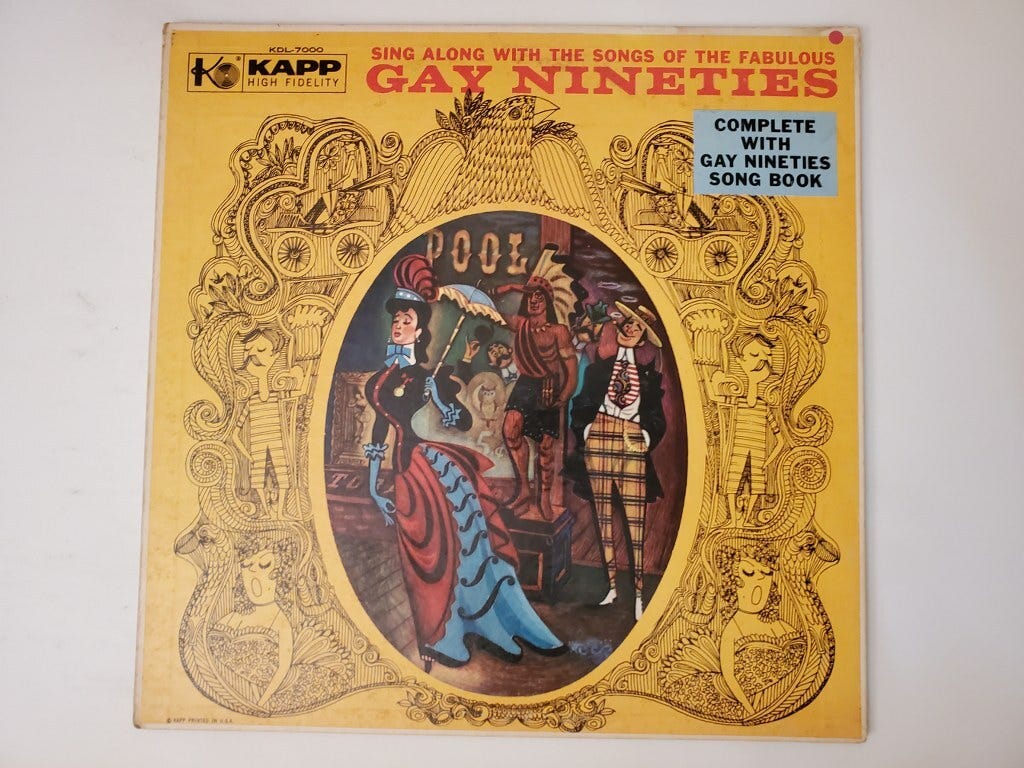
“Old songs these days never really grow old. Somebody always keeps bringing them back and back and back,” Hugh A. Mulligan wrote when covering nostalgia releases for the Meriden Record in 1957. “Faced with an even more awesome dearth of first-class material than television, record companies have been forced to rake deep into the musical ashes of yesteryear for some mighty moldy old chestnuts.”
Many of those “mighty moldy old chestnuts” from the 1890s have proven quite durable. America the Beautiful, Daisy Bell (Bicycle Built for Two), Maple Leaf Rag, and The Stars and Stripes Forever were all released during the 19th century’s final decade.
The Music Hall Revival
The 1960s might be the decade associated with more revolutionary popular music than any other. As I noted at the beginning of this piece, we’re still listening to The Beatles, that decade’s crown jewel. But even as rock music matured, the charts were rife with nostalgia.
Throughout the decade, the influence of music hall—the British equivalent of vaudeville in the United States—was everywhere. Multiple number one hits, including Herman’s Hermits’ I’m Henry VIII, I Am and The New Vaudeville Band’s Winchester Cathedral, pulled heavily from this early 20th century tradition.
The Beatles’ Paul McCartney was especially influenced by this 60-year-old music. When I’m Sixty-Four, Honey Pie, and Maxwell’s Silver Hammer, among others, lean on music hall tropes.
The Rock ‘n’ Roll Revival
While artists of the 1960s were nostalgic for music from over a half-century before, those of the 1970s were looking back much more recently in the past. Along with the Scott Joplin revival, the 1950s were en vogue during the 1970s. Most people point to television shows, like Happy Days and Laverne & Shirley, and films, like Grease and American Graffiti, when discussing this nostalgia, but it was also readily apparent in music.
Nostalgia acts like Sha Na Na kicked off shockingly long careers around this time. Many 1950s hitmakers, like Neil Sedaka and Chuck Berry, also found themselves at the top of the charts again.
Much of this nostalgia would only grow stronger at the beginning of the 1980s. Queen would top the charts with an Elvis Presley-inspired tune, Crazy Little Thing Called Love. The Stray Cats would score multiple hits the year after with an exceedingly retro sound. Billy Joel would also get into the mix around the same time with his doo-wop-inspired project An Innocent Man. Tell Her About It, the lead single from that album, even went to number one.
The Swing Revival
If it wasn’t enough for Brian Setzer of The Stray Cats to push rockabilly back into the mainstream, the guitar savant felt the need to bring swing—a genre that died in the 1940s—back in the 1990s.
As I’ve noted elsewhere, the swing revival is one of the movements that made the 1990s such a strange musical decade. While it was short-lived, the revival did have a legitimate moment. Along with Brian Setzer, groups like Big Bad Voodoo Daddy, Squirrel Nut Zippers, and the Cherry Poppin’ Daddies were selling millions of records, scoring legitimate hits, and playing the Super Bowl. Advertisements and films even came to rely on the genre.
So, What’s the Deal with Revivals Today?
These earlier musical revivals are a good reminder that nostalgia is not new. We’ve been reviving sounds for at least the last century. In that sense, it’s not that strange that people are still listening to music from the 1960s today. Even so, it’s important to remind people that the scale of that listening is very small.
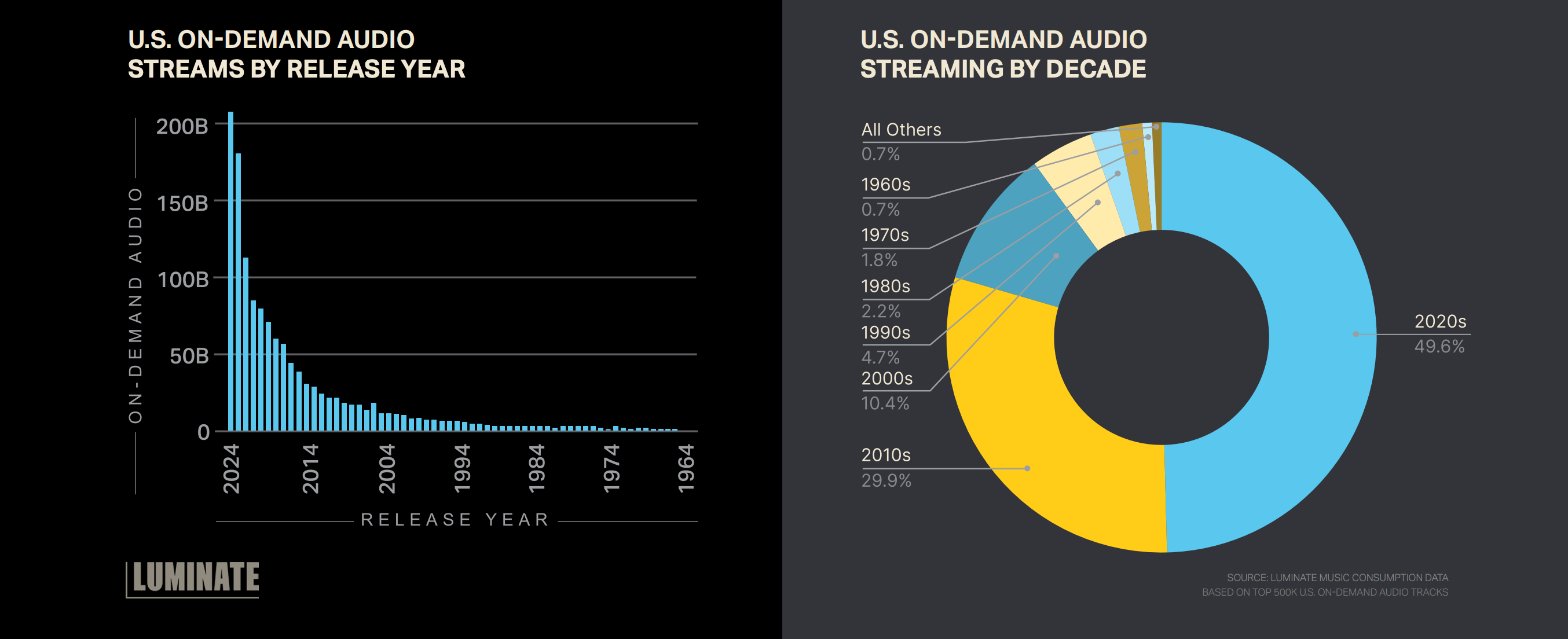
In 2024, Luminate reported that 0.7% of streams were on music from the 1960s. Nearly 90% of streams were on music released after the year 2000. In other words, people are mostly listening to recent hits.
You might notice that there is a clear difference between our current musical nostalgia and that which came before, though. When ragtime and music hall and any other musical style was revived during the 20th century, new songs were being made in those styles rather than people listening to the original recordings.
Nobody, for example, in the 1990s was listening to Louis Prima’s original recording of Jump Jive An’ Wail. They were listening to Brian Setzer’s cover. That’s not what’s going on today. When Dreams by Fleetwood Mac resurged in 2020, it wasn’t a cover of the song. It was the original recording that was climbing the Billboard charts. Why?
This comes down to an idea that I have discussed before: recording quality. When artists in the 1970s were looking to the early rock ‘n’ roll era for inspiration, those original recordings were lower fidelity than those being produced at the time. In other words, those original recordings sounded older even if the music felt fresh.
This is the case with nearly every revival of the 20th century. The original recordings of the music being revived would have sounded very old. That’s not the case anymore. Since the middle of the 1960s, recording fidelity hasn’t changed that much. A song released in 1982, for example, might sound dated because of the production choices, but the actual quality of the recording won’t be much different than something made today.
In short, don’t feel guilty if you are still drawn to songs of the past. This is an urge that’s been with humans since the dawn of recordings. Nevertheless, you should still check out some new stuff too. You might miss out on your next favorite song.
Chris Dalla Riva is a musician who spends his days working at Audiomack, a popular music streaming service. He writes a weekly newsletter about popular music and data called Can't Get Much Higher. His writing and research has also been featured by The Economist, NPR, and Business Insider."
Grab a copy of his book Uncharted: What Numbers Tell Us About Hit Songs and Ourselves and read our interview with him here.