 Andrew Farriss Profile
“I’ve been here for a while,” Andrew Farriss enlightens when he calls The Music from the US. “First of all, from about June the 11th, my wife Marlina and I arrived in Dallas, Texas. And then we flew to Dayton in Ohio, because her family is there and we have a family member there who’s not well.
“So, we went to look after her and them, and do the best we could. And then I drove myself to Nashville, where I’ve been promoting my new album, The Prospector. Then, as I’m talking to you right now, I’m in Knoxville, Tennessee, ‘cause I’ve been travelling around talking about my record and also playing live on some US country radio.”
Launching The Prospector at the Grand Ole Opry
When asked how one goes about launching their album at the legendary Grand Ole Opry – on release day, no less – Farriss, who is doing just that, acknowledges, “Yeah, I know! Listen, I swear – I wish I could say I was that clever, right? But when I saw that that was actually the date that they wanted me to perform at the Opry, I went, ‘Who the hell gets that!?’ you know?’” He admits with a chuckle. “I couldn’t believe it! So yeah, no, it’s beyond reality. I’m a very, very fortunate person. And not only that, it’s the second time I’ve been invited to perform there!”
Farriss made his Grand Ole Opry debut on 14 December, 2024, during which he invited Keith Urban to the stage for a surprise take on Never Tear Us Apart by INXS.
“For a Christmas present last year, Marlina actually bought me – well, I was talking metric, but I suppose I am getting a bit older [laughs]: it’s about a foot by a foot wide, where they took some of the original wood from the floorboards of the Ryman Auditorium and had it framed. It’s hanging on our wall in the old kitchen back at the farm, where we entertain people and other scoundrels.
“But on the stage at the Grand Ole Opry, they actually have some of those other [original] floorboards… And you stand in that circle, and you realise some of the people who have been on that stage [eg. Hank Williams and Patsy Cline] – it’s pretty mind-blowing, I’ve gotta say, and respect is a word that comes to mind.”
“It was a different world when we were teenagers, really”
“Lawrie Minson, who’s definitely Australian country music royalty, called me up and said, ‘Hey Andrew, I’ve got this idea for a song’ – and it’s usually the other way around; I'm usually the person that’s got a bit of a spark going with something. But I said, ‘Well what have you got?’ And he played what he had for me, and I said, ‘I like it, mate.’
“So I left my farm and went down to Tamworth and started working on [what would become one of The Prospector’s standout tracks, Something Stronger]. And then we began to talk about what life was like when we were teenagers, ‘cause Lawrie’s even older than me. And it was a different world when we were teenagers, really. And a different Australia even, I’d say.
“It was sort of, ‘Well, what were we actually doing?’ We were doing things like rolling cigarettes and drinking whisky and being stupid, and we liked fast cars and we liked girls, and we tried to put all those sorts of things into a lyric – that somehow we all liked something stronger, like, you were always looking for something stronger, whether it was a relationship or a smoke or a drink or something, and we just thought it was a basic song idea.”
“I’ve been writing songs since I was a teenager”
“I’m a big believer in: you do good things and good things happen to you. So, I dunno, there’s something goin’ on, and I just feel that this is one of those times in my life where I’ve gone into a music genre that I’ve always admired, since I was a teenager – I’ve been writing songs since I was a teenager.
“And I kept writing songs all through the early years when INXS was trying to get somewhere. And then I kept writing songs. And then when the band started playing the biggest stages in the world – over and over again – I kept writing songs. And then came out the other side of it and kept writing songs – even when we finished performing as INXS – and I’m still doing it now!
“It’s somewhere between a blessing and a curse, because it’s like a disease. I wake up, or I see something, a phrase or a situation of people, you know, where I look at it, and I think, ‘Oh, wow, that would make a great song’. And sometimes they're personal reflections on my own life, but more often than not – as a writer – I tend to observe things.”
“The Prospector’s not just about looking for gold or silver; it’s about looking at things in life”
“I called my new album The Prospector, because a lot of the songs are observations of things. For example, the first song on my 12-song album is called Gold Rush To Ghost Town, because so many things in life are not just about digging for gold or silver. And everyone’s gotta pay the rent – the mortgage or whatever – you’ve gotta buy food, get where you’re going, and all that requires us to work hard.
“So there’s that aspect, but there’s also the ‘Ghost Town’ part of it. Life’s a journey, isn't it? We hold a candle or a light up in hope. I heard a guy on the radio a while ago, an American guy, he was talking about looking at what is in front of us. And he used the expression ‘hope or dope’, and I just thought that was so cool, because it’s like, that’s right!
“You have to hope, you have to believe, or you become despondent, and you turn to drugs or dope or something, because you don’t have anything to believe in. And in that sense, I am a believer. I have my own personal beliefs, and I respect other people’s beliefs; I do. But I don’t think it’s all just about the ‘Gold Rush’ part of it.
“We’re all on a journey, all of us, and we all go through hard times at times in our lives, but hope and belief in something higher than yourself is a good place to start. It’s so important to have people around us that love us and care about us and put up with our crap.”
“I wrote Looking Everywhere with a young songwriter out of Nashville I’d met – just purely by coincidence, through a studio – and his name’s Jacob Reese Thornton: he’s kind of like a young Bob Dylan character. We wrote this song called Looking Everywhere, just about observing things, you know? And I began to realise how many of my lyrics were beginning to drift into that area.”
“There’s another song called I Got Eyes On It, like the military expression that they use – it’s kind of like an anti-war song. And I began to realise that The Prospector’s not just about looking for gold or silver, it’s about looking at things in life, and that’s why I called it The Prospector.”
A tongue-twister breakdown in I Got Eyes On It impressed us: try saying “conquerors, conquistadors” ten times quickly! “You should try singing it!” Farriss suggests, laughing. So how many takes were required for that particular section? “Actually quite a few, to get that one right,” he admits.
“But what you’re actually talking about is this section here, where it goes: ‘[recites the lyrics] Conquerors, conquistadors/ Cavalier killers, kings and queens/ Not all we see, is what it seems to be/ Jesters ’n’ justice, jokers ’n’ judges/ Hustlers ’n’ rustlers/ Whores and thieves/ Not all we hear, is what it seems to be...” – nailed it!
“Just thought I’d chuck that in, you know? I was bored. I had to get my head around it first; it was like, ‘Farriss, what the hell are you talking about?’ But, yeah, I find so many things in this digital sorta tech age a little bit frightening, you know what I mean? The speed at which things are going. But if you stop and think about it for a minute, 50 years ago there was totally different technology. And then there’s what’s happening now. And then in 50 years’ time there’s gonna be some other totally different technology. In Nashville they now have driverless cars! Can you imagine that? That’s the reality.”
“What if I actually started writing folk songs?”
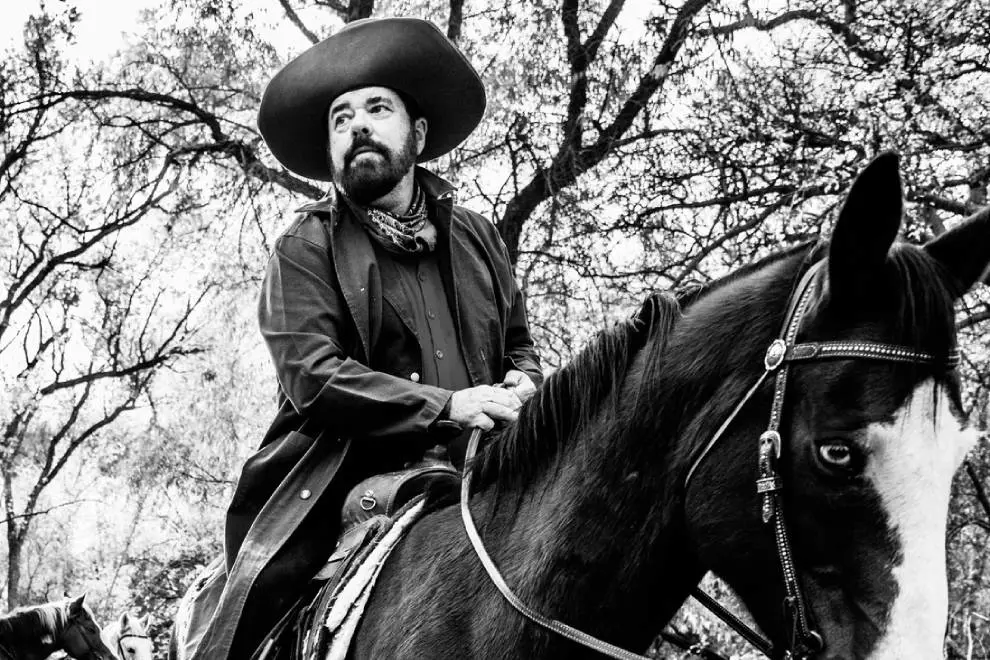
“I wrote Truth Or Consequences all by my little lonesome. I was driving up from Arizona and Marlina, and I had been spending a lot of time – well we used to, especially – in the southwest of the United States along the Mexican border. I love that area down there; it’s like the Australian desert in many ways, and the characters that run around down there really are true-life cowboys. And it also happens to be the area where Tombstone was – that’s not far away from where we would ride our horses, right?
“And I started thinking about what life must’ve really been like for some of these characters, 120 years ago. And got such inspiration thinking about, ‘Okay, instead of trying to think about bro-country or supermodern country, what if I actually started writing folk songs? About what it really felt like to be in that era, in 1880? And compare it to what people were experiencing in life before, say, the railways were built in Australia?
“What was life really like with horses and carts and everything? And I realised the parallels were really similar. And that’s why, on my first album [2021’s Andrew Farriss], I wrote a lot about all that sorta stuff because we tend to forget where we all came from.
“Life‘s not about big tech, life’s much simpler than that. I can remember life before a lot of this technology, and everything important got done. You can’t eat a smartphone; you’ll need good food, and you’ll need good water in 50 years, 100 years, 200 years’ time. That’s why I got involved in professional agriculture [Farriss and his wife Marlina run a historic cattle and grain farm called Piedmont Station near Barraba in north-west New South Wales].
“In the end, what I’ve learnt from growing food for people for many years is that at the end of the day the most important things are: food, clean water, shelter and people that care about you.
“Everything else around us is seducing us to pay for something, with all this tech, and I find that makes me very uneasy; ethically, I really struggle with it.”
We just need to know who sang the BVs on Truth Or Consequences – they’re gobsmackingly brilliant! “Yes, they are,” Farriss concurs. “There’s Angie [Primm] and Gale [Mayes]; they’re two women that have done a lot of recording with me on my records. Well, this is actually my third release as Andrew Farriss – as a solo artist.
“They were on certain songs on my five-track EP [2020’s Love Makes The World] I put out during that crazy time when we all had to have injections. Then they sang all over my first album, the self-titled one – ‘cause I’ve got no imagination, I called it Andrew Farriss… Angie and Gale are on a lot of my recordings. And they are just amazing, amazing singers, those two women. I thank them publicly.”
“He felt he could fly, Michael”
When asked whether he initially struggled with finding the confidence to step out as a front guy, Farriss reveals, “Yes, I struggled with the idea immensely, ‘cause I always saw my role – especially within INXS – as sort of writing a living theatre play; I kept having to feel that I was writing a different scene in a theatrical performance. And it better be good!
“The more attention we began to get, the more I felt the pressure of that. And so did Michael [Hutchence], too – the two of us were the main writers in INXS. Michael never really played an instrument. He didn’t feel confident playing instruments – his instrument was his voice – and, in that sense, he was like a Frank Sinatra character.
“But where Michael was a genius was with lyrics. He had that turn of phrase, lyrically. I recognised that in him when we were still school kids. Other guys I was going to school with, in high school, they’d say, ‘Oh, yeah, have you watched the footy lately, mate?’ Or, ‘We’re gonna go down and have a few beers at the pub later,’ and Michael would pull out some poetic prose, because he’d been reading books from Hermann Hesse or Kahlil Gibran and I’d be like, ‘Excuse me?’ And I’d look at what he was writing, and I thought, ‘This isn’t normal’ – [compared] with the other guys I knew at school.
“So [Michael’s] head was always in that area, and I think that’s where we clicked. I played various musical instruments – keyboards and then guitars or whatever. But I began to realise that the two of us together could make a very interesting writing partnership, because he felt he could fly, Michael; he could soar into the atmosphere. And the more he wrote the lyrics – and I was cool with that, ‘cause I wrote the lyrics, too – when he walked out on stage, he really believed in what he was singing about.
“It wasn’t always just, ‘Gee, that was a clever little pop lyric ya got there, pal,’ you know? He was really exploring some stuff. Especially in the really early years of INXS, some of those lyrics he was writing were very interesting. Even just the lyrics in [the title track] on our second studio album, Underneath The Colours: ‘Underneath the colours, red, white and blue/ Catch a glimpse of others…’ – those sorta lyrics weren’t altogether normal, [compared] with what a lot of other people were doing.
“And I think we were a nightmare, INXS – for the record companies. Because what a record company wanted us to do, they wanted us to make the same-sounding song and make the whole record exactly like that. Then they’d know how to promote it and make money out of it. And then they’d maybe throw some money at you – if you were lucky – and didn’t rip you off. And that’s how they wanted us to be as a band.
“But, instead of that, we went and made 12 studio albums that sounded completely different from each other. In fact, most of the songs on every album sounded completely different from each other [laughs]. So, in that sense, we were a nightmare. But we were lucky to have had support from people who somehow understood what we were trying to do.”
“A lot of people have asked me if I am comfortable with what I’m doing”
“People are finding me a curiosity. A lot of people have asked me if I am comfortable with what I’m doing as Andrew Farriss, and whatever I am now – country, rock, folk, Americana – and I say, ‘Yeah, I’m totally happy.’ Because I’m totally at ease with the songwriting part of it. I'm really enjoying it.
“I can remember at the Gympie [Music] Muster – the first time I played it back in 2019, and I was so nervous, ‘cause I was trying to be me – whatever that was at the time. I was trying to develop who the hell is Andrew Farriss as a frontman? I found that journey fairly terrifying at first, to be honest. I’m sort of better at it now – haha, sort of. But when I first started it, I was just like, ‘Hooley dooley, what have I gotten myself into here?’
“But the Davidson Brothers, them being bros – you know, I worked with my brothers for so many years [in INXS] – and they were just sitting backstage, jamming bluegrass stuff and talking with anyone that wanted to walk up. And I thought, ‘That’s the part of this I really enjoy, actually.’
“It’s not like, ‘I need a marble floor in my dressing room, thank you very much.’ There’s no airs and graces, you’ve gotta be pretty upfront and have your feet on the ground.”
The enduring legacy of country music's storytellers
“The history of country music is so fascinating to me, because where it came from, really, was folk music – it came from Europeans. The very early folk music, they were fleeing, say, the Irish Potato Famine, or they were fleeing some really awful situations, politically – or wherever they were from – and they would come for refuge in other countries, like the United States.
“Then you combine that with, say, the Delta blues and the music sorta coming out of a lot of pain and suffering – out of the United States.
“But the Europeans also brought all different kinds of instruments. They would bring a violin, which then became a fiddle. Then they would change the classical use of a violin and start messing around with it and experimenting with it. Or you’d have a banjo, which is the combination of a drum and a guitar, and they put it together and then suddenly you had all this crazy stuff going on with music that was so exciting and different. Because, in that sense, it wasn’t pop music.
“And not only that, but the lyrics of what they were doing. Songs like Can The Circle Be Unbroken, as a funeral song about your mother going off in a hearse – that’s not a pop song. What is that song? That song’s real, and that song’s about what was really happening to somebody, and they wrote those words down.
“The same with a song like Ghost Riders In The Sky by Stan Jones – that is 100 years old – about cowboys. And that song is still as strong as it was 100 years ago.
“Some things never change, you know? It’s that part of the country music community, the songwriting part of it, for me.
“‘Cause someone was saying to me – I think it was on American radio – ‘Welcome to the dark side’ [laughs]. And I was like, ‘Woah, steady there. Sorry, what was that?’... Because you can have dark country, but it depends what you wanna write about. And you can have a light, silly little pop song, sure! But then if you wanna go the other extreme – into a completely different area – it can get very intense in what you’re singing about. I mean, it’s the way you roll it out; it depends what you’re trying to say.
“And so, as a songwriter, I don’t feel uncomfortable at all writing with girls and guys of different ages. And some are famous people that I’ve been writing with, some are unknown people, and that’s okay, too. I just enjoy someone wanting to spend time with me and write some songs together.”
“I can write a song just by my little old lonesome!”
“When people know I’m in Nashville – because there’s plenty of other places in the United States I have been to, and I still go to, ‘cause I have family living in other parts of the United States – someone will say, ‘Who are you writing with in Nashville?” I say, ‘Me, I can write a song just by my little old lonesome!’ [laughs].”
For songwriters considering heading over to Nashville in search of collaboration opportunities, Farriss enthuses, “It’s exciting, too. And, quite frankly, for a lot of younger Australians, they go there – if they can afford the journey there, and then they can afford the US dollar when they have to pay for accommodation. But they can get off a plane, and they go somewhere, and quite well-known artists will say, ‘Sure, I’ll write a song with you’ – with some completely unknown Australian. And I think that says a lot about the American culture, quite frankly. That’s a very cool thing, you know?
“Australians get so excited about that and so they should! I remember from INXS, when we first started touring the United States in 1983, we’d go to a radio station – like what I’ve been doing at the moment – and they‘d say, ‘Are you guys from Austria?’ And we’d say to them, ‘We’re from Australia!’ ‘Oh, where is that?’ you know what I mean? But not any more. They know where we are now.”
The Prospector is out today via Rockingham Holdings Pty Ltd / AWAL (The Orchard).