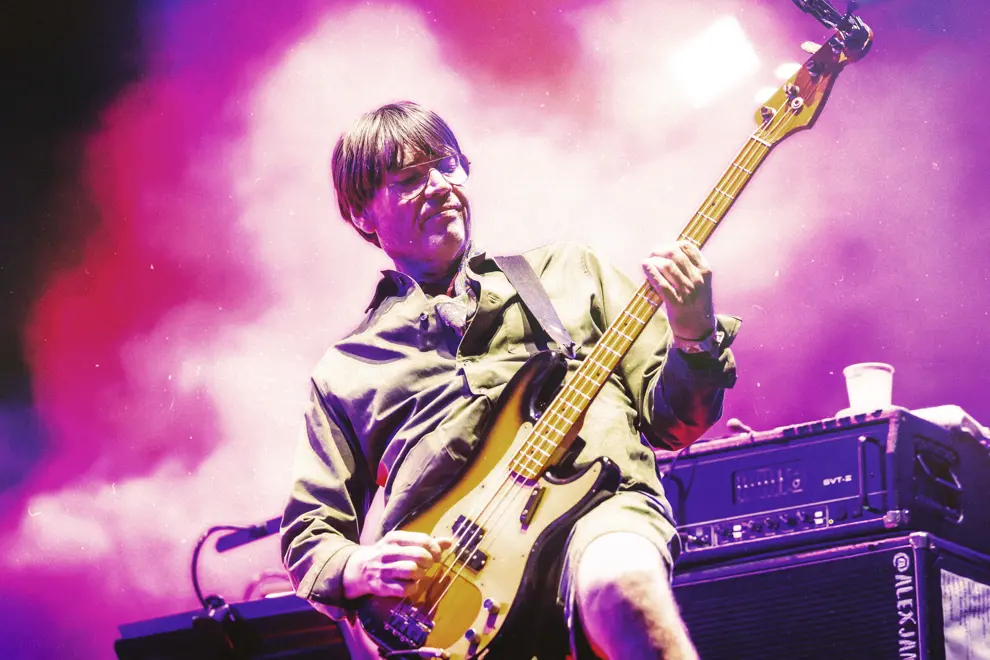
 Alex James Profile
When Alex James turns his Zoom camera on, we find him inside a rustic barn – resplendent with rough-and-ready, antique-white paint job – with exposed wooden beams accentuating an impossibly high ceiling.
When asked where we find him, James exhales what appears to be a cloud of vape smoke before revealing, “I am sitting in the office, about 20 miles west of Oxford, in the English countryside.” Gazing out a window through which sunshine streams, he adds, “It's an absolutely glorious Spring morning. We don't get many of those, so, hahaha, feeling good.”
Charming, floppy-fringed and fast-talking, the Blur bassist laughs easily – often mid-sentence. He sports a long-sleeved white tee accessorised with a stylish charcoal, jade, and burgundy-printed scarf – probably McQueen – knotted at his breastbone.
Like a hyper kid, James often rocks back and forth in his chair, gesticulating widely with his hands. Peak excitement is expressed by leaning back and simultaneously flinging both arms skyward.
Britpop Classical: origin story
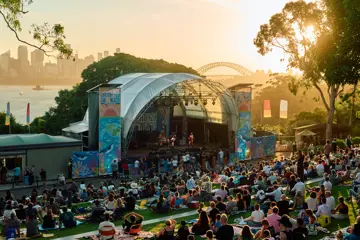
“It all came about by accident, really,” James explains. “My day job now is running a food and music festival [Big Feastival] on the farm where I live [in the Cotswolds]. And I can't remember why – or even who our [original] headliner was – but our Saturday night headliner dropped out at the last minute, which is a disaster, you know? You ain't got a Saturday night headliner, you ain't got a party [laughs]!
“So there was a really panicky Zoom call with all the execs and the booker, and everyone's going [wide-eyed, he shakes both hands on either side of his head], ‘Oooh! What are we gonna do?’ And the booker was like, ‘Alex, Alex, don't worry, don't panic! Ministry Of Sound Classical – you're gonna love it. It's 90 minutes of hits, trust me.’
“So I didn't know about it – didn't totally trust the booker – but I didn't really have any choice. And nothing's 90 minutes of hits, right? Not even ABBA Voyage [the Swedish pop group’s virtual concert residency] – solid 70 [minutes of hits], 20 minutes to go to the loo and get a drink, ha!
“But I was like, ‘Just grab it. We need to grab it. Grab it, grab it!’ We grabbed it, I watched it – it was actually 90 minutes of hits! It was the best show we've ever had at Feastival. Literally, just everything about it – stage production, lighting, repertoire, musicianship – was just brilliant.
“And I kinda had an epiphany on the spot, watching it. Went running backstage saying, ‘We have to do a Britpop version of this, let's make it happen,’ so, yeah!
“I persuaded Feastival's backers to book it for Feastival last Summer, thinking, ‘This cannot fail,’ ha! But you never really know if something's gonna work or not until you actually do it… And it blew the roof off. Next day, there were promoters on the phone saying, ‘Do you want to take it on tour around the UK?’
“[I said] ‘Yeah, definitely.’ I mean, it's just great, great, great, great fun. So, yeah! Sold-out tour in the UK for a month or two, back in the Spring, got a festival run here over the Summer, then out to Oz in November. Just can't wait.”
Any scoops on special guests for the upcoming Australian leg of his latest venture?
“Well, we like to keep a few surprises up our sleeve,” he teases, “but the way that it works is: it’s probably going to be local talent, like, who's around in the cities we play… We did the show a while ago in the UK when the boys from Travis were around, so they jumped up and did one of the songs. So, yeah! I mean, it doesn't rely on the special guests, but, you know, they do add a certain something.
“And the reason you can tour it to Australia is because, you know, every city that we're going to has a fantastic orchestra and a fantastic venue. It's the same production team from Ministry Of Sound Classical, same orchestra. Actually, I think Ministry Of Sound Classical's done good business in Australia.
“So we travel the core band, leader of the orchestra, leader of the production, leader of the percussion section, conductor. But we can sort of plug into local special guests, local orchestras, and that's how it all works – that's how it all worked here in the UK.”
“It's a lotta people, a lotta personnel – just the number of microphones! – and there's a lot of technology involved. So there's one rehearsal – and nothing ever gets written down in pop music. I remember Robin Gibb [Bee Gees] telling me that, you know? They just used to sing the string arrangements to the orchestrator [laughs]. But with orchestras, you have to play what's written on the page, otherwise it's chaos. So it's sort of mixing two different schools together and, you know, you don't really know if that's gonna work until you try it.
“I got to the production rehearsal, walked into this room and tripped over some tubular bells, fell into a harp, you know? [laughs] There's a room just full of [musical instruments], it's like, ‘Yikes!’
“But I think we were about halfway through Creep by Radiohead when I noticed I was crying; I don't think I was the only one, it was just so emotional.”
On interviewing a Bee Gee
Given that James is a well-documented Bee Gees fan, can he recall the first Bee Gees song he ever heard?
“Oh, my word!” he exclaims, laughing while massaging the left side of his head. “I mean, I think growing up in the ‘70s, their music was part of the fabric of everyday life.
“I remember actually being off school sick, and hearing Tragedy on the radio, and just really digging into that. But, actually, Robin lived not far away [leans towards the camera and points to the left], in Oxfordshire, and I went to interview him, actually – oh, God, like, going back 20 years – for Q magazine. He was a wonderful, wonderful guy – told me how they made all those records. He was absolutely brilliant. Really, really lovely.”
“Mixing two different schools together”
“How it works is: you've got the rock band, the symphony orchestra, a bunch of session singers – sprinkling in a few special guests – banging out 90 minutes of hits from a golden age of British pop music, I think [laughs].
“We started digging into it, and I think we'd had, like, three production meetings on how it might all work, and what it might look like. And after those three meetings, we’d kind of got it down to four-and-a-half hours of hits that we absolutely had to do. But the way that it evolved, it's all about how the songs kinda knit together in terms of tempo and what key they're in.
“So, you know, it's quite a complicated piece of knitting. You break it down into suites, basically. I've learned a lot of new vocabulary: a suite is classical music jargon, it's basically just a passage of music.”
To illustrate the various suites Britpop Classical is composed of, James places invisible boxes across the desk in front of him.
“So it starts with a heritage suite, which is the DNA of where [Britpop] came from – all those classic songwriters from the ‘60s: The Beatles, Kinks, Bowie, T. Rex, The Who – bands that influenced what became the Britpop movement; just the band [playing]. And then the lights come on the orchestra, and we rip into Ocean Colour Scene’s The Riverboat Song.
“There's a sort of feel-good suite, and then a high-energy suite, and then a Manchester suite, and then we let the orchestra run with it for a bit and let them rip on Radiohead's Creep, and The Verve's Bittersweet Symphony, and by the time we get to the sing-along suite at the end – where all the really big guns come out, your Pulp and Oasis – the audience are bought in.
“And that's how it's worked so far, you know? The audience is singing louder than the band. Because I think when you’ve got a big group of people, and you kinda hit them with that familiarity of songs that they know – but just played with all the huge dynamics of a band paired with an orchestra – it's just BOOM! It's been absolutely going crazy.
“I think the thing about all the material in the set is that they're just such great songs. And songs are sort of the currency of music. All of the songs, if you just sat and played them with an acoustic guitar, you'd get goosebumps.
“So, when you add all these layers of band, orchestration, lights, production and so on – it just takes it really next-level, and yeah! As I say that, the familiarity thing – once you just keep hitting an audience hard with stuff that they're familiar with, it's really elevating. And there's, like, 50 people on stage, you know? So just the energy coming off the stage... Trust me, it’s a great show.”
“Orchestra and band, it's kinda like a double whammy”
“It's not like we've kind of reinvented these songs and made them classical; it's just sort of adding orchestra juice to them. They're all good enough songs that if you just actually sang them in the shower, haha, you know? They'd make you feel good. So adding all the dynamics, all the nuance, all the power, of a whole 50 musicians all going for it – it really is mind-blowing.
“‘Cause I think orchestra's quite cerebral. I love going to the ballet, actually – you know, I'm in my fifties [laughs]. I've noticed it kind of gets me here [clutches his brain], orchestras, and rock music kind of hits you in the chest [pounds his chest like Tarzan]. Orchestra's more in the brain. So I think orchestra and band, it's kinda like a double whammy.”
Fat Les: working with a 120-piece orchestra
“I did a football record that did really well for the 1998 World Cup [Vindaloo, co-written by James and one-time Icehouse bassist Guy Pratt] and that, literally, was just drums and bass [laughs] – it was a real rabble-rousing terrace anthem. And we thought we'd go completely the other way; we thought we'd go posh for the next football tournament. So it was a crazy big orchestra and five choirs! But I think it just goes to show: you can be too clever, but you can't be too stupid when you're making pop music, maybe.
“I mean, Vindaloo [re-charted] in 2020 and ‘24. If England gets to the quarterfinals, it starts going crazy. The semis, it's like – there were two versions of it [Vindaloo and the 2021 charity re-recording, Vindaloo Two] in the Top 10, it's crazy! I couldn't believe it, haha.”
Blur adding orchestration was “a reaction to the nihilism of grunge”
If you’re familiar with James’s discography – Blur, but also his work with Fat Les, Me Me Me, WigWam and Bad Lieutenant – you’ve probably already noticed a throughline of orchestration in a couple of those outfits. “Indeed, yeah, yeah, yeah,” James agrees.
So was Blur’s second album, 1993’s Modern Life Is Rubbish, the band’s first to incorporate orchestral elements? “Exactly right, yes,” he confirms. “After we got back from America – touring our first album [1991’s Leisure] – grunge had just sort of detonated in America, and I think it probably was a reaction to the nihilism of grunge. And I think, yeah!
“We were tapping into something very specifically and uniquely British. And that went on for three albums – Modern Life Is Rubbish, Parklife [1994] and The Great Escape [1995] – where we were kind of playing with – there is quite a lot of orchestration on a lot of those songs: string sections, brass sections…”
In James’s excellent biography, 2007’s Bit Of A Blur, he hilariously likens brass sections to painters and decorators, before observing that string players are “more like a maiden great aunt coming for afternoon tea”. When reminded of this excerpt, James laughs his head off, rocking back and forth in his chair.
Now that he’s accumulated even more experience working with orchestras, would he say those comparisons still ring true? “Well, yeah – I'm glad I didn't say anything horrible about string players or brass players [laughs]. I mean, it's true! It’s just sort of like giving everything a fresh lick of paint, brass; it does brighten everything up. And I think string sections are kind of ennobling in a way that, yeah! When your posh auntie comes to tea, you bust out the best china.”
“I don't need [Blur’s] permission, but I do need their blessing”
On whether James had to get permission from the artists whose songs grace Britpop Classical’s setlist (we were secretly hoping for a smug Gallagher brother quip, obviously), he enlightens, “Anyone can play anyone's song. If you want to synchronise your recording of someone else's song, then you need the songwriter's permission. But, I mean, obviously I mentioned to the Blur boys that I'd be doing it and, you know [laughs] – I don't need their permission, but I do need their blessing.
“Dave [Rowntree] came to the [Royal] Albert Hall [show] in London. He loved it, yeah. I mean, we got back together in 2023, Blur, and we did the best run of shows that we've ever, ever done. It's a real shame we didn't get to Australia; I don't know why it didn't happen – it was quite a short run of shows.
“But part of what made me think this might all work, actually, was the number of kids there were at those [Blur] shows; that, and what a global phenomenon the Oasis tour was. You know, these songs have found a whole new audience. They seem to mean more to more people now than they did when they were written.”
The Battle Of Britpop: “The whole thing was hilarious”
In 1995, Blur shifted the release date of their Country House single to deliberately coincide with Roll With It by Oasis.
The resulting Battle Of Britpop, Blur versus Oasis, went down on Monday, 14 August and was promoted as the greatest music rivalry since The Beatles versus The Rolling Stones.
The British music press had a field day, positioning Blur as snooty, middle-class, art-school boys (representing the South of England), whereas Oasis (representing the North) – fronted by the mouthy Gallagher brothers – were their gritty, working-class adversaries.
Fans queued around the block at record stores, and excitement reached a fever pitch. Blur were ultimately victorious.
When asked whether this chart rivalry was fun at the time, or added unnecessary pressure, James posits, “I think all of the people in Blur reacted to it differently. I just thought the whole thing was hilarious, I really did. And so, I mean, certainly now, I just see Oasis as a great songwriter and a brilliant singer.
“It was crazy, yeah [laughs]. But music was the focus of absolutely everything, you know? Things have moved on. Celebrity's kind of the focus of everything, now. But, yeah, I mean, that's part of why these songs mean so much to people, because music was very much front and centre, you know?”
On Wonderwall’s bassline: “Blimey, that's tricky!”
So did James find any of the basslines in songs by other bands particularly tricky to master? “I mean, the one that really surprised [leans conspiratorially towards the camera], I think Wonderwall, Oasis – bassline on that! Incredibly groovy. And that was probably the trickiest, actually, ‘cause it's all about feel. It's just got a beautiful feel to it [demonstrates on air bass].
“Actually, I bumped into Andy Bell, Oasis's bass player, last year, ha! And I was like, ‘Blimey, that's tricky, that one!’ He said, ‘Yeah, it is tricky, isn't it?’
“They're all just such simple-but-clever songs… I guess because there was so much material to choose from, everything in the set has a sort of perfection to it. It's a really great thing just to have the excuse to study music, actually. It really does reward patient study, you know? You never regret learning how to play something, or just giving it your full attention. And it was a wonderful thing to give it some patient study, as I say.”
Alex James’ Britpop Classical comes to Australia in November. Tickets are now available here.