 Air Supply Profile
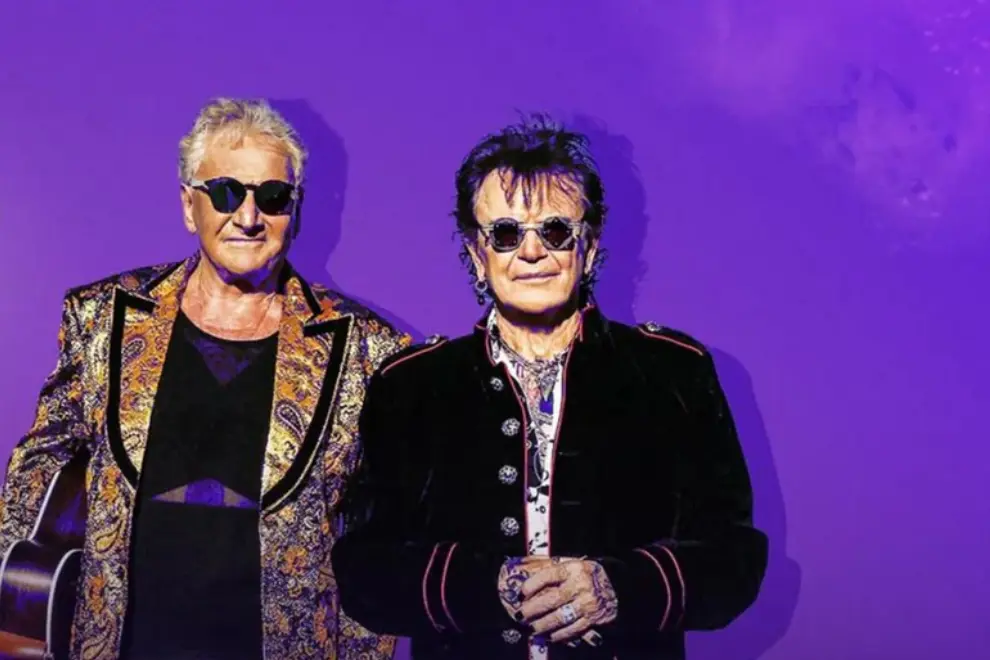
Australian duo Air Supply remain one our biggest exports into the US music market. In the early ‘80s they dominated the Billboard charts at a time when Australians were a go-to for pop rock melodies.
Air Supply rode the Stateside wave alongside fellow Aussies Little River Band, Bee Gees, Helen Reddy, Olivia Newton-John, and Rick Springfield. But even after their initial success they “couldn’t get arrested in Australia” and the local media “wasn’t too kind” according to Russell Hitchcock, one-half of the long-surviving group.
However, under the guiding hand of one of America’s most well known record executives, the late Clive Davis, Air Supply reached a point where they could no longer be ignored back home.
Best known for their epic love ballads, Air Supply’s hits luxuriated in lush arrangements of strings and harmonies. Formed in Melbourne in 1975, their sound was a far cry from the dirty rock and stomping glam that was filling pub venues in the city at that time.
50 years later the duo are constantly touring the globe, having clocked up almost 6,000 gigs in their lifetime. They were the first western band to tour China in 1983 (yep, two years before Wham!) and, in 2005, performed at Cuba’s famous Jose Marti Anti-Imperialist Tribune to a record-sized crowd estimated at 175,000 (Rolling Stones have since broken that record drawing 500,000 people to a 2016 gig at Cuba’s Ciuda Deportiva).
This year Air Supply has already played gigs in the United States, Canada, South and Central America, Asia, Europe, and the Middle East. They are set to return to Australia in December. However, when Hitchcock jumps on the phone for promotional chores, he’s interrupting some well-earned time off.
“Yes, we're having a bit of a break,” confesses the singer. “Three or four days is a break for us. We just actually got back from a vacation last night for a couple of weeks. Went to Fiji and Tahiti for a bit of R&R on a cruise and now we're back to the ‘nose to the grindstone’ as they say. We fly to Texas next week and then we're off to the races for the rest of the year. Back to Southeast Asia in December and do it all again next year. It's been great.
“We're busier now than we've ever been as a matter of fact. I think last year we did 130 shows plus. And I think we've done maybe 80 or 90 already this year. We're always on the go and we love it so far. Graham [Russell, the other half of Air Supply] and I still feel great physically. We're still performing at a level we're very happy with and obviously without the support of the fans all over the world we wouldn't be doing it.
“But we're doing great business,” he adds. “I love my life. I love my job. I love everything about Air Supply and what it's given me.”
50 Years Of Love (And Other Bruises)
When Air Supply first emerged in 1976 they appeared seemingly out of nowhere with a fully realised sound in the shape of debut single Love And Other Bruises. The song perfectly showcased Hitchcock’s high tenor voice, the band’s ability to pen love songs with a hint of melancholy and their dramatic arrangements that pointed to their stage musical background.
At the time that single arrived, Air Supply was fronted by Hitchcock, Russell, and Jeremy Paul (he replaced original vocalist Lindsay Hammond who went on to find fame with her sister in rock outfit Cheetah).
The three had met in 1975, working on the national production of Jesus Christ Superstar and the musical was still on the road when the first single was released. The band were unable to promote it until the Superstar tour was completed.
But after being featured on the high-rating, national music show Countdown, Love And Other Bruises took off, eventually crashing into the top ten (it remains their highest charting single in Australia, having peaked at number six).
According to Hitchcock the single’s evolution happened fast, “I guess I started working with Graham only about two or three weeks after we first met in Jesus Christ Superstar. He was always determined that when the show had run its course that he wanted to be ready to do something.
“We decided early on that we wanted to work together. I don't remember specifically when, but in Melbourne he'd written about four or five songs, one of which was Love And Other Bruises. We recorded a demo on a very primitive cassette recorder in the pit of the orchestra in Melbourne with some of the musicians from Superstar.
“And we just walked it around to every record company we could think of and we were rejected by everybody except Peter Dawkins from CBS who heard the demo and loved it. The Australian version was produced by Charles Fisher, an amazing producer.
“I think a guy called Bill Motzing [who later worked with INXS] did the string arrangements for it. So at the time it was quite a classy… refined production and it's always stood the test of time for me. It's a great song and it's the reason why we're having a chat today.”
Following the initial success of the first single, the band recorded a self-titled album that featured Mark McEntee on guitar. McEntee and Paul would later split from Air Supply to form Divinyls with Chrissy Amphlett, who also went on to experience overseas success.
The album was a modest hit, charting top 20 and being certified Gold sales status but three follow-up singles failed to gain traction. It was three years and two albums later before the band cracked the Australian charts again in 1979 with Lost In Love.
It proved to be a frustrating period for Hitchcock, “I mean obviously Love And Other Bruises is a great song and it's us. But… we'd done this Rod Stewart tour and come back to Australia and we really couldn't get arrested. I mean it was just like we were dead in the water and Graham and I decided that we kind of just had to think about what we want to do in the future. He went to Adelaide and I went to stay with my sister in Melbourne and I was doing jingles for Les Gock, from Hush [major Australian glam band in the ‘70s], who had an advertising thing going and I'm very thankful to him because he supported me for a little while there.
“In any case, Graham called me and he said I've written some songs, why don't you come over to Adelaide and have a listen? And the first song he played me was Lost In Love, just acoustic guitar and his voice. And it's only one of two occasions I said to him ‘This is a hit song. We've got to get this somewhere to somebody’. And I don't know how, once again, because my memory's not that great, but we got it to Tony Hogarth in Sydney at Wizard Records and he signed us and obviously it just exploded in Australia.
“Then from 1978, when it was recorded, it took two years to get to the US to the desk of Clive Davis, who recently passed, the president of Arista. He called both Graham and I in our respective places in Australia and he said ‘You guys have to get to the US. I'm just doing a deal with your management. We've got to do an album straight away.’ So we both flew over there with a bunch of songs, including All Out Of Love, The One That You Love and Sweet Dreams and we did the first album and, you know, I hate to say, it's a cliche, but the rest is history.”
In 1980, Lost In Love would break out in the US and become the first of seven consecutive top five singles that Air Supply scored there. At the time that feat equalled a run of hits made by The Beatles in the ‘60s (the record is now held by Madonna who managed 16 top five hits in a row in the late ‘80s).
The song was a marvel of sophisticated production, a song that built from a simple acoustic strum into a climax of soaring vocals and harmonies – it seemed custom-built for US radio at the time.
Hitchcock recalls the song’s importance to the band’s rise, “Lost In Love, I think it got to number three in the US but it was either number one or between number one and number four in every country in the world – all over Latin America, all over Southeast Asia. It was a monster and you know it's a song that's never been out of our set since we recorded it and I'm very grateful.
“It's a beautiful song and once again the production, Charles Fisher, I think, was involved with that as well and I remember being in the studio, I think it was Trafalgar Studios in Sydney, and after we'd done a bunch of the lead vocals Charles said you know I want [more takes]. I did all the background vocals and it took me hours and I was so pissed off with him I said, ‘Dude, enough.’ I said ‘No no’. [Charles said] ‘I want you to record this part five times and do that part five times’…”
He adds, “But it sounds beautiful to me. I love hearing it. I certainly don't sit down and play it but when I hear it anywhere I just love the way it sounds and it's as fresh to me today as it was then.”
“We Were Kind Of Unstoppable”
In America there was a ready-made ‘adult contemporary’ market for artists like Air Supply. In Australia terms such as ‘middle of the road’ and ‘easy listening’ were used as put downs of soft rock musicians at a time when pub rock ruled and punk and metal were on the rise.
In America the soft rock genre was celebrated – US music media stalwart Billboard has had an adult contemporary chart for decades. It could be rough for a band like Air Supply in ‘70s Australia.
Hitchcock remembers some hostility, “Well, the thing was even when we started to perform in 1976 we played all the pubs. We played The Bondi Lifesaver, you know, an iconic music venue in Sydney which was all very hard rock and roll and we, you know, we had to take a bit of flack from a lot of people. The media wasn't too kind to us then – most of the media. And it was just a tough slot for us.
“Coming back with Lost In Love, things had kind of changed but just a little bit. Because as you know in the mid-‘70s there weren't any, or not very many, concert venues where you could go and sit down and enjoy a concert. It was all pubs.”
While still in Australia waiting to be taken seriously, Hitchcock found himself hanging around the set for Little River Band’s Reminiscing video. LRB were like-minded locals who had also been embraced by US audiences hungry for fresh adult contemporary sounds. It was here that Hitchcock was made realise he didn’t need homeland acceptance first.
Hitchcock says, “Beeb Birtles [LRB co-founder] said to me on the shoot he said, ‘What are you guys doing here?’ ‘Well, you know, we're just waiting for a deal.’ And he said, ‘You should be in America. You guys should be in America because that song is going to be a major hit.’
“So we had an inkling about what we should be doing. And, of course, when we went to the US, our very first tour there was all colleges, kind of a captive audience, but it just built the bridge for us to become as successful as we were. Plus, you know, we had Clive Davis in our corner. And… the first seven songs we released were hits, top five or better. So it was a great start for us and we were kind of unstoppable at that point, you know.”
During that run of hits from 1980 through to 1982, Air Supply were one of the biggest bands on the planet. But Hitchcock remains modest about their success, “I consider The Beatles and the Stones and, you know, ELO and AC/DC, Bee Gees, and Queen, I consider those actually famous.
“I think that we're, you know, we've done a great job so far. We've recorded some great songs, great quality music. We have a great show.”
But he does still remember the moment when he first felt the buzz of impending success, “I think one of the times where I felt, ‘Whoa, this is really bizarre’ was when I was driving down in Los Angeles on Sunset Boulevard in a convertible in the summer. How cliche is that? And Lost In Love came on the radio and I had to pull over to the side of the road because I was in shock. And I just couldn't believe that I was hearing our recording, you know, in California, which meant that it was being played all over the US. So that was big.”
He continues, “We've done stuff that I never dreamed about doing… playing at the Bicentennial for Princess Diana and [the now] King Charles, we played for the Sultan of Brunei, Imelda Marcos, Indonesian heads of state. But I'm still, you know, I'm a fan if I'm anything else.
“And I've been through the situation where when we're enjoying the success that we did, that we do, I've made the mistake of introducing myself to a couple of people that I was big fans of and being very disappointed by being kind of dissed by them – I don't do that anymore. I just look from afar and go, yeah, I'd like to say hello, but I don't know how you're gonna greet me.
“I’m still the guy from Brunswick and, you know, doing my thing and I love it,” he adds. “I've had a great life and I have a beautiful wife and we get to travel the world, playing some great venues, seeing a lot of stuff that I never dreamt about when I was a kid. So I'm – as my mother would say – I'm as happy as a pig in shit right now.”
Not Out Of Love
That string of hits that Air Supply experienced in the ‘80s included evergreen tracks All Out Of Love, Every Woman In The World, and The One That You Love – the latter giving them their only number one hit in the US. They also managed multiple Platinum-certified albums in the US market (Lost In Love, The One That You Love, Now And Forever). And, in the age of streaming, these songs are still attracting millions of listeners each month. All Out Of Love alone has clocked up 600 million plays on Spotify.
“I've said this forever to anyone who would listen, people wanting to get into the business,” says Hitchcock about his band’s longevity, “You have to have the song. You know, if you don't have that, you have nothing. Fortunately, we have Graham Russell, who's written some spectacular songs, and then our recordings are always top-notch with great producers. But people took the songs to their hearts.
“In fact, during our shows now, especially in the US, I mention, you know, ’50 years’ because you can't really not mention that. And I always say it's probably five generations of people that have been coming to see us. And I [say], ‘Thank you people for being there tonight, the people that you brought with you. You introduced our music to your kids, your grandchildren.’
“We're getting a huge influx of teenage couples now. Even, you know, guys coming to see the show because they love the music. And they love the music because they love the songs. They love the simplicity of them. They love the sincerity of them. They love the performance of them.”
Coming full circle, Air Supply return to Australia later this year to celebrate 50 years of making music. The band even have an 18th studio album, A Matter Of Time, dropping in October. Ever modest, Hitchcock remains thankful for the career he’s been able to sustain across the decades, “I couldn't be more grateful for the support we've had for 50 years plus now. And that's it, man. I mean, I really don't know what else to say.
“When I talk about music, I talk to you and you mention, you know, 600 million plays and 500 million of this and a million of that. And I never see those numbers. So I'm pretty much in the dark about that.
“I mean, I know that some of the places I go to, I get recognised a lot, especially overseas. America, not so much. But it's always nice if somebody comes up and says, you know, ‘Are you Russell?’ ‘Yes.’ ‘Your music means the world to us and may I take a picture?’ And, ‘I proposed to my girlfriend, to your music.’ We've had people that were going to commit suicide say, ‘Thanks for your music. You inspired me to move forward.’ We've had women deliver their children to our videos in the delivery room. It's overwhelming. And I'm very grateful. And I'll never take it for granted.
“As I've said to the guys in the band, because they're a lot younger than we are, who isn't? But I say, ‘This is the first show for the rest of your life. So make sure that you give it a hundred percent. People pay a lot of money to see us. And I expect you, the guys in the band, as I do it myself, to give a hundred percent and nothing less than that.’ Because, you know, it's a tough business to be successful in. And it's even tougher to stay successful.”
Tickets to Air Supply’s Australian tour are on sale now.
Air Supply – 50th Anniversary Celebration
The Absolute Best Of Air Supply
Thursday, December 3rd – The Star, Gold Coast, QLD
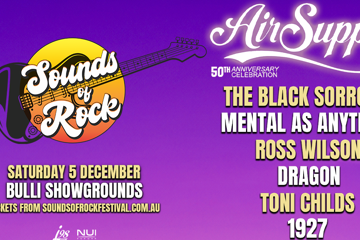
Saturday, December 5th – Sounds Of Rock Festival, Wollongong, NSW
Tuesday, December 8th – PCEC Riverside Theatre, Perth, WA
Thursday, December 10th – Adelaide Entertainment Centre, Adelaide, SA
Saturday, December 12th – Newcastle Entertainment Centre, Newcastle, NSW
Tuesday, December 15th – The Civic, Auckland, NZ
This piece of content has been assisted by the Australian Government through Music Australia and Creative Australia, its arts funding and advisory body