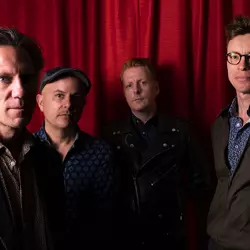
 Bluebottle Kiss Profile
At the turn of the millennium, Sydney indie rockers Bluebottle Kiss were at something of an impasse.
Having released their first two albums on Sony imprint Murmur (right as that label grappled with the rise and rise of Silverchair), they’d released their 1999 third album Patient – recorded over four days on the smell of an oily rag – via revered Sydney indie label Citadel Records, but that hadn’t set the world on fire and they now found themselves homeless.
Little did they know that a chance meeting after a local gig would lead the then three-piece on a rollercoaster overseas adventure encompassing intrigue, misfortune, strong resolve and even more chance post-gig encounters on far-flung shores, which would not only come to help define the aesthetics of their next album Revenge Is Slow but reconfigure the very nature of the band itself.
“It was this very strange thing that kind of happened and then it just got stranger when we got over there,” marvels founding Bluebottle Kiss frontman and chief songwriter Jamie Hutchings.
“We just played this gig one night and this American guy came up to us and, in short, he invited us to America off the back of this record label that he was working for – he was scouting for bands in Australia.
“It was probably 1999 when he introduced himself to us, I can't remember, but it was a record label that was held aloft by investors and it was supposed to be a direct marketing sort of thing, a direct label where they would just be releasing music on the internet – I really don't know how it worked, but they were out to avoid the ‘usual pitfalls’. They had this new model as a record label and they managed to find all of these investors and they paid for us to fly to America.
‘He just saw us the once, somebody recommended that he come and see us, and he was just really effusive about it. Like he was sort of converted straight away and thought we were really good, so we got given this really basic contract and our manager Millie [Millgate] managed to get us a government grant. The idea was that we would go over there and just play a lot and they would release the record and we sort of just naïvely went over, we kind of had nothing to lose.
“We ended up being there for three months, but it all kind of fell apart pretty quickly over there: I think the head of the record label may have ended up in jail or something, like there was some kind of weird scenario. They were living it large and they all got busted, though we actually never met the people that ran it – it was all a bit Kafka-esque.
“But we had this van that we bought with the money that we got from the government grant and we sort of lived in the van and just played constantly up and down the West Coast, but just sort of dive bar gigs for three months. We ended up just booking ourselves and the record label thing we just sort of left and just thought, ‘Well, we're over here’ and we just sort of gave it a go for a while. And then we ended up getting some free recording time at a couple of really high quality studios due to some people seeing us at a gig who really liked us.
“They were a couple of young guys, Zak and Krevis, who had been the assistant engineers on the big breakthrough album for At The Drive-In [2000’s Relationship Of Command] at Indigo Ranch Studios in Malibu. And so they ended up recording us for free, and that was how we got Gangsterland – we recorded Gangsterland and Ounce Of Your Cruelty both over there.
“It was such a weird, weird time, you could write a book.”
Gangsterland and Ounce Of Your Cruelty were both released as singles in 2001 and both feature on Revenge Is Slow – albeit Gangsterland is in different form as it was re-recorded during the album sessions – so the American sojourn was, despite the setbacks, already paying handsome dividends.
All this time spent careening around the States in a tour van also exposed Hutchings to some music bubbling away during that period which would in time expand the scope of the new record.
“I think maybe because we were over there, I found myself listening to some of the more detailed kind of recordings that were coming out at the time,” Hutchings recalls. “A bunch of bands that I knew were quite big that I'd sort of overlooked, but I just found myself intently listening to the production.
“Even stuff like, say, [guitarist Ben] Fletcher had just loved Radiohead – he played The Bends and OK Computer endlessly in the tour van – and I used to find them quite annoying at the time: it was just a bit too polished and perfect for me. But then that album Kid A came out around that time – Kid A and Amnesiac – and they're like just real headphones albums, they were really using the recording studio as a real playground.
“And then The Soft Bulletin by The Flaming Lips was at the same time, and I think I picked up And Then Nothing Turned Itself Inside Out by Yo La Tengo – those were kind of, I think people called it widescreen at the time, just albums that were kinda cinematic for want of a better word.
“I guess that I'd always loved stuff like Pet Sounds by The Beach Boys and, and loved all The Beatles’ more ambitious recordings where they were really using the recording studio as a bit of a playground.
“So I started thinking – because the last album had been pretty much a ‘live in the studio’ record ‘cause we had no money – I was, like, ‘If we're going to do another album, it'd be great to do something that's more ambitious in its scope’, like some of these other kind of artists at the time were starting to do.”
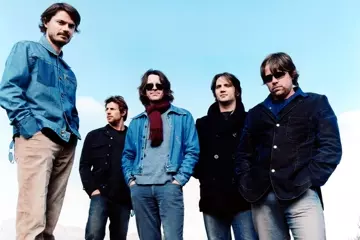
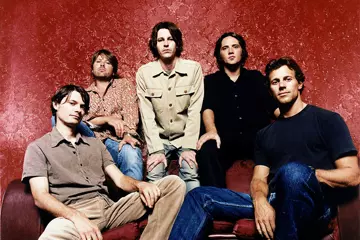
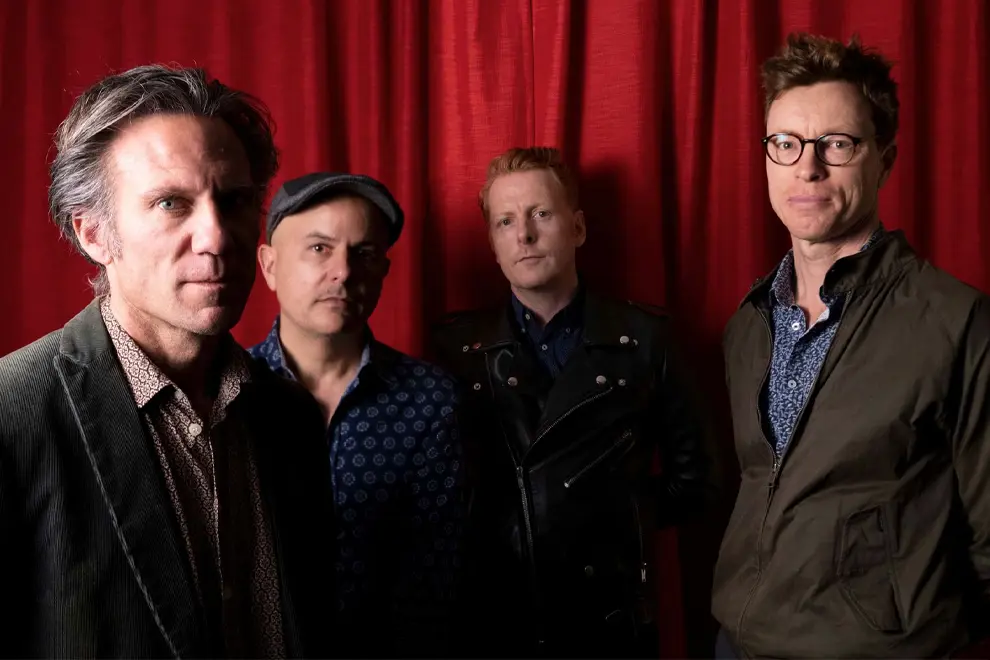
The further seismic shift prompted by their trip through the US diaspora was that – not long after their return to Australia – Bluebottle Kiss morphed from a trio to a four-piece, with bassist Ben Grounds joining the ranks and Fletcher moving from four-string to second guitar.
They’d made it so far in trio formation but change was needed to keep things moving forward, and Hutchings was going to need to make some concessions of his own if the new arrangement was going to work.
“I don't think Richo [drummer Richard Coneliano] and I had ever really thought about shifting to a quartet, it was more Fletcher,” the singer muses. “Everyone was really burnt out after coming back from America, and I think something had to change or the band was probably going to stop. So he basically sort of said, ‘I want to keep going, but I don't want to play bass anymore – I want to play guitar’.
“And at first it didn't really appeal to me, but I thought, ‘Well, you know, it's pretty fair – he’s such an important member of the band and it's a fair enough suggestion’. And so when it did come to pass I really changed my guitar tone cause I used to sort of have a set-up where – even the pickup I use – the whole sound was kind of compensating for there only being one guitarist, to a degree.
“So we started thinking more about the way that bands with technically sort of thinner guitar sounds worked – not your big sort of grungy sound, but thinner guitar sounds, like bands such as Television or Straitjacket Fits or Crow. There was always space for the two guitars to interact and sort of talk to each other.
“And Fletcher was really good about it, it wasn't like he was going to join and just double up my parts. You see a lot of bands that are three-pieces – like, say, Nirvana – then they get a touring guitarist and the touring guitarist is pretty much just playing exactly what the main guitarist is playing to make it sound bigger. So we were very much, like, 'Well, we're not going to do that though’.
‘I was kind of like, ‘Are you going to be cool with sometimes just not playing at all?’ and the same for me. And again, I backed off my guitar tone so that it was a little bit cleaner and was playing with the front pickup more so that the two guitars would sort of clang against each other rather than it being like a single, big beefy single guitar tone that would come in and out. So that was a pretty big shift in the way that we kind of decided to rearrange things as well.”
This huge change in the band’s dynamic also had a flow-on effect on the songwriting moving forward.
“A lot of the songs on Revenge is Slow – a good stack of them – were already written when we were a three-piece: like as mentioned Ounce Of Your Cruelty was recorded as a three-piece and Gangsterland was too,” Hutchings continues. "We re-recorded Gangsterland when we got back to Australia and did the album, which meant that you could sort of allow space for a second guitar part.
“But also on the album, there's quite a few songs where there's an acoustic guitar – either a nylon string or a steel string – and then Ben will be playing like an electric part as well, so we weren't so obsessed with being kind of ‘rock’.
“I think the shift in that album can be heard on the bonus disc that came out with the next album [2003’s Come Across], which was sort of a bunch of songs we all recorded at the same time as Revenge Is Slow, which we called The Cutting Floor.
"And that sort of spare album is basically an album that should have come out between Patient and Revenge is Slow, which sort of catches the transition. That one's a lot more indie rock, where Revenge is Slow, I think, is definitely not really as obsessed with being ‘indie’ – there's some really classic sort of influences, even like exotica and music from the ‘50s and folk music and then big band music and a lot of those other colours are coming through and we're kind of moving away from the punkier, grungier influences.”
Not long after the expansion to a four-piece and the ensuing sonic explorations a new Sydney indie label Non Zero Records entered the frame, funding sessions for what would become Revenge Is Slow in an improvised studio inside a Kogarah rehearsal space.
It was the first time that Bluebottle Kiss had recorded outside of the traditional studio construct and – with Hutchings overseeing production – the ballsy move paid handsome dividends.
“The reason we did it that way was that Nick Carr came onboard with Non Zero Records to help us out,” Hutchings recalls. “We had absolutely no money after coming back from the States, but he gave us – you know, understandably – a pretty modest budget. At that point we were more into having time – time to work – rather than the best circumstances.
“We fortunately had the help of Dave Trump, who recorded it – he was pretty incredible and was really keen to be part of it. I think Dave had had a really good start to his career as an engineer when he was really young – he sort of had a bit of a breakthrough with the Pollyanna album and some of Big Heavy Stuff’s albums – then he went to America to try his luck and got an internship or something, but he’d come back and was almost starting all over again. So he worked at a criminally underpaid rate for us in this rehearsal room.
“The whole idea was that we would have two weeks to record, to be able to make the album that we envisioned. Whereas if we'd gone into a proper studio, we would have been stressed and trying to do it in like four or five days. So we kind of just built an environment that we could really basically tick every sort of visionary box, as it were.
“I know for myself, I had a lot of ideas and really wanted to be able to see all of them to their end, so that's why we did it that way. And it's pretty hilarious to think of it now that we even got a two-inch tape machine delivered! We hired one and got delivered in a van, those things weigh an absolute ton, but that's what we did.”
Together they pulled the perfect sound for this new more ambitious aesthetic, and Hutchings explains that his bandmates’ unconditional trust proved pivotal in this regard.
“Dave did an amazing job engineer engineering it,” he continues, “but in terms of the production it's kinda funny how by that stage the guys – meaning Groundsy, Richo and Fletch – really had my back, to the point that I was pretty spoiled in a way that they really trusted me.
“They kind of were more into working in the live domain, but when it came to recording they were quite happy to do all the sessions and the live stuff that we needed to do, and then just sort of take off and let me kind of mess around with Dave, and that's sort of what happened.
“And Dave is really, really good at encouraging me to do whatever I’m feeling at the time – even if it seemed like a really stupid idea, he was extremely accommodating. I remember doing Gangsterland and there's all this sort of yelling and screaming with delay on the outro in the background – he was really trying to get me comfortable doing it.
“He was, like, ‘Do you want to just do a handheld mic? You know, like Hank Rollins?’ Most engineers would be, like, ‘Oh no, we've got to get you to sing through a proper tube mic with the blah blah’, and I just was doing it with the SM57, just holding it in my hand through a delay pedal.
“We were doing stuff that you’d do at home if you're on a four-track – just kind of amateur sort of intuitive stuff – and he was really cool about it, accommodating all the zaniest kind of ideas that I had at the time. So that really helped as well.”
These calculated risks paid off, and Revenge Is Slow came out in 2002 to great reviews with the three singles – Gangsterland, Ounce Of Your Cruelty, and Father’s Hands – scoring plenty of triple j airplay, allowing Bluebottle Kiss to expand their profile in the regions as well as prospering in the inner-city.
The traction pushed them into the ARIA charts for the first time – Revenge Is Slow eventually peaking at #63 – and they toured hard, earning a spot on the Homebake line-up and even scoring a coveted J Files special.
“Well, we did have a really big champion in Richard Kingsmill,” Hutchings smiles. “Even early on before we were getting played on triple j he was a fan, but I think – from talking to him at the time in the mid-’90s – that the station programmer at the time was not into it and didn't want to play us. It seemed he was standing in Kingsmill’s way into the world of different things he wanted to program on the station.
“And when he ended up taking the job over, as much as a lot of people were critical of him later – because it's such a hard job – he ended up actually giving a go to quite a few bands that were for a long time going nowhere in terms of trying to get airplay on triple j. He definitely opened some doors for us.
“For a period, there were a few of our albums where triple j were really supportive, even if other parts of the music industry weren’t. Though the first song we got good airplay on was a song that came out just we got dropped by Murmur – that’s when they added us for the very first time.
“We'd had all these records that Murmur had put out and Murmur were backed by a multi-million dollar company who were trying to push triple j to play us, and they just wouldn't do it. And then they finally went, 'Oh, actually, we'll play this one’, and then Murmur dropped us.
“But once they did give us a go, triple j for a while were really supportive and that had a massive impact because because in Sydney we didn't have a 3RRR or 4ZZZ or anything like that yet, it was basically you got played on triple j or you didn't get played at all – or you got played on a tiny station – so it made a really big big difference."
Excitingly, Revenge Is Slow has just been given its first ever vinyl pressing – courtesy rising Perth indie label Love Is Fiction – but even after revisiting his lyrics for the reissue Hutchings wasn’t able to discern a thread tying together his sometimes cryptic narratives.
“I think the main thing I noticed was that they were just better than the ones I'd written before,” he smiles. “When I was writing them all out, I felt like I could type them all out and feel I wasn't cringing at any line. I don't know, I don't really write that way so that songs are connected over an album.
“I kind of write pretty unconsciously, like in a semi-stream of consciousness way. Sometimes there's a narrative, but even then – like a lot of my favourite writers – there's an unconscious element to the writing.
“I think at a certain age I had to find the courage to write freely in an almost nonsensical way and trust it – trust my intuition. I still do that to this day and often a theme reveals itself after everything has come out, it seems to just happen in and of itself.”
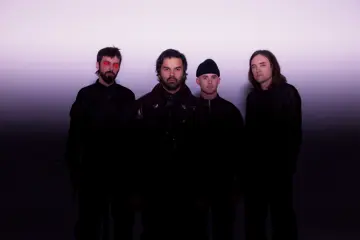
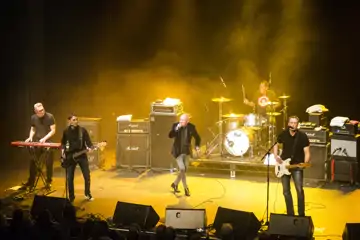
And to celebrate the reissue Bluebottle Kiss – the same four-piece line-up that recorded Revenge Is Slow, who first reformed back in 2022 behind the Patient reissue – are hitting the road, kick off at The Gum Ball Festival in late-April and then covering the east coast (plus Adelaide) throughout May.
“We’re looking forward to it, it’s going to be great,” Hutchings grins. “We're going to do the album from start to finish and then just do a bunch of other songs, we haven't started working together on it yet but that'll just be an interesting thing to do.
“I think we want to try and capture some of the textures of the album, though I don't know how successful we'll be yet. There's quite a few different weird found sounds in that album, like samples from old opera records and different things like that. The multitracks of the album have been digitally converted and we have those, so we’ll see how we go. We're hoping to be able to do a really good tribute to the album.
“Because there's certain songs that back in the day – we'd be playing at The Annandale Hotel or whatever – and as soon as you play a quiet, more textured song, people would just start blabbing over the top: they just want you to rock the whole time.
“And I don't know, that may happen this time, but hopefully not – we’re definitely going to be exploring some of the quieter corners of the record, so that'll be a challenge, but that's kind of what makes it more fun in a way.”
Tickets to Bluebottle Kiss’ upcoming tour dates are on sale now, with copies of their Revenge Is Slow reissue available now.
Bluebottle Kiss – Revenge Is Slow Returns Tour
Sunday, April 26th – The Gum Ball Festival, Hunter Valley, NSW
Thursday, May 14th – Live at The Polo, Canberra, ACT
Friday, May 15th – Stag & Hunter, Newcastle, NSW
Saturday, May 16th – Crowbar, Sydney, NSW
Friday, May 22nd – Northcote Social Club, Melbourne, VIC
Saturday, May 23rd – Ed Castle, Adelaide, SA
Friday, May 29th – Mo's Desert Clubhouse, Burleigh Heads, QLD
Saturday, May 30th – Black Bear Lodge, Brisbane, QLD
This piece of content has been assisted by the Australian Government through Music Australia and Creative Australia, its arts funding and advisory body