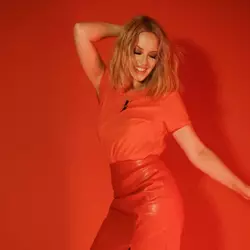
 Kylie Minogue Profile
No one captures the hearts beating in chests and the toes tapping on dance floors like Kylie Minogue.
With her gold hot pants, breathy soprano voice, constant resilience, and – most importantly – catchy tunes, she has been an icon for decades.
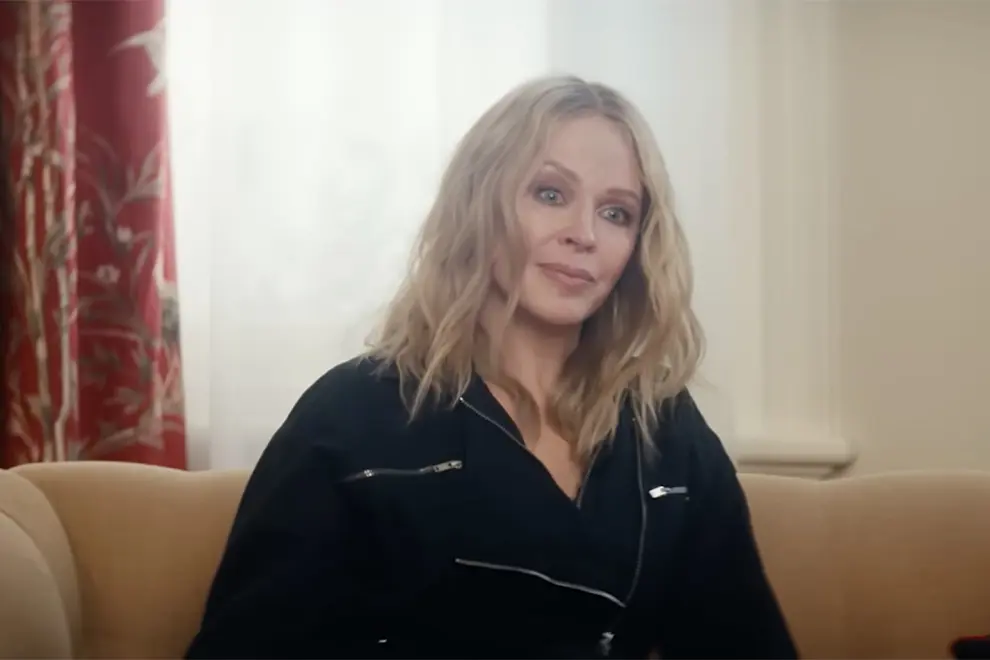
And now, Netflix’s brand new three-part documentary series allows us insight into the complicated, joyful life of the Princess of Pop. Helmed by Emmy and BAFTA Award-winning director Michael Harte, and detailing highs and lows in intimate details, KYLIE shows us a Kylie that we have never quite seen before.
Kylie: The Girl Next Door
Kylie Minogue was only nineteen – naive and fresh-faced – when she first touched down in London in the September of 1987 to work with powerhouse record producing trio Stock Aitken Waterman. (Producing mega-hits such as Dead Or Alive’s You Spin Me Right Round (Like A Record) and Rick Astley’s Never Gonna Give You Up, the trio earned the title “The Hit Factory”.)
SAW knew little about the Aussie upstart, and as such her arrival in the studio totally slipped their minds. As a result – though the story varies – they wrote the song that launched her career, I Should Be So Lucky, in a reported 40 minutes. (In the documentary, Pete Waterman insists that it actually took them two hours to write the song.)
What the trio didn’t know as they wrote I Should Be So Lucky, was that they had a soap opera darling on their hands, who would launch the single into the stratosphere.
Minogue first won the hearts of millions as Charlene Mitchell on the soap opera Neighbours, with her mane of teased hair and long, open vowels. The show was an unbelievable success. Episodes attracted as many as 20 million viewers in the United Kingdom – more than the entire population of Australia at the time.
The show helped Minogue cultivate her “girl next door image,” which rendered her beloved in the UK. As such, when I Should Be So Lucky was first released in 1988, Neighbours fans were waiting and ready. The song was a huge, reaching Number One in Australia, Finland, Germany, Hong Kong, Israel, Switzerland, and the UK. Suffice it to say, a star was born.
Kylie Minogue & Jason Donovan: The It Couple
In Neighbours, Kylie starred opposite the voluptuously mulleted Jason Donovan, and their sizzling chemistry had viewers in a tizzy. In the documentary, a hoary, grumbling modern-day Donovan complains, “The amount of times I get into a cab and someone will go, ‘How’s Kylie?’ And it’s like, ‘Oh, fuck, I don’t fucking know. You go and ask fucking her.’”
The two dated from 1986 to 1989 as Kylie’s musical career took off, and she jumped from set to plane to studio to plane to set and back again in a dizzying whirlwind. (Some dazzling home footage, however, lets us into the quiet moments in between all the chaos, of the two bickering on holiday, or lazing about in bed, looking startlingly young in the scheme of things.)
In the documentary, Kylie calls the experience “a baptism of fire.” (Neighbours had to construct a plot-line involving Charlene taking a job in the faraway land of Brisbane to fit in all of her music commitments.)
Though Donovan and Minogue were the Aussie It Couple of the late ‘80s, as her star rose, it wasn’t all smooth sailing. “Her music career at that point had really taken off, and it…” He hesitates, and then says to the camera, laughing. “It didn’t piss me off, but…I had my own ego at that point. ‘Why isn’t this happening to me?!’”
He admits, “I guess I was frightened for some reason that I was going to lose her.”
As he discusses the dissolution of their relationship, Donovan says gruffly, “Love hurts, mate,” and then jokes that he will be in therapy tomorrow as he starts to stand up and walk away from the camera.
Paparazzi Onslaught: The Singing Budgie
As Minogue’s success spiralled out of control, so too did the media’s vitriol toward her. Montages of newspapers from the time display ghastly caricatures of Minogue and describe her with such unflattering adjectives as ordinary, dull, banal, bland, forgettable, talentless. Several TV and radio personalities agree that she can’t sing.
“Some stations refuse to play her record because of what they call ‘the high irritant factor’,” says one snide journalist from the time. Another says that she looks “like a slept-in Qantas blanket.” One particular phrase abounds: due to her minuscule height, the press mockingly dubbed her “The Singing Budgie.”
In the documentary, Minogue refers to the press’s abject cruelty as simply “being mean.” Sighing, she adds, “To be 19 years old and having to cop that… that was unpleasant… What would happen if I met them is I would sit face-to-face with them and say, ‘How would you feel if that was your daughter?’”
Her sister Dannii still appears to be enraged at the memories of the media’s mistreatment of Kylie. “Everyone thought it was okay. If you had signed up to be a pop-star, then you’re meant to be emotionally bulletproof.”
And she brings up a salient point: “For a female pop artist, don’t say anything, just be pretty and shut up. But it really did hurt her.”
Minogue, still essentially a fragile teenager, was forced to grin and bear it, as paps and journalists gnashed their teeth at her.
The Love Of Kylie’s Life: Michael Hutchence
“My brother found this the other day,” Kylie says, flashing her ticket to see INXS in Sydney years ago. The concert was the first time she had ever met the outfit’s frontman, the late rock god and sex symbol Michael Hutchence. “He just had it,” she says wistfully.
Michael and Kylie dated between 1989 and 1991, a liaison which appears to have begun after he invited her and Jason Donovan to an INXS afterparty. “He wasn’t interested in me. I could tell he was focused on her,” Donovan mutters. “She disappeared into the bathroom with him if I remember correctly, which is fine.”
In the tabloids, Hutchence was characterised as a corrupting influence, a devilishly sexy junkie introducing Australia’s dewy-eyed girl-next-door to sex. Minogue, in the documentary, has nothing but praise to heap upon him.
She specifies that while they had fun together – perhaps sometimes a little too much fun – but that the intentions were never malicious. She describes him as nurturing, cultured, and hilarious. Heart-rending home footage shows them joking and snuggling together. As Michael toured all over the world with INXS, Kylie sent him adorable video messages, but the constant distance proved to be taxing.
“He was the first in so many ways. And one of those firsts was heartbreak,” she admits. “We were good together. Shoulda woulda coulda… I’ve probably been looking for something like that ever since, and haven’t got it.”
“Really?” the director behind the camera ventures, and she nods calmly. “Yeah.”
In 1997, Hutchence died by suicide. The world was rocked by the tragedy. “Another first,” Kylie says tearily. “The first service I’d been to. Always with the firsts.”
She goes on to say, “I always feel he’s with me. It’s kind of crazy, but I do… He really didn’t want me to be someone else for him at all. He was encouraging me to discover me.”
Kylie’s Bottom Shocks The World
Feeling boxed in, Kylie attempted to distance herself from her “good girl” image, and leaned into a more sexualised stage persona. The shift was partially influenced by having spent more time in the clubbing world, and reportedly supported by Hutchence.
“She couldn’t have picked a worse thing to do,” says Pete Waterman.
The world was scandalised by Kylie’s onstage dry-humping and fishnetted behind. In a montage of newspaper snippets from the time, the word “raunchy” abounds. As is often the case with female pop stars, Kylie taking ownership over her own sexuality was far from popular.
By the end of 1992, PWL did not renew their contract with Minogue, believing the singer "was [not] moving in a direction that was going to be successful.”
Kylie’s Experimental Era
Creatively stifled, ridiculed, and pigeonholed, Kylie looked to artistically self-actualise – and for her, this came in the form of extreme experimentation.
Thus followed her creative partnership with the embodiment of “the Australian nightmare,” Nick Cave, who says in the documentary, “She had mass appeal. She had everything but credibility. And I looked at her because I had credibility, but not much else.”
Their murder ballad Where The Wild Roses Grow reached top ten in several countries, but more importantly it helped lend Minogue credibility as an artist.
However, her foray into experimentation was not met with widespread approval. Her 1997 effort Impossible Princess – imbued with trance, rock, and alternative influences – became the lowest-selling album of her career.
In footage from an interview of the time, on Donovan is shown saying of Minogue’s new era, “It hasn’t worked, I don’t think.” She was dropped by her label, Deconstruction Records, in 1998.
Kylie Finds Her Way Back To Pop Music
Encouraged by Cave, Minogue chose to recite the lyrics to I Should Be So Lucky as poetry in London's Royal Albert Hall in 1996 – a moment which is treated in the documentary as a bit of a breakthrough, the spark that leads her to later embrace her original pop persona.
Cave describes those heady pop lyrics as “poetry that we could all understand,” and calls Kylie “this force that is there to affect thousands and thousands of people. It’s all outward. It’s all giving…The great beauty of pop music is that it is a joy machine.”
Kylie says, “You’ve got the coolest guy on the planet saying, ‘Where’s the pop tunes?’” She shrugs. A full-throttle pop comeback was inevitable. She embraced a sound for the masses, a sound for the dance-floor, a sequinned sound of joyous abandon.
And so followed those tunes that we all know and love: Spinning Around and Can’t Get You Out Of My Head, among others. She effortlessly topped the charts, and was firmly established as the Queen of Pop. She had taken unabashed ownership of her voice – unabashed ownership of pop, a genre routinely dismissed – and the world celebrated her for it.
Kylie: Queer Icon
Kylie Minogue has long been touted as a gay icon, and it is easy to understand why. Apart from frequently attending gay bars where performers have dressed as “supersonic versions” of her, in a press conference featured in the documentary, she once said, “There was a time in the beginning of my career when I was having this tirade of nastiness just for being myself. And I think my gay audience may have related to that.”
Her love for the queer community remains unwavering. In the documentary, she says, “I feel like I could go to war with my gay audience. They were there way back when it was the most uncool thing.” The connection between Kylie and her queer audience appears to be one of the most steadfast relationships of her entire career.
Kylie’s Battle With Breast Cancer
In 2005, Kylie’s career was on fire, and only expanding. She was dominating the charts, and was announced to be headlining Glastonbury that year, on top of launching into a world tour. The preparation was rigorous, and Kylie was exhausted. A doctor’s check-up eventually revealed that Kylie wasn’t merely overworked – she had breast cancer.
The tour was postponed as Kylie underwent treatment. Footage shows paparazzi swarming around their family home, committing an obscene level of intrusion. She describes herself as feeling like a prisoner, before deciding to undergo chemotherapy in Paris.
Kylie talks with brutal honesty about the effects of the chemotherapy: hair falling out in clumps, the physical pain, the emotional dissociation. “We didn’t know if she was ever going to be well again,” Dannii says solemnly, and reminisces on playing Kylie music to help throughout her recovery.
“That took us back to what we knew. Back to the beginning… In the process of getting her better, music kept us going.”
After months of chemotherapy, the pop princess was finally declared cancer free. But her second cancer diagnosis came in early 2021 – something she kept to herself at the time.
“I don’t feel obliged to tell the world,” she says. “And actually I couldn’t at the time because I was just a shell of a person… Thankfully, I got through it. Again. And all is well.”
Kylie’s IVF Journey
Just as Kylie was recovering from breast cancer, she was pelted with questions by tactless interviewers about when she would finally be settling down and having children.
The documentary does reveal that the popstar had always wanted kids – to the point of postponing chemotherapy to try IVF a number of times.
The procedures were, unfortunately, never successful. “I never saw myself as being a parent, and she always did,” confides Dannii. “And that is…it’s heartbreaking.”
The Reigning Queen Of Pop
In 2019, Kylie finally got her chance to perform at Glastonbury, to an outpouring of love. In 2023, her single Padam Padam went viral online and won a Grammy for Best Pop Dance Recording. As she enters the latter half of her fifties, her career refuses to slow down (much to the probable chagrin of all the crusty male interviewers who often indicated to her throughout the documentary that pop is a young woman’s game).
Cave sums up her appeal well: “You know what the world really loves essentially about Kylie is that she really went through something. That’s the sort of definition of joy, in a way, which is the capacity to be able to rise out of a certain suffering and to see the world in a positive way. And her connection with the audience is not phony. It is very real for her. It is a true form of love. “
Kylie describes pop music as something that nurtures her. “It can be a type of salvation for some people.”
Despite it all, Kylie has managed to achieve salvation – and has allowed her audience to achieve it too. Or, as she says in the documentary, smiling sweetly, “Little Kylie got there.”
KYLIE is available to stream now on Netflix.
This piece of content has been assisted by the Australian Government through Music Australia and Creative Australia, its arts funding and advisory body