
A provocative chauvinist and a small collective of leading feminists go toe-to-toe in a heated live debate on women's liberation as the public scrambles to spectate. It's a scenario that could very well take place today. But the events presented in The Wooster Group's The Town Hall Affair took place over 45 years ago.
Making its exclusive Australian premiere at the Sydney Festival, the play reimagines the events depicted in Town Bloody Hall, a documentary about the combative 1971 debate between author Norman Mailer (whose essay, then book, The Prisoner of Sex ruffled feathers in the women's liberation movement) and some of the foremost feminist voices of the time, including "our" Germaine Greer, played by ER actor Maura Tierney.
In the era of #metoo and in the lead up to the first anniversary of the 2017 Women's March, it's interesting to look back to a time when Greer was at the top of her game. Hot off the success of The Female Eunuch and making her first public appearance in the US in her face-off against Mailer, alongside the likes of Jill Johnston, an outspoken lesbian separatist, and Diana Trilling, a New York intellectual and apparent keeper of the elder stateswomen of feminism.
It is not through the perspective of Greer, however, that we are invited into this landmark event, but rather through the gaze of Johnston, who seems more set on causing chaos than engaging with Mailer's sexism.
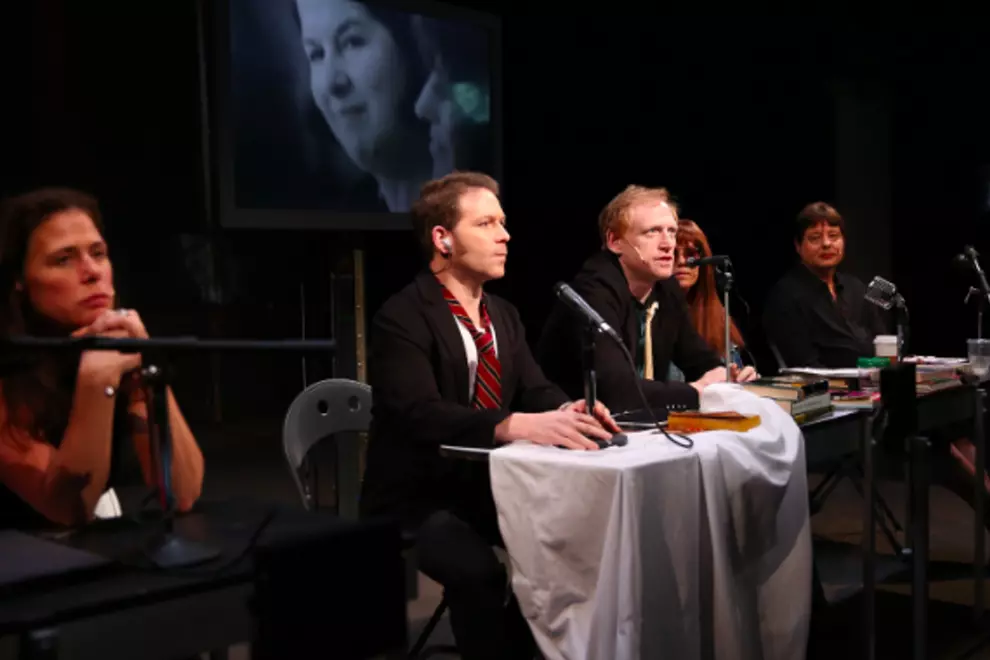
The play takes a collage-like approach to the storytelling, unfolding in scraps of mismatched dialogue and action. Extended clips from the original documentary play on screens overhead, as the performers re-enact some of the most poignant moments from the debate with forensic precision, perfectly mirroring every snatched breath, every shaky misstep and every smirking jab at the opposition. The debate is eventually spliced with re-enacted excerpts from Mailer's 1970 independent film Maidstone.
As the debate unfolds, Greer calls on artists to abandon their egos and evokes a harmony between the movements for gay rights and women's rights, while Mailer suggests that women have brought subjugation on themselves. Johnston filibusters until she makes out with a woman onstage; Mailer threatens to get out his dick. It's a tit for tat sparring match as cerebral as it is shocking.
In the overall composition of the production, the Wooster Group bring to light some of the best and worst of experimental theatre. Two actors simultaneously share the role of Mailer, Trilling is portrayed by a male actor, and there's a ship's mast on stage. But rich as this storytelling may appear, it is also incoherent - all the above decisions have the potential to enhance the performance, but to the audience at least, there seems to be little tangible intention behind any of these bold choices. Perhaps there is a lineage to the New York City group's devised performance style and the direction of co-founder Elizabeth LeCompte that is lost on Sydney audiences. But one would hope that a story tackling such an evocative topic, in the hands of one of America's most prestigious contemporary theatre ensembles, would connect more universally with its viewer.
The Town Hall Affair succeeds in bringing attention to a documentary about a feminist discourse that is worth recalling given our current cultural climate. However, its execution leaves much to be desired. Audience members unaware of the key principals the feminist movement of the 70s and the personalities featured are likely to be left scratching their heads as they attempt to fill the gaps. While the biggest laughs and scoffs from the audience come from the original transcripts of the debate, the speeches themselves are for the most part deeply, dryly intellectual to the point of being totally impenetrable — and dare I even say, a bit wanky.
As Johnston put it, this iconic occasion was a disaster for women and the social event of the season, and much like the debate itself, the play is a mish-mash of triumph and failure; a cluttered jumble of personalities and arguments, peppered with some zingy one-liners but still overwhelmingly navel-gazing. If anything, this play could be viewed as a warning to modern feminists, or any social justice warriors for that matter: when the discussion is hogged by provocative raconteurs and deliberate controversy, messages are lost, chaos ensues.
The Town Hall Affair evokes much of the pandemonium and moxie of the event it pays homage to, but in the process, it also loses sight of the principals it's supposed to enshrine.
Sydney Festival presents The Town Hall Affair until 13 Jan at Sydney Opera House