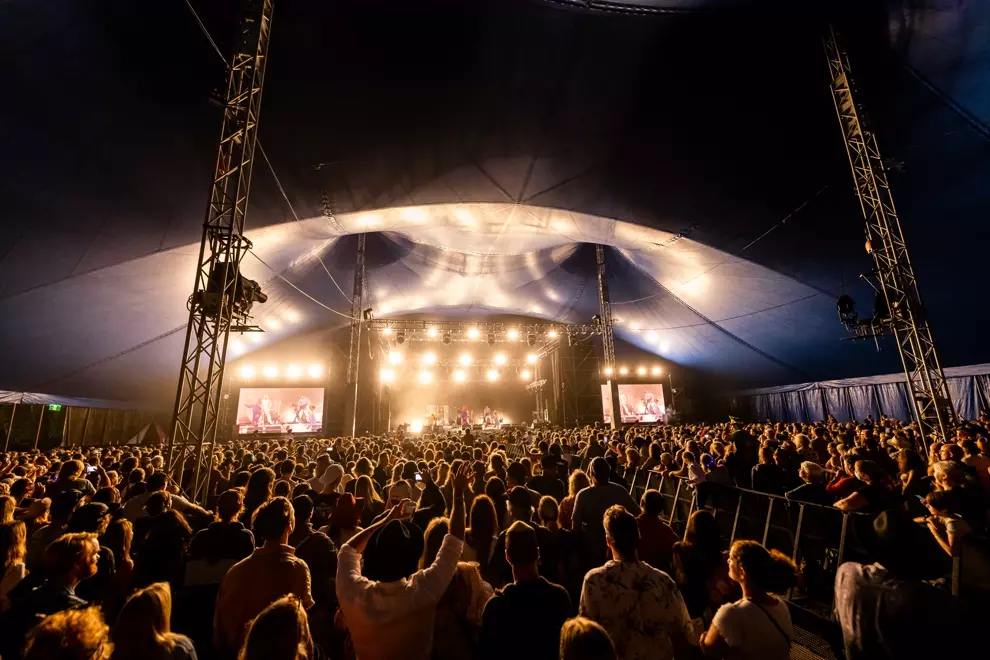
Australian festival-goers could be paying up to an average $427 a head by 2030, based on how ticket prices are “soaring dramatically” past inflation.
A new analysis by Culture Kings drew that conclusion after surveying 11 major festivals.
The average Australian festival ticket cost around $120 in 2004. By 2025, it was $334. This was an increase of 180%, reported Culture Kings, and more than triple that of inflation across the same period.
It went on to estimate that based on current price growth trends, the national average is projected to hit $427 by 2030 and $546 by 2035, a further 63% rise within ten years.
“Festivals are part of Australia’s cultural heartbeat,” said Justin Hillberg, President of Culture Kings ANZ (Australia and New Zealand). They’re where people meet, discover new music, and feel part of something bigger.
“But when ticket prices rise faster than wages and faster than inflation, it risks turning a shared cultural experience into a luxury,” he says.
“Our analysis shows worrying acceleration: if trends continue, a $400–$500 festival ticket will become standard within just a few years.”
Hillberg went on to stress: “Festivals should remain something every Australian can enjoy, not just those who can afford premium pricing.”
The report outlined how Queensland EDM festival Earth Frequency has lifted its average ticket price from $60 at launch to $339 today. The festival’s website advertised its 2025 prices as ranging from $300.00 + $15.65 fee, and $320.00 + $16.62 fee.
Culture Kings stated: “At its current trajectory, Earth Frequency’s average ticket could hit $550 by 2030, rising at an annual rate nearly four times higher than inflation.”
In another data dive, the study estimated, “Lost Paradise, already the highest-priced major festival in 2025 with an average ticket of $506, is projected to reach around $660 by 2030.
“Spilt Milk is forecast to climb from an average $320 in 2025 to about $500 by 2030. Handpicked Festival could rise from $180 to around $280 over the same period.”
The report said Bluesfest Byron Bay “maintains one of the widest price ranges nationally, offering premium passes up to $1,950 alongside entry tickets around $85, a spread of more than $1,800.” It added it “could push its average ticket from $482 now to roughly $630 by 2030.”
Remains
Whether these festivals do indeed increase their prices remains to be seen, of course.
Through Bluesfest’s recent ups and downs – its latest up being drawing 109,000 in 2025, its third largest crowd ever – its director Peter Noble has stressed that he’s tried to keep prices down.
A few years ago when the festival returned after COVID restrictions, Noble emphasised to The Music that despite massive losses due to its cancellations, he was trying to keep prices down as much as he could.
“It doesn’t mean the festival is costing us any less, it doesn’t mean we’re paying the artists less – everything has gone up, but Bluesfest hasn’t. Now, I can’t do that forever, but for those people who are welded on Bluesfest, we care about you and we wouldn’t be here without you.”
Chris O’Brien, Head of Touring at Destroy All Lines, admitted to The Music that their customers are passionate and loyal about their acts. But they do grumble about rising ticket prices.
“That’s totally understandable, of course,” O’Brien stated. “What we do is to include in all our marketing just why prices are going up. That makes them realise costs are rising in all facets and we’re not being greedy.”
Artist fees are the biggest issues: promoters say these have virtually doubled in the last few years. Splendour In The Grass, once untouchable, had to pull out a few weeks after tickets went on sale because the bill was considered lukewarm.
Justin Bieber is estimated to be paid US$10 million (AU$14.9 million) to headline Coachella 2026, a fee similar to what Beyonce and Ariana Grande scored to headline America’s biggest music festival in the past.
But he seems to have been worth it. After struggling to sell tickets in 2024 and 2025, Coachella tickets for 2026 vanished in three days after it was expected they would take seven months to sell out.
The location of the festival site is all-important but is quite complex. Those in the city or in picturesque locations come with higher venue fees, security, and municipal services, as well as more substantial council taxes.
These costs might be less for festivals in rural or semi-rural locations. But transportation, roads and accommodation issues could affect prices.
Making sites greener is also a priority for music punters and also costlier as this includes bin hire and collection fees, landfill levies and costs of technology, labour, recycling and transportation.
US/UK
How do American and UK festivals fare with their tickets? There are no estimates for 2030.
But for the first time in five years, average ticket prices did not increase in 2025, according to the Billboard Boxscore chart.
Tickets for US festivals ranged from $200 (AU$298) to $600 (AU$894.18), relatively quite low. But patrons can spend $800 (AU$ 1,192.25) to $3,000 (AU 4,470.93) when you factor in travel, accommodations, food and drink depending on luxury options.
GA admission tickets for Coachella 2026 start at $549 (AU$818.18) while VIP is at $1,199 (AU$1,786.88)
In 2025, Lollapalooza’s GA started at $415 (AU$618.47) and VIP at $1,670 (AU$2,488.82). Lowest GA for Austin City Limits was $380 (AU$566.31) and VIP at $1,670 (AU$2,488.82).
Three years ago, UK festivals were damned for having the highest ticket costs in the world.
Most expensive was Reading and Leeds, which after a 34.4% increase between 2022 and 2023, was charging £125.00 (AU$251.38) per day last year.
Price jumps from 2022 to 2023 were Creamfields (18.2%), Wireless (17.0%) and Latitude (12.20%).
Glastonbury’s price rise in that period was 19.6%. But last year it was priced at £74.70 (AU$150.22) for each of its 5 days.
More expensive in 2025 were BST Hyde Park (£101.95/ AU$205.03), Homestead Festival (£100.00/ AU$201.11), Parklife Weekender (£97.70/ AU$196.48), Bloodstock (£96.00), Forever Now (£95.00/ AU$193.06) and Wireless Festival: (£94.60/ AU$190.25).
This piece of content has been assisted by the Australian Government through Music Australia and Creative Australia, its arts funding and advisory body