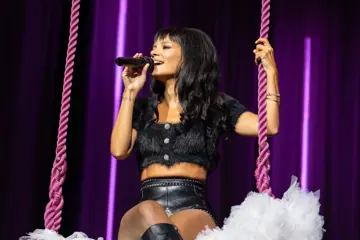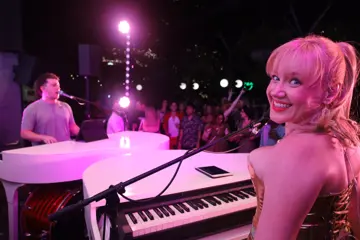
POOF DOOF has already secured the achievement of possessing the single greatest moniker for a night club of all time. Now, to add to their growing list of achievements, Australia’s premier night club and events brand have launched POOF DOOF Records, an exciting new label set to amplify queer voices and redefine the intersection of nightlife, music, and culture on a global stage.
The project has already made waves with its first musical release, drag-queen-cum-musician-extraordinaire Jimi The Kween’s upbeat single All I Need.
Over a Zoom call, the stalwarts of POOF DOOF – founder Anthony ‘Hockers’ Hocking, creative director and festivals co-ordinator John Davis, and Jimi The Kween – discuss this decision to branch out, a decision that has clearly been mulled over for quite some time.
POOF DOOF’s 15th birthday is imminently approaching. “Over those years, we’ve built a community, we’ve built a queer ecosystem around the club night,” Hockers explains. “We’ve booked tens of thousands of DJs, producers, drag queens, singers, burlesque performers, pole dancers – you name it. We’ve been in that realm and we’ve witnessed all of these young artists trying to make it.”
Davis chimes in, “Artists are always reaching out to us, looking for bookings, looking for work.“
They watched these journeys; they fielded questions about the music industry. “It just became really obvious that there was a gap there, and we could use our experience to do something in the queer space and help our community work out the roadmap to producing their music and getting it to market,” Hockers says.
‘How can we empower artists performing in our spaces, performing at our venues and festivals, and elevate those acts with what we do in the real events?’ These were the questions they posed to themselves, and POOF DOOF Records was the obvious answer to all of them.
“We want to provide real-life solutions for employment, giving our community places to perform their music as well as giving them the roadmap to releasing their tracks or getting their demos produced or whatever it may be,” Davis says.
“The label was a natural progression to plug into everything else that we do,” Hockers says. “I think some other labels have to try to create an ecosystem, but we’ve already got it.
Jimi The Kween – long a POOF DOOF staple – started to become serious about songwriting and DJing over the bleak COVID years. Involving him was a no-brainer. Meeting with labels followed. The ball was starting to roll. And thus All I Need – a pulsing club banger, rife with dance breaks, propelled by the euphoria that comes of finding one’s chosen family – was released.
“The process was highly collaborative,” Jimi says of the track, and describes himself as particularly lucky to have been able to work with some “amazing” producers on the song.
“With this particular song, it was the first time I’d been working with a team in LA. It was super cool. Troye Sivan was actually recording in the studio next to me, which was a gag.”
As the song – and team behind it – expanded, Jimi started to realise, “Okay, this is bigger than what I am able to do myself as an independent artist.” Pitching the song to become part of POOF DOOF Records “just made sense.”
While All I Need has a universal quality, Jimi admits, “The other songs on the EP, some of them might not be so celebratory, let’s say. The other sides of me jump out a little… I get a little bit nasty, little bit stinky, little bit dirty. So having a nice clean, easily accessible start was an important factor.”
“As a pride anthem, All I Need was the right launchpad for the label,” Hockers says. “And with pride month coming up in June, it was the right timing to make some noise around that and launch this queer-owned and queer-focused label. But,” he specifies, “it’s not only queer artists, it’s for allies too. We’re a label for all.”
“The label is really focused on queer people, but as Hockers said, allies are important too, and if you support us, we support you,” Davis adds.
“At the end of the day, it is all about the music,” Hockers states. “Music is the answer. It’s been really heartwarming that since we’ve launched it, we’ve had seventeen artists submit music.”
“And in all different fields as well,” Davis notes. “House and techno, singer-songwriters, Troye Sivan-adjacent pop artists. All parts of our community want to be involved. It really is a come-one-come-all kind of label.”
Though the experience has clearly been a heartening one, and though the trio is confident, launching a label is bound to be overwhelming.
“The music industry is a complicated beast,” Hockers admits. “It’s really hard to navigate. Even with people in the music industry and in music PR that we speak to, I’m brutally honest with them and I say that it's been a huge learning curve for us.
“We haven’t pretended to know everything but we’ve got the right people helping us. That was really important to us.
“When we started the label, we were like, ‘Who are the best people to give us advice?’” he recalls. “So we have made sure that we received advice from the best, and then in turn we impart this information on to our artists to give them a roadmap to get out of their bedrooms and sell their music to the world.”
“I’m sure lots of artists would agree with this: putting music out is really stressful!” Jimi adds, laughing. “It’s quite vulnerable and revealing in lots of ways. So having the POOF DOOF team backing me, it alleviates a little bit of that anxiety and makes it way more enjoyable. Because I’m not alone!”
“When the music’s good, it resonates with people, and that’s something we’ve seen immediately upon the single’s release,” John says.
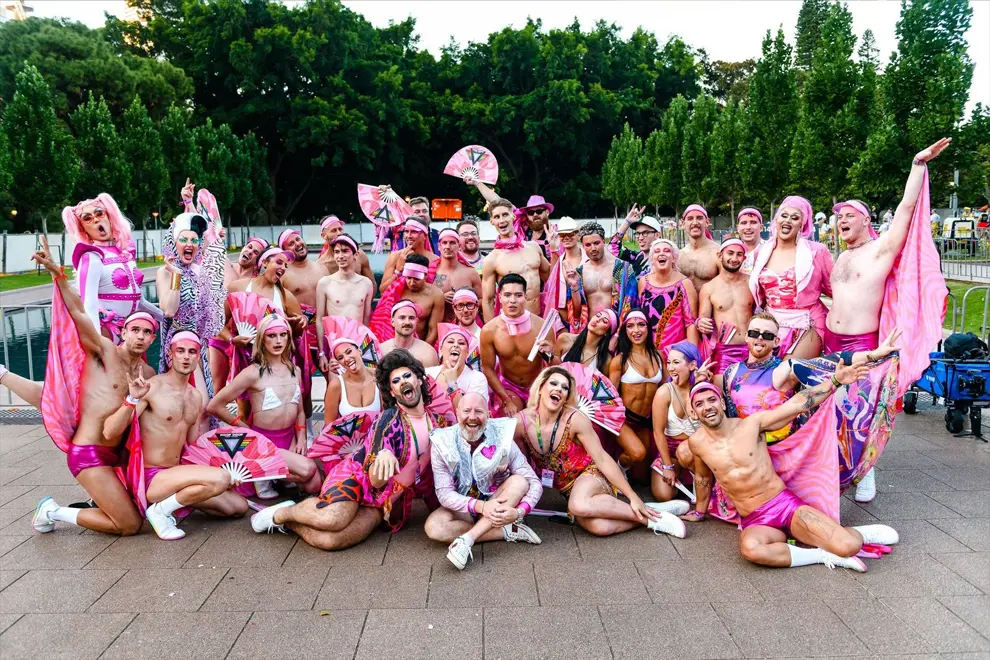
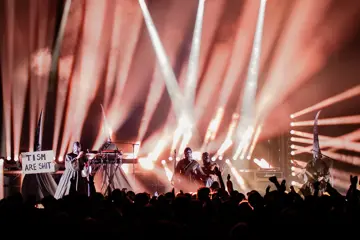
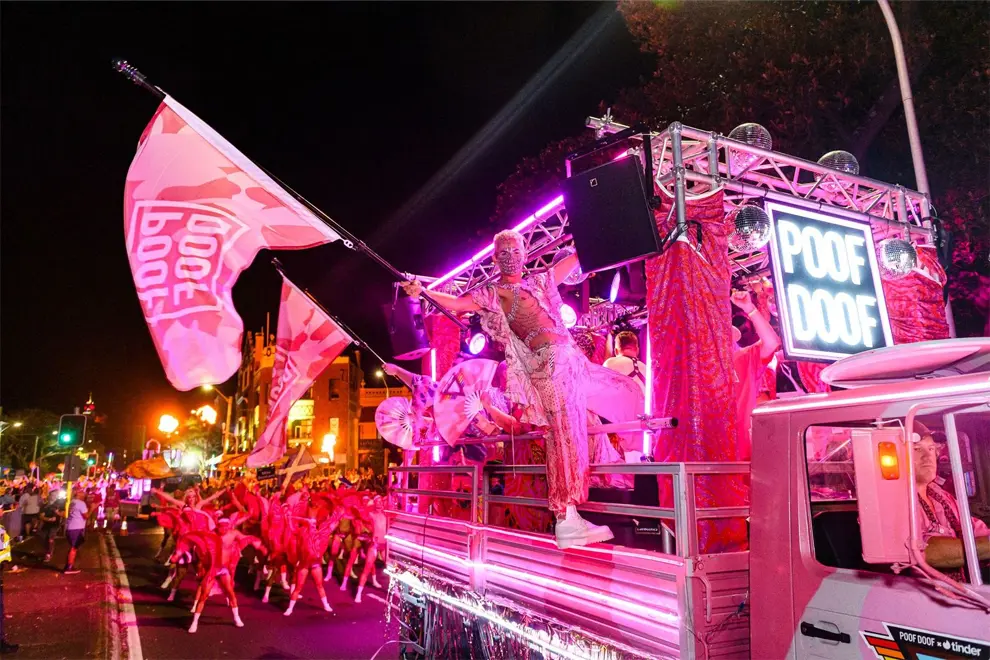
POOF DOOF at Mardi Gras (Credit: Joel Devereux)
As of now, POOF DOOF Records is just in its infancy – the label’s short-term focus is Australia, but Hockers hints that aspirations are global – but POOF DOOF itself is anything but.
“We started POOF DOOF all that time ago in the city,” Hockers says, reminiscing fondly upon their 2011 origins. “There was a gap in the market. There were no queer spaces that were playing future-forward techno and house. All the gay bars were playing Kylie [Minogue] and Britney [Spears].”
Once they migrated from the city to Chapel Street, in South Yarra, “It just went gangbusters. It was really accessible, it was something new, something fresh.”
Since the birth of POOF DOOF, Hockers has noticed what he calls the “fragmentation of music” in the nightlife scene.
“I don’t think it’s just in queer clubs, it’s also in straight clubs,” he muses. “If you’re into hard-style, you go to hard-style parties. If you’re into pop and Zara Larsson, you go to pop clubs. There’s a party for each different segment of the market now. Whereas back in the day, you went to the one club and you listened to what was there.”
He has also noticed that younger people aren’t frequenting the clubs as often as they used to. “I think people are very selective about what they do with their time and their money,” Davis offers.
“And the way this translates back into the record label is interesting, because as Hockers said, we started off as a club focused on house and techno, and then over the years we’ve started doing events that are pop-focused, or have live music elements. And I think this really translates well into the label, because it gives us an opportunity to uplift queerness in all fields.”
“We don’t discriminate when it comes to music,” Hockers says. “We like it all.”
Queerness has long thrived on the nightlife circuit. Underground bars and clubs existed as safe havens; beneath disco balls, queerness could be celebrated. Back in the day – though, crucially, not that long ago – gay bars were often the only places where people could escape persecution, feel like they belonged, fall in love, or even just have a good time.
“Queer people like to dance,” Davis says. “If you think of disco, house music – all those genres were pioneered by queer people and people of colour.”
“Back in the day, you used to congregate together as a minority,” Hockers explains. “Queer people have always been really good at being creative and experimenting and pushing boundaries.”
“I mean, when it comes to art in general – whether it’s film, music, or whatever – you want to say thank you to queer people,” Davis adds.
Jimi chimes in, “And doing drag during the day is difficult!”
Things have changed vastly since POOF DOOF’s birth, and will hopefully continue to change as the label grows.
“The heteronormative music festivals and the larger labels are doing a better job at engaging minorities,” Hockers says.
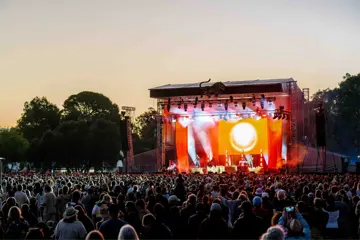
“We’re pretty lucky that POOF DOOF is given the opportunity to produce side stages and safe spaces at mainstream music festivals like Pitch, Beyond The Valley, A3,” John says.
“I think that’s a really good first step for mainstream promoters and producers to authentically engage with the community, to get us to produce experiences that we know how to book with artists that we know are great. It is a wholly queer experience in a mainstream space.”
“They could always be doing a bit more, especially the larger labels, in seeking out and nurturing and incubating young queer talent. I would like to see a lot more of that,” Hockers says. “Writing camps and things like that, spending more of their money in these spaces, because they’ve got the means to.”
“Open your ears more,” Jimi says, voice buoyant with warmth and hope. “Music is all about how it sounds, how it makes you feel, so if people were to open their ears a bit more, they would be able to be more authentically led into the music that makes you feel a certain type of way. The stuff that makes your heart sing.”
Follow POOF DOOF for more updates about future releases via the nascent label, or upcoming club events.
This piece of content has been assisted by the Australian Government through Music Australia and Creative Australia, its arts funding and advisory body