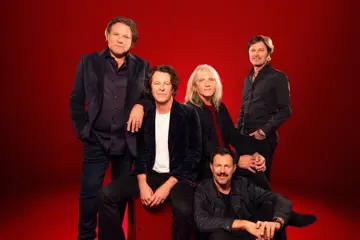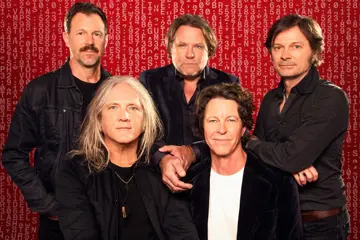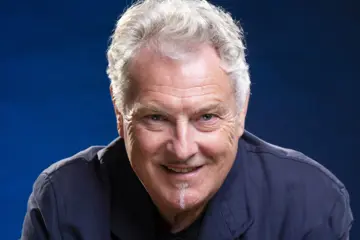
Cordrazine’s breakthrough EP was aptly titled: Time To Leave. The much-loved Melbourne band is today releasing a new EP, You See In Me.
And then they’re breaking up. Again.
“It’s no secret I have a complicated relationship with music,” Hamish Cowan posted when he announced that the EP’s launch show, at the Northcote Social Club on December 12th, would be the band’s last.
“I love singing and making beautiful sounds with my dear friends. Performing, however – the build-up to a show and then standing before an audience – provokes extraordinary stress and anxiety. It pokes all of my fragile parts in a way nothing else does.”
It’s been a long, strange trip for the artist who grew up loving music with his high school buddy Nick Batterham, who also became a recording artist.
“If it wasn’t for Nick, I wouldn’t be a musician,” Hamish says.
Every week, Hamish would go to Plato’s in Frankston and buy the imported copies of NME and Melody Maker. “Back in our day, there was a lot more fantasy – we didn’t have the internet to jump on, information wasn’t at our fingertips. So we had to fill in the gaps.”
“It was like we dressed differently every week for whatever was on the cover,” Nick fondly recalls, “and we tried to sound that way with what we were playing.”
“Countdown was also really important to me,” Hamish adds. “I’d religiously sit down on a Sunday night and watch every week. When everyone else was talking about the football scores, I’d be talking about the Top 10 and 3XY and Triple R.”
Nick and Hamish’s first band, Blindside, signed to Summershine and had releases in the US. Nick then joined The Earthmen, while Hamish started Cordrazine (named after a fictional drug in Star Trek).
Hamish was also inspired by another big music fan. “My mum was a big influence, particularly the more indie stuff. I can vividly remember the day my mum took me out of school for some reason, and we went to Sovereign Hill. To this day, I’ve got no idea why.
“My recollection of it is like a fairytale: the hills between here and Ballarat looking like the rolling grey hills of Ireland. And I heard U2’s I Will Follow on the radio. And that was just this moment … there was a call that hit something in me and started something that became quite obsessive. It was like a spirit had entered me.”
Hamish would later cover U2’s With Or Without You for the Looking For Alibrandi soundtrack.
“When I was young, I was like a magpie,” Hamish says. “I would just pick up things from everywhere.
“No one starts out with a vocal style; we mimic the things that we admire. And for me, rather than just mimicking the things that I was inspired by, I tried to inhabit the life. Literally, it was fully inhabiting my hero of whatever that movement was.
“One week, I’d be a punk, the next I’d be a New Romantic. And somewhere within all of that, you find your own voice, your true self slowly emerges.
“But even now, I can pretty much hear all of the influences in every moment. They might not be obvious to other people, but they’re still obvious to me.”
Hamish pays tribute to one influence – Jimmy Somerville – on the new EP, covering Bronski Beat’s Smalltown Boy.
“Jimmy’s vocal was an inspiration. His falsetto was something I imitated. Its influence is evident all through Cordrazine.”
Hamish also loves the Cocteau Twins.
“She [Elizabeth Fraser] is the voice that’s inspired me more than any other. Throughout the course of my life, being compared to X, Y and Z – with Jeff Buckley probably the most common one – Liz Fraser was the one that inspired me to want to sing.
“I think there’s something about the feminine voice that doesn’t rely on power or aggression. There’s a subtlety to it. Yeah, Liz Fraser, she’s the voice of an angel.”
Despite the multitude of musical heroes, Hamish quickly started to write his own songs.
“For me, that was a necessity – because I was really terrible at playing other people’s songs. And I was sensitive to criticism. You realise that if you play something that’s your own, no one can tell you what you’re doing is wrong. It might not be good, but no one can tell you it’s not meant to sound like that.”
And then Hamish created a song called Crazy. It changed his life, for better and for worse.
“I remember I was living on Dandenong Road [in Melbourne] in a share house that was probably its own version of Dogs In Space. It had that sense.
“And, to paint a very visual picture, I’m sitting nude on a white stool in the lounge room surrounded by people playing guitar.
“People would literally just let themselves in and sleep on the floor. The reason that the EP is called Time To Leave is self-evident.”
With Crazy, Hamish didn’t think he’d come up with a song that would connect with thousands of people. And even his record company boss, David Vodicka at Rubber Records, was unsure. After listening to the song, Vodicka had one question:
“Where’s the guitars?”
Cordrazine made the record for just $1,500. And then Hamish split. He went backpacking in Southeast Asia. As Crazy was taking off, he was in Bangkok, making a reverse-charge phone call to his grandmother.
“Where are you?” she asked. “There’s a lot of people trying to find you.”
Hamish returned home to radio play and big gigs. Cordrazine were no longer playing at The Tote on a Thursday night, “where after paying the sound guy, there was nothing left for the band”.
Crazy landed at No. 17 in triple j’s Hottest 100, and the Time To Leave EP was a Top 50 hit on the ARIA charts, spending more than four months in the Top 100.
But Hamish found the sudden success “terrifying”. The pressure was on for a follow-up hit. Hamish came up with Clearlight.
Cordrazine were now in a big studio – John Farnham’s Gotham Audio – with a big budget and the backing of BMG.
“The reason that song turned out the way it did, which was big and bombastic and quite desperate, was because I thought, ‘Well, even if nobody likes it, I don’t want it to be a song that you can ignore.’
“I can hear it in the production being very overblown. Like, there’s big horns and massive keyboards, and then all of the drumming that comes into it. And that was that sense of doubt and anxiety coming through.”
Clearlight was the first single from Cordrazine’s 1998 debut album, From Here To Wherever, which hit the national Top 10, received rave reviews and was nominated for an ARIA for Breakthrough Artist – Album (the trophy went to Natalie Imbruglia’s Left Of The Middle).
The acclaim didn’t exorcise the demons in Hamish’s head. He had a difficult time dealing with this dilemma:
“How do you tell the people around you how unhappy you are when all they can see is you living a dream you sought your whole life?”
“At that time, Cordrazine was the loneliest place on earth for me,” he reveals.
“I isolated myself so much as a way to protect myself from all the things I was unable to deal with, and I was unable to articulate what it was I couldn’t deal with, as even I didn’t understand.
“It’s no secret, I’ve never been particularly comfortable with sharing any part of myself with the world, apart from music.”
Hamish laughs. “I suspect I am the only narcissist alive who doesn’t like attention!”
Crazy took Cordrazine to the US. After playing SXSW, Hamish found himself sitting in an office at the Sony BMG building in Times Square in New York. Looking at the Chrysler Building, Hamish feared he’d be exposed as a fraud.
So, he disappeared.
“To claim that at any point in time I was confident with any of my output would be absolutely disingenuous and misleading,” he explains.
“I suppose it’s the external validation, when someone recognises something and attributes value to it, that you go, ‘Okay, this might be something.’ But I don’t think I’ve ever arrived at that point. And I think that’s probably pretty obvious when you look at my relationship with the music industry – I will record a record and disappear without even promoting it, or without giving any explanation or insight into it.
“It’s that insecurity and lack of self-belief … there’s a hidden imposter syndrome, where my whole life it was easier to do something and walk away from it than face the reality of what I knew about myself to be discovered by others.
“So, hence, with Cordrazine, I quit the band before the record was even released. And again, the second Cordrazine record was released: we did one show, and I was gone again.”
With Hamish’s obvious talent – obvious to everyone apart from perhaps the artist himself – there were offers to collaborate with other acts.
“But when you’ve got as much self-doubt, and you don’t have that confidence in what it is that you’ve done and you’ve kind of extracted yourself from the industry, it was something that I avoided.”
He did, however, manage to finish a song with Groove Terminator’s Simon Lewicki. Electrifyin’ Mojo was the title track of the GT album released in 2002.
I once asked Hamish why he wrote songs.
“A catharsis, I suppose?” he replied. “Yeah, I don’t think there’s any other way. It’s an emotional response to a moment of time in my life. It expresses things in a way that I probably would struggle to in any other form.
“The words that come out of me when I’m writing are probably the most honest and unfiltered voice that exists in my life. When I write songs, all of the filters seem to be turned off. And a song becomes a primal scream, it’s the most honest description of something that’s happening in my life.”
But the art form remains a mystery to the artist.
“I don’t recall writing songs; it feels as though they come fully formed.
“There are people that can craft songs, like Paul McCartney or Nick Cave. There’s a sense of discipline that I don’t have. So that’s why I’m not a particularly prolific writer.
“I’ve never sat down and put pen to paper to write a lyric. They just seem to be there, completed. And I don’t know why that is. It’s a curious experience.”
After Cordrazine’s first split, the singer started Hamish, an electronic collaboration with producer Bryan St James. They released an album called Homesick in 2002.
Cordrazine’s second album, Always Coming Down, arrived 12 years after the band’s debut. Produced by Hamish’s old schoolmate Nick Batterham, who also joined the band, News Corp music writer Kathy McCabe told Hamish he had created “the greatest Smiths album the Smiths never made”.
Perhaps the most uplifting song in the Cordrazine catalogue is Sunshine, on the second album.
“I had an image in my head,” Hamish remembers. “I always wanted to write a song that I could imagine being performed on the steps of the New York apartment block where Sesame Street is filmed. But the meaning of the song, and actually understanding what the words were, didn’t come to me until months later, after the recording was finished.”
Sunshine had a life beyond the band.
“One of its lives was promoting voting in a Spanish general election,” Hamish reveals. “I never saw the campaign, but we were approached by the Spanish government, asking whether they could use it to encourage voter turnout. And I was like, ‘Yeah, of course you can.’
“That seemed like a good cause, supporting democracy.”
Hamish is a fascinating interview subject. Revealing and brutally honest.
Halfway through our chat, he says, “So, as our therapy session goes on, the question is: What does all of this reveal?
“It’s like there’s this conflict within me.
“Behind the humility, there’s clearly a smugness on some level that goes, ‘Okay, despite all of your rhetoric, why would you even bother going into the studio? Why would you ever take to the stage?’
“So there’s a conflict.”
The new EP is as beautiful and as moving as anything Cordrazine has released, particularly the title track and Florence.
So, why quit when you’re loved?
For Hamish, the answer is simple: self-preservation.
He realises that what makes an artist great can also be their downfall.
“I think if you look around the industry, sadly, it’s all of the inadequacies that make us as artists, that gives us a voice that’s unique, but it comes with a vulnerability.
“And it’s all of those inadequate parts of ourselves – the self-doubt, the self-loathing, the anxiety – that we express, which seem to be relatable to people. But it’s also those things that, for many of us, make it difficult to continue to inhabit the space that we’ve dreamed of being in our whole lives.
“So, it’s unsurprising that we see horrid rates of suicides amongst artists and, you know, drug and alcohol addictions and inability to maintain relationships. So, for me, it was one of those things where you protect yourself: you leave.”
As he prepares to do his final show, what advice would Hamish give a young artist just starting out?
“I’m conscious of the fact that old people like me giving advice to young people is gonna make bugger-all difference,” he smiles.
“My only advice would be for the person to be able to find ways to enjoy themselves and actually have fun and appreciate the good fortune that we have to be in that space.
“Don’t lose humility and just be able to enjoy it. If you can enjoy it and you understand it a little bit, then you’ll be able to exist in that space in a way that I wasn’t able to.”
If he had his time again, is there anything Hamish would do differently?
“I would love to know more about music,” he admits. “I would love to be able to read music; I would love a basic understanding of music theory. I’ve had no training. I put my fingers on the guitar, and I don’t know the chords that I play most of the time, other than my basic shapes.
“So, I would like to know a little more about the art of it. I think that probably would have made my life easier. It certainly would have given me a confidence that I lack within that space.
“You know, a big part of my lack of confidence comes from the absence of that knowing, particularly when you’re surrounded by remarkably talented people who do have that understanding.”
The title track of Cordrazine’s second album featured the line: “It’s never over.”
When I asked Hamish if that was how he felt about bands, he replied: “No, it’s just life. I don’t believe in absolutes, I have never been one of those people who says, ‘I’m never doing that again.’
“That type of thinking creates prisons in our minds and closes the door to the amazing opportunities life can offer. People never stay static; we always grow and evolve, so nothing ever ends. It just changes.”
From here to wherever. Where did Hamish end up?
“Here. Everything leads us to now. Everything leads to this moment, for better or worse. The thing is to make the most of every moment along the way to your ‘Wherever’.”
Breaking up is hard to do. But Hamish stresses he is not breaking up with music. He will always cherish the “Orpheus effect”.
“Music captures the moment and expresses something that I want to relate to. Music has amazing transformative power; if I’m feeling a particular way, you can take me somewhere else.
“So, it’s extraordinary comfort and companionship, and it’s the most reliable and consistent companion in my life.
“It’s like this: it never gets upset with me. It never lets me down. And in the moments of sorrow and isolation, it always has the right word. It always tells me that it’s going to be all right, because someone else has been there and is able to give voice to and give meaning to what I’m experiencing at that time.”
And though Hamish Cowan would never admit it, that’s exactly what Cordrazine’s music has done. And will continue to do.
Cordrazine’s new EP, You See In Me, is out now. The band will play their final show at Melbourne’s Northcote Social Club on December 12th – tickets are available now.
This article discusses mental health issues and suicide. If you or someone you know is suffering from depression, anxiety, suicidal thoughts or other mental-related illness, we implore you to get in contact with Beyondblue or Lifeline:
Beyondblue: 1300 224 636
Lifeline: 13 11 14
Suicide Call-Back Service: 1300 659 467
Beyondblue and Lifeline both offer online chat and counselling. Please check their respective websites for operational hours and additional details.
This piece of content has been assisted by the Australian Government through Music Australia and Creative Australia, its arts funding and advisory body